WITH descriptions on the cover like “haunting” and “heartbreaking” you are under no illusion that Kenneth Grahame’s life story is going to make for easy reading.
Accomplished biographer Matthew Dennison deftly and poignantly portrays an awkward, bookish bachelor dogged by personal tragedy who retreated into his own imagination from an early age.
His lasting legacy, of course, was the book he published in 1908 which became one of the greatest children’s classics of all time, The Wind In The Willows.

And as Dennison explains, the Thames Valley appears to have given Grahame the inspiration for his writing – as well as providing a place of sanctuary and escape from the harsher realities of life.
Born in Edinburgh in 1859, Grahame was only five when his mother died, and his father, who had a drinking problem and was overcome by grief and self-pity, gave the care of his four children to their grandmother, who lived in Cookham Dean in Berkshire.

There they lived in a higgledy-piggledy but dilapidated home in extensive grounds by the River Thames where they would be introduced to the riverside and boating by their uncle, David Inglis, the local curate.
Although they would later have to move to Cranbourne before the young Kenneth attended school in Oxford, it was at The Mount in Cookham Dean that the author became a “doodler and a dreamer”, exploring the adjoining Quarry Wood and the Thames beyond during a golden two-year interlude that would provide him with his most vivid and intense memories.
An unexpected bonus of his schooldays at St Edward’s School in Oxford was that the pupils were free to wander the city’s cobbled streets alone, imbuing in him a fascination for the city that he hoped to further explore as a university undergraduate there.
Unfortunately his sensible Scottish uncle had different ideas about his future prospects, and his appointment as a bank clerk in London was to pave the way for a respectable banking career that would immerse him in City life but leave him free to day-dream about riverside adventures and leave him free at weekends to return to the Thames.
Still in his twenties, he began to publish light stories in London periodicals and in the 1890s started to write tales about a group of parentless children whose circumstances sounded remarkably similar to his own childhood days at Cookham Dean.

By the mid-1890s, Grahame had tasted success in both his banking and writing careers, but Dennison reveals a bookish bachelor more comfortable with his pipe, a solitary ramble or male colleagues than in female company.
Nonetheless Grahame was to marry Elspeth Thomson in 1899 when he was 40 after a pursuit by her characterised by Dennison as “single-minded and unwavering”. But the marital relationship was emotionally sterile and both appeared to find it disappointing and unfulfilling.
Their only son Alastair (“Mouse”) was born blind in one eye and was plagued by health problems. Tragically he would later take his own life on a railway track while an undergraduate at Oxford University a few days before his 20th birthday in 1920. And yet it was Grahame’s bedtime stories for Alastair that formed the basis for The Wind In The Willows.
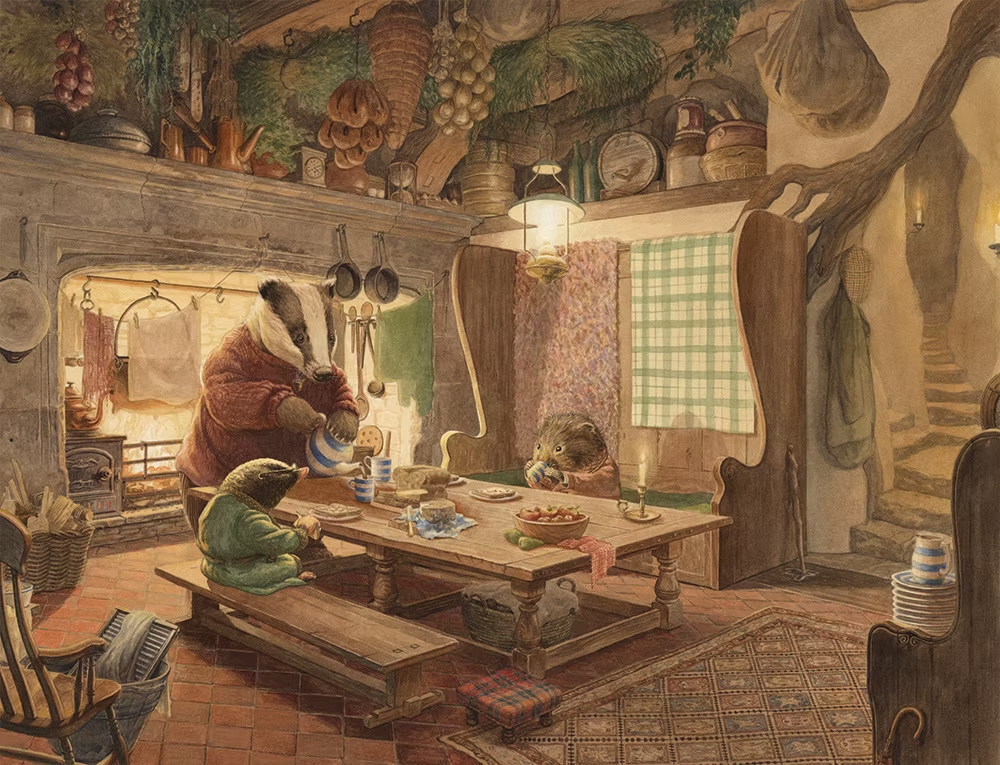
‘Mouse’ was about four when Grahame started to tell him stories and on the author’s frequent boating holidays without his family he would write further tales of Toad, Mole, Ratty, and Badger in letters to Alastair.

The four animal friends provided the basis for the manuscript for the book which would secure Grahame’s reputation, published in the year he took early retirement from the Bank of England, by which time he had moved back to the Thames, initially to Cookham and later to Blewbury.
Despite its success, he never attempted a sequel, although the book gave rise to many film and television adaptations and Toad remains one of the most celebrated and beloved characters in children’s literature.

Indeed the Julian Fellowes 2017 stage adaptation — filmed at the London Palladium, and starring Rufus Hound as Toad, Simon Lipkin as Ratty and Craig Mather as Mole — was offered free online when theatres closed as the coronavirus scare spread in the UK, with a small donation requested to help support theatre workers.
The pastoral tale of riverside camaraderie seemed to reflect the author’s fascinating with “messing about in boats” and is celebrated for its evocation of the Thames Valley.

But as Dennison explores in a sensitive and nuanced account of his life, both the literary and real-life riverbank escapades may have provided a necessary escape from darker emotions.
It also warned about the fragility of the English countryside and expressed fear at threatened social changes that became a reality in the aftermath of World War I.

Grahame’s life was not without adventure. He met many of the literary greats of the period and was even shot at in 1903 when a gunman opened fire at the Bank of England.
But when he died in Pangbourne in 1932 it was for one thing that he was remembered – as his cousin and successful author Anthony Hope had engraved on his gravestone in Holywell Cemetery, Oxford: the fact that he left childhood and literature “the more blest for all time”.
Matthew Dennison has published a number of works of biography and writes for Country Life and the Telegraph. Eternal Boy: The Life of Kenneth Grahame was published in 2018 by Head of Zeus Ltd at £8.99