Epiphany: a day of divine revelations

IT’S the Christian feast which marks the end of Christmas, and it’s been celebrated all over the globe for centuries.

But in an increasingly secular world, it’s doubtful how many ordinary UK people on the street in 2023 could actually explain the significance of Epiphany.
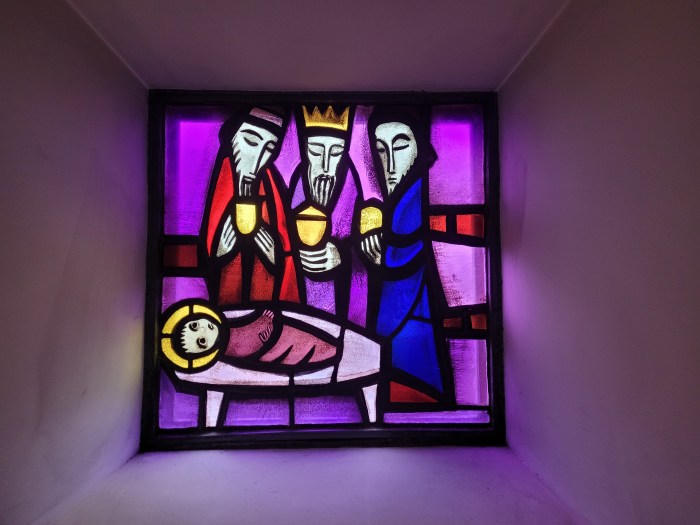
WISE MEN: a stained glass portrait of the Magi in the church at Taize

The celebration commemorates the Magi’s visit to the baby Jesus and the baptism of Jesus by John the Baptist in the River Jordan.

Eastern traditions usually call the holiday Theophany and focus on Jesus’ baptism, seen as the revelation of Christ as both fully human and fully divine.

Western traditions focus on the Magi’s visit, seen as the first manifestation of Christ as saviour of Gentiles as well as Jews.

DIVINE REVELATION: a church window in the Netherlands PICTURE: Paul Zoetemeijer, Unsplash

The feast takes place on the day after Twelfth Night, the traditional end of the Christmas season, which in the Middle Ages was a period of continuous feasting and merrymaking from Christmas Day until January 5.

Shakespeare used Twelfth Night as the setting for one of his most famous stage plays and today we know it as the last day for decorations to be taken down, although in Elizabethan England, decorations were left up until Candlemas.

BEARING GIFTS: the “three kings” PICTURE: Jonathan Meyer, Unsplash

After Twelfth Night, Epiphany celebrates the revelation that Jesus was the Son of God, focusing on the visit by the Three Wise Men “from the east” to worship the king of the jews, bearing gifts of gold, frankincense and myrrh, along with the baptism of Jesus in the Jordan and the wedding at Cana, when Jesus performed his first public miracle.

In the early Church, Christians celebrated all these events, including the nativity, on January 6. It was only in later centuries that both Christmas Day and Epiphany became established as feast days, separated by the 12 days of the Christmas season.

NATIVITY SCENE: Christmas Day changed date PICTURE: Walter Chávez, Unsplash

Many countries celebrate “Three Kings Day” with parades and processions, sweets, cakes and presents, along with baptismal rites, house blessings and special church services.

Time to start seeing the light

OUT WITH the old, in with the new. After the sombre removal of the Christmas decorations on Twelfth Night, January 6 sees a distinct change of mood with the celebrations marking the feast of the Epiphany.

And anyone feeling a little sad at the lights and tinsel disappearing for another year can always look forward to Candlemas Day on February 2, which since pre-Christian times has been a feast of lights celebrating the increasing strength of the sun as winter gives way to spring.

Epiphany, also known as Three Kings’ Day, originated in the East with Christians celebrating the birth and baptism of Jesus. The Western Church began following it in the 4th century as the day the wise men were led by the star to visit baby Jesus, according to the story of the Nativity.

inbal-malca-53324-unsplash-1
THREE KINGS: Christians mark Epiphany on January 6  PICTURE: Inbal Malca, Unsplash

The traditional English Christmas has its origins in the ninth century, when King Alfred the Great enshrined in law the importance of keeping the church’s feasts. He commanded that there should be a holiday on Christmas Day and the 12 days that followed, for it was believed that the Magi had journeyed for 12 days to see the infant Jesus.

The twelve days of Christmas would have been a most welcome break for the workers on the land, which in Tudor times would have been the majority of the people. All work, except for looking after the animals, would stop, restarting again on Plough Monday, the first Monday after Twelfth Night, as Ben Johnson explains.

As with all good traditions, there’s no universal agreement over the exact timing of Twelfth Night, since some regard Christmas Day as being the first day of Christmas, while others believe the 12 days begin on Boxing Day.

But the Victorians began the tradition that it should be the night that Christmas trees and decorations should be taken down, to avoid bad luck after the season of merriment (and to encourage everybody to get back to work).

There’s similar disagreement over the precise details of the story of the Magi: how many wise men actually visited, for example? And when was this? Some theologians argue that Christ would have been around two years old, since the wise men followed the star for two years and King Herod had all children two years and under massacred; by that time the Holy Family would also have moved out of the stables and into more permanent accommodation.

dan-kiefer-467645-unsplash
TIMELESS TALE: the story of the Nativity PICTURE:Dan Kiefer, Unsplash

Maybe the precise details don’t matter too much – after all, it was Pope Julius I who had the bright idea of adopting 25th December as the actual date of the Nativity, helpfully blurring religion with existing feast days and celebrations.

By Shakespeare’s day, as well as the carols and church-going, Twelfth Night would have been marked by music, masked balls and feasting – and it was in this context that he wrote his raucous comedy Twelfth Night (or What You Will), as fitting entertainment to close the Christmas season.

The first record of its performance comes from Candlemas of 1602 to bring down the curtain on Tudor festive celebration which used to last throughout the month of January.

In fact, many of our favourite Christmas traditions date back to the Tudor period, it seems, including carol-singing, present-giving, mulled wine and mince pies, as the BBC’s History Extra magazine explains with the help of Alison Weir and Siobhan Clarke – authors of the 2018 book A Tudor Christmas.

So if the sight of those bedraggled Christmas trees got you feeling a little down, don’t despair – the spirit of Epiphany is upon us, and Candlemas is just around the corner!

CHURCH