Fabulous fungi lurk amid the fallen leaves

IT’S the month of first frosts and stormy nights when the sights, smells and sounds of autumn really bring the countryside to life.

GLORIOUS TEXTURES: fallen leaves and fungi PICTURE: Andrew Knight

The rapidly-changing colours and glorious textures of October make it a favourite with photographers, especially deep in the woods where the yellow, green and russet hues contrast so beautifully with the rugged outlines of ancient trees.

AUTUMN HUES: trees start to lose their leaves PICTURE: Sue Craigs Erwin

Amid all the leaf mulch, autumn is also one of the best times to head out foraging, with woods and hedgerows filled with a feast of delights from hazelnuts and rosehips to blackberries, sweet chestnuts and crab apples.

LEAF MAGIC: striking outlines at Penn PICTURE: Sue Craigs Erwin

It’s a month of ripe berries and falling fruit, with trees and bushes bursting with tasty treats for birds, insects and mammals alike and a huge array of startling fungi hiding beneath the fallen leaves.

FIERY FLAME: the yellow stagshorn PICTURE: Graham Parkinson

From the foul-smelling stinkhorns to poisonous toadstools, it’s thought there are more than six million species of fungi in the world, and we’re only really beginning to fully appreciate what an impact they have on our lives.
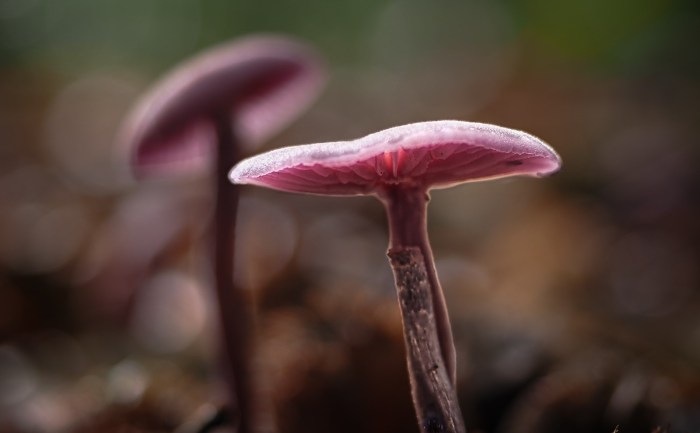
MUSHROOM MAGIC: fungi come in all colours PICTURE: Ken Law

They can change our minds, heal our bodies and even help us to avoid environmental disaster, as Merlin Sheldrake showed us in his fascinating 2020 book Entangled Life.

DELICATE OUTLINE: a saffrondrop bonnet PICTURE: Graham Parkinson

But although we may have only formally identified around 150,000 of the millions of fungi out there, they are a source of fascination for photographers and nature lovers alike.

FASCINATING: texture contrasts at Hughenden PICTURE: Ken Law

The colours and shapes fascinate us, even though we know their beauty can be deceptive and that there could be deadly consequences of dabbling with the most poisonous of them.

SUBTLE TONES: an amethyst deceiver PICTURE: Graham Parkinson

They vary in size from the microscopic to the largest organisms on earth and boast the most intriguing array of sinister-sounding names, from gelatinous jelly ears to toxic beechwood sickeners.

SPINY OUTLINE: a puffball in Bisham Woods PICTURE: Graham Parkinson

If you can’t tell a tasty morsel from a destroying angel, funeral bell or death cap, it’s perhaps best to give those colourful mushrooms and toadstools a wide berth.

TOXIC TOADSTOOL: fly agarics in Penn Wood PICTURE: Andrew Knight

Widely regarded as magical and equally frequently mistrusted, toadstools and mushrooms are associated with ancient taboos, dung, death and decomposition.

PEACEFUL SPOT: mushrooms at Penn PICTURE: Sue Craigs Erwin

But as the Woodland Trust explains, trees and many other species rely on fungi and we’re only just starting to fully understand how close this relationship is: great woodland networks that link and support life.

VITAL RELATIONSHIP: fungi play a crucial role PICTURE: Gel Murphy

As Gillian Burke explained in a previous Autumnwatch series: “90 per cent of our plants are utterly reliant on fungi for survival. By breaking down dead wood, cleaning the soil and recycling nutrients by the most intimate relationship with living plants, fungi are vital to life on Earth.”

SUPPORT NETWORK: many species rely on fungi PICTURE: Gel Murphy

At this time of year, those forest floors and woodland glades are full of colourful and intriguing characters, from puffballs and stinkhorns to earthstars and jelly fungi – and while many of them could be poisonous for us to touch and eat, it’s fascinating just how important they may be for our survival.

If you have a picture or two you would like us to feature in a future post, drop us a line by email to editor@thebeyonder.co.uk, join us in our Facebook group or contact us on Twitter @TheBeyonderUK or Instagram at thebeyonderuk.

Fungus foray reveals the secrets of survival

SOARING temperatures and flash floods marked a summer where climate change concerns were never far from people’s minds.

BLAZE OF COLOUR: sunflowers at Chesham PICTURE: Sue Craigs Erwin

So after an unseasonally mild October, perhaps it’s a relief to finally feel the chill in the air on a starry Chilterns November night.

SEPTEMBER SKIES: birds on the wing outside Amersham PICTURE: Gel Murphy

Back in the hot, dry summer, temperatures soared to a new UK record temperature of 40.3C in Lincolnshire and much of the local countryside looked brown and parched, with hosepipe bans in place across large areas.

EARLY START: morning mist creates an inviting haze PICTURE: Gel Murphy

The joint warmest summer on record for England, and the fourth driest, it meant wildlife enthusiasts having to rise early to catch the countryside at its best before the searing heat of the midday sun.

FEELING CHIRPY: a stonechat at Widbrook Common PICTURE: Graham Parkinson

It takes patience and perseverance at the best of times to capture our native species on camera, but all the more so when they are taking refuge from such unpleasant heat.

POLLEN COUNT: hundreds of insect species pollinate plants PICTURE: Gel Murphy

What a delight, then, to savour the mellower temperatures of autumn and watch the sights, sounds and smells slowly switching to a different pace and palette.

AUTUMN HUES: trees start to lose their leaves PICTURE: Sue Craigs Erwin

Suddenly it’s crisper and colder in the mornings and darker evenings, though the woods are ablaze with colour as families look out their scarves and winter coats to make the most of the seasonal spectacle.

SILENT SWOOP: a short-eared owl in Oxfordshire PICTURE: Graham Parkinson

With Autumnwatch back on our screens and pumpkins suddenly swamping the shelves of local farm shops, a host of animals and birds are stocking up for the winter months.

SEASONAL SPECTACLE: woods are awash with colour PICTURE: Sue Craigs Erwin

And from the banks of the Thames to Ivinghoe Beacon, there’s no better time of year to venture outdoors to smell the ripening fruits and admire the beauty of the leaves as they change colour. 

SUNNY FACES: sunflowers ready for picking PICTURE: Lesley Tilson

In just a few short weeks, the landscape has been transformed: from the August fields of sunflowers ripe for the picking, we have seen the dust of the combine harvesters blowing across the land and subtle changes in the light deeper in the surrounding woods.

OUT OF THE SHADOWS: autumn brings a change of light PICTURE: Sue Craigs Erwin

In the grounds of Windsor’s Great Park the autumn rutting season may have had an extra resonance for visitors this year following the death of the Queen.

POLLEN COUNT: deer at Windsor PICTURE: Nick Bell

After so many thousands swamped the town to pay their final respects, many returning ramblers might be only too keenly aware of the monarch’s absence from her beloved castle, with the current herd all descendants of 40 hinds and two stags introduced in 1979 by the Duke of Edinburgh.

FINAL FLOURISH: ferns capture the sunlight before dying back PICTURE: Sue Craigs Erwin

And from the historic Ridgeway to the depths of Burnham Beeches, a myriad other changes are taking place in this ancient and fascinating landscape, most noticeably the sudden golden glow as nature puts on its most spectacular fireworks display of the year.

SNAZZY DRESSER: the colourful jay PICTURE: Graham Parkinson

The autumnal leaf fall is a clever form of self-protection, allowing deciduous trees to drop thin leaves that would otherwise rupture during the winter, making them useless for photosynthesis, giving the tree a fresh start in the spring while the nutrients from the decaying leaves are recycled to help grow the next generation.

RECYCLING PLANT: fallen leaves and fungi in Hodgemoor Wood PICTURE: Andrew Knight

Amid all the leaf mulch, autumn is also one of the best times to head out foraging, with woods and hedgerows filled with a feast of delights from hazelnuts and rosehips to blackberries, sweet chestnuts and crab apples.

FORMIDABLE: the woods are home to a huge variety of fungi PICTURE: Gel Murphy

The woods play host to a formidable array of mosses, lichens and fungi too, but not all of the intriguing range of shapes and colours to be found among the soaking foliage are safe to eat, as their spine-tingling names might suggest.

FRIEND OR FOE?: many fungi are poisonous PICTURE: Gel Murphy

If you can’t tell a tasty morsel from a destroying angel, funeral bell or death cap, it’s perhaps best to give those colourful mushrooms and toadstools a wide berth.

ANCIENT TABOOS: not all mushrooms are magical PICTURE: Gel Murphy

Widely regarded as magical and equally frequently mistrusted, toadstools and mushrooms are associated with ancient taboos, dung, death and decomposition.

SUPPORT NETWORK: many species rely on fungi PICTURE: Gel Murphy

But as the Woodland Trust explains, trees and many other species rely on fungi and we’re only just starting to fully understand how close this relationship is: great woodland networks that link and support life.

PLUSH PLUMAGE: a little egret PICTURE: Graham Parkinson

As Gillian Burke explained in a previous Autumnwatch series: “90 per cent of our plants are utterly reliant on fungi for survival. By breaking down dead wood, cleaning the soil and recycling nutrients by the most intimate relationship with living plants, fungi are vital to life on Earth.”

VITAL RELATIONSHIP: fungi play a vital role PICTURE: Gel Murphy

At this time of year, those forest floors and woodland glades are full of colourful and intriguing characters, from puffballs and stinkhorns to earthstars and jelly fungi – and while many of them could be poisonous for us to touch and eat, it’s fascinating just how important they may be for our survival.

As always, we’d like to give a very big thank you to all the keen local photographers who have allowed us to use their work.

If you have a picture or two you would like us to feature, drop us a line by email to editor@thebeyonder.co.uk, join us in our Facebook group or contact us on Twitter @TheBeyonderUK.