OXFORDSHIRE Museum has succeeded in a crowdfunding campaign to put some remarkable Iron Age artefacts on public display.
The extraordinary hoard was unearthed in the county by a metal detectorist in 2020 after having been buried almost 2,000 years ago following the Roman invasion of Britain.
It includes a beautifully preserved horse brooch described as the most significant discovery of its kind since the Polden Hill Hoard unearthed in Somerset in 1800.
RARE FIND: the ancient horse brooch PICTURE: Allen Beechey
The items were excavated and recorded in partnership with the Chilterns National Landscape’s heritage and archaeology manager Dr Wendy Morrison, who was contacted by a detectorist investigating a field in Rotherfield Peppard.
The detectorist rightly recognised the unusual nature of the artefact but had been unable to contact the county finds liaison officer because of the pandemic.
Dr Morrison realised from a photograph that the item was an extremely rare horse brooch. She said: “Seeing that picture come in on my phone, I leapt off the sofa in excitement – I knew immediately that this was a significant find.”
The enamelled brooch was part of a collection of items of value, including a rare silver Roman coin, that had been deposited into a large ceramic pot and buried at some point around AD 50 to 150.
BURIED TREASURE: the base of the pot PICTURE: Allen Beechey
The pottery urn was sealed with a quern stone made of Hertfordshire puddingstone. Such stone tools were traditionally used in pairs for hand-grinding a variety of materials, especially grains.
The items will now go on public display after the Friends of the Oxfordshire Museum succeeded in raising more £11,000 through a crowdfunding campaign that attracted more than 200 donors, including academics and local residents.
Prior to the Roman conquest, horses and the chariots they pulled were an important part of Iron Age life and the harness and chariot fittings were a way of displaying someone’s wealth, status and skill in caring for these animals.
STONE SEAL: quern stone fragments PICTURE: Allen Beechey
Dr Elaine King, CEO at the Chilterns National Landscape, said:“This case demonstrates the huge value of having archaeological expertise in our staff team. A regionally significant discovery has been preserved, along with its context, providing vital information that improves our understanding of people living in the Chilterns nearly 2,000 years ago.”
THERE must be something enormously reassuring about having a centuries-old link to the land you live on.
Like those great old aristocratic English families whose estates have been passed down from father to son across the centuries, history oozing from every brick of the ancestral home.
Or hill farmers who can look back across the generations knowing every square foot of their local landscape in exactly the same way as their grandfather and great-grandfather once did.
In our fast-changing modern world, that certainty in one’s own identity must surely be comforting. But does it really matter that much?
We know identity has been a powerful theme in literature across the ages, and in a world of mass migration and climate change it will remain so in the future. But isn’t it possible for new arrivals to feel an immediate connection with their surroundings and be able to relate to their local landscape without those historical links?
Perhaps an awareness of history helps – and it’s certainly possible to soak up that sense of the past in the Chilterns countryside, however recently you have arrived…
Here, amid the rolling chalk hills and cathedral-like beech woods, the old days never seem too far away, and there’s always a strong awareness of people from the past who have walked this way before, from Iron Age families and Roman soldiers to 20th-century chair bodgers working in the woods or passengers on a steam train thundering along the old Great Central Railway.
I’m reminded of that on a wander round our “patch” – necessarily curtailed in my meandering by the requirements of the coronavirus lockdown.
Although we have only been here a few years, those links with the past make us feel a lot less like strangers.
Our parish magazine recalls how early hunter-gatherers adept at curing and stretching animal skins may have used coracles on waterways like the Thames, where flint tools and Roman remains hark back to a time before the Norman invasion, when two manors became the focal points of local life.
A short wander along part of the Berkshire Loop of the Chiltern Way gives you glimpses of churches which have been holy places for a thousand years or more, of picturesque cottages in brick and flint, of deserted lanes where the sound of birdsong echoes above the cow parsley and wild garlic.
Sauntering down the Church Path footpath towards St Nicholas’ church at Hedsor on a fine spring evening, it’s not hard to imagine the Chilterns equivalent of Thomas Hardy’s Mellstock choir heading homewards with their instruments and lanterns for a celebratory pint or two.
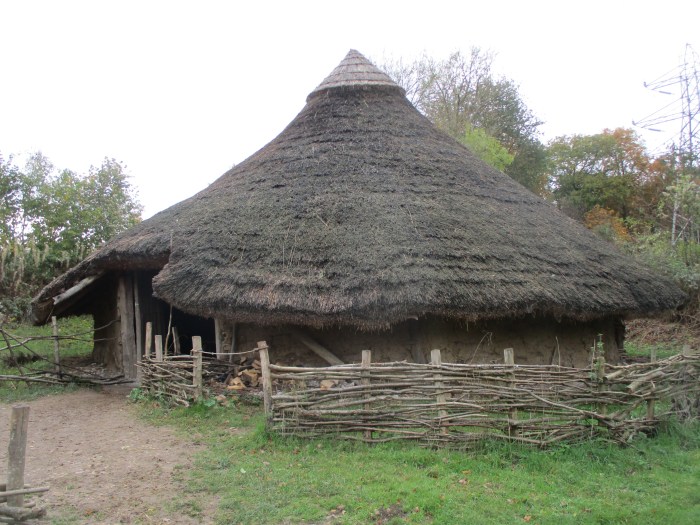
Iron Age roundhouses and hillforts excavated in the Chilterns remind us how this part of England has been continuously inhabited for thousands of years, with more than 20 sites harking back to a more dangerous age where communities needed to keep their possessions and livestock safe from marauders.
The earthworks are virtually the only major constructions that have survived from this ancient time, although the Chiltern Open Air Museum has done its bit to recapture something of the atmosphere of life in those times.
The Romans trod these paths too, finding ways of crossing the Thames, while footpaths and bridleways often traverse routes well known as ancient droving routes along which thousands of cattle, sheep, pigs, geese and turkeys were once driven, or sunken lanes known as hollow-ways or holloways, thoroughfares worn into the landscape by cartwheels, hooves and feet across the centuries.
It’s a landscape of coaching inns and highwaymen tales and of ancient woodlands which supplied vast quantities of charcoal before canals allowed easier access to coal from the Midlands – and later allowed the furniture industry to flourish.
The carefully managed beech woods supplied excellent raw materials for chair-making for the rapidly-expanding industrial population of London and small workshops flourished in the villages around High Wycombe, with the Chiltern “bodgers” toiling in the woods to produce the millions of chair legs needed.
The bodgers and paper mills may be long gone, but the past is still very much alive in the landscape, with woodland still making up around a fifth of the AONB landscape, making it one of the most heavily wooded areas in England.
The influence of the industrial past is hard to ignore, from brick-making to chalk and gravel extraction, but in the depths of a bluebell wood it feels easier to relate to those varied individuals who walked these paths across the years, savouring the same ancient woodlands, downlands and commons.
London may not be far away – and of course the proximity of the capital contributed to the establishment of those small furniture factories, paper mills, orchards and watercress beds, as well as fuelling an influx of day trippers once the railways and Tube stations began to open.
So is it a problem not to have centuries of family tradition to fall back on to help appreciate this ancient landscape? Hopefully not. Like countless other newcomers, it’s been easy for us to fall in love with the Chilterns.
That’s as much to do with marvellous neighbours as the sweeping views, leafy lanes and wonderful wildlife, but it makes for a winning combination.
So thank you, all the locals, businesses and new friends who have made it so easy to love your “area of outstanding natural beauty” (and it is): there’s no place like home, they say, and this place certainly feels like home…from those sweeping views over the Vale of Oxford to the timeless paths meandering through the beech woods or the stolen glimpse of a tawny owl in the treetops.