Impeccable service is even even more elusive, especially in a digital age which has fostered a respect for speed and efficiency over any authentic attempt to engender a sense of trust and loyalty among patrons.
Perhaps it’s appropriate, then, that the art deco surroundings of The Ivy Marlow Garden should reflect not just the timeless elegance of the 1920s but the attentive service we normally tend to associate with a bygone age when an expert maître d’ could make every customer feel personally known and valued.
It’s a dying art. And it’s one of the reasons behind the success of the original Ivy, opened in Covent Garden back in 1917 as an unlicensed Italian café and rapidly turning into one of London’s great Theatreland rendezvous, patronised in the 1940s by Olivier and Gielgud, Marlene Dietrich, Noel Coward and the like.
Revitalised in the Nineties, it became as popular with Hollywood stars and Royalty as it had been with the theatre legends of old, with long waiting lists for reservations boosted by the potential prospect of catching a glimpse of Madonna, Brad Pitt or Kate Moss.
Under the ownership of Richard Caring, over the past 20 years the brand has dramatically expanded beyond London’s Theatreland, with more than 40 cafes and brasseries opening around the country, including Marlow, Windsor, Oxford and St Albans.
Thankfully the passion for fine food has extended to ensuring that the elegant ambience and intimate attention to detail has not been diluted in the process of expansion, and the warm welcoming glow has an extra festive flavour when the Christmas decorations are up.
We’re here for a December breakfast treat, a chance to enjoy a little old-world luxury before facing the rigours of the high street, and we’re not disappointed.
They say breakfast is the most important meal of the day, a sacred meal, one to be savoured and embraced, full of promise and possibilities.
Where better to enjoy it, then, than in an establishment that understands how to create a memorable, multi-sensory experience which never feels pretentious, stuffy or uncomfortable.
This is the sort of meal which conjures up the characters from an Evelyn Waugh or PG Wodehouse novel, a leisurely moment of respite from the outside world where all the senses are engaged, from the feel of linen and heavy hotelware to the taste of well-cooked fresh ingredients, elegantly presented.
At around £60 for two, breakfast at The Ivy is perhaps double the cost of an equivalent full English at your local greasy spoon, but the cheaper option is likely to be a lot less memorable.
Like an affable colonel in an Agatha Christie mystery, we linger over the toast and marmalade before emerging onto the high street replete, mellow and ready to cope with the challenges of the day ahead. And it’s pretty hard to put a price on that sense of wellbeing.
SOMETIMES you need a little help to capture your favourite wildlife on camera.
Hiring a hide for a morning could be one way of getting up close to fast-moving kingfishers, for example, which so often fly at lightning speed low over the water.
Even those living beside chalk streams often struggle to see more than a fizzing flash of turquoise that disappears round the bend and out of sight, giving the merest glimpse of those unmistakable blue and orange colours.
TURQUOISE FLASH: a kingfisher on the Chess PICTURE: Carol Ann Finch
Knowing a favourite hunting perch could be another way of capturing the birds at rest, and young Hertfordshire photographer Will Brown favours the wetland reserve at RSPB Rye Meads beside the River Lee, which is a firm favourite with birdwatchers and photographers thanks to its many trails and hides.
Down on the Chess at Sarratt, Carol Ann Finch and friends enjoyed a relaxing morning beside the river watching a colourful friend on the lookout for minnows, sticklebacks and small insects, using an Olympus camera with a 70-300mm macro lens to capture the action in close-up.
HUNTING PERCH: on the lookout PICTURE: Carol Ann Finch
Kingfishers can’t swim, so they tend to favour slow-flowing rivers or motionless water, making picturesque chalk streams like the Wye and Chess the perfect environment for a spot of fishing.
The birds hunt from riverside perches, occasionally hovering above the surface before diving at high speed into the water with their wings open and eyes protected by transparent eyelids. Once the fish is caught, it is taken back to the perch where the kingfisher usually stuns it before swallowing it head first.
MONDAY, DECEMBER 2
ARE foxes really as sly and cunning as they’re painted? It’s a pretty persistent stereotype that seems to date back millennia.
Foxes epitomise trickery and deceit in Shakespeare’s plays but references to their artfulness can be found much earlier, including repeated mentions in the fables collected by Aesop, a slave and storyteller living in ancient Greece centuries before Christ’s birth.
In medieval European folklore and literature foxes in general have the same dubious reputation and the specific character of Reynard is a legendary anthropomorphic red fox portrayed in some two dozen tales deceiving and outwitting his adversaries.
Doubtless much of the reputation is based on close observation of these highly adaptable, opportunistic animals. We know the common fox, vulpes vulpes, is a rapid learner, remembers where food is stashed and has adapted well to the presence of humans.
They appear bold around our cities, thrive in urban environments and farmers know them to be resourceful and ingenious in their hunting techniques, which probably helps to give the impression that they’re using their wits to get ahead.
But rather than being elborate tacticians, it’s their versatility that has been the key to their evolutionary success, allowing their survival in such substantial numbers despite being persecuted by hunters throughout history for spot, as a pest or for their fur.
Elegant, ingenious and much maligned, foxes know a thing or two about survival. Or as Chris Packham puts it: “I like foxes because they are widespread, beautiful and successful. It’s always a treat to see a fox dashing through some rusty bracken.”
TUESDAY, DECEMBER 3
IT’S hard to believe that at one time a third of the land area of southern England was designated as royal forest, including whole counties like Essex.
The recollection is prompted by a chance morning encounter with a few skittish deer. These days ramblers and dog walkers are probably pleasantly entertained by such brief meetings, usually at dawn or dusk, before the shy animals slink off into the undergrowth.
But estate managers have no such affection for the growing deer population that poses a real threat to our woodlands, while motorists have different reasons to fear the animals, of which more than 40,000 die in collisions on our roads every year.
Current exact numbers are not known, but the figure is probably at its highest for a thousand years and could even top two million.
Flash back across the centuries, and William the Conqueror’s arrival marked a whole new era of forest law designed to proect game animals and their forest habitat, as we discovered last year on a visit to Epping Forest.
The Norman kings were enthusiastic hunters and huge tracts of the country were designated as hunting areas reserved for the monarch and his aristocratic guests, with deer parks like those at Stowe, Langley and Whaddon equipped for the management and hunting of deer and other wild animals to provide a constant supply of food throughout the year.
The narrative of an evil foreign tyrant disrupting prosperous settlements and evicting tenants to create space for his leisure pastime featured prominently in the folk history of England, and one vitriolic poem written in 1087 on the king’s death lambasted him for his greed and cruelty.
Forest law was designed to protect the ‘noble’ animals of the chase like deer and wild boar, along with the greenery that sustained them, with verderers policing poaching and illegal felling while overseeing the rights of locals to take firewood, pasture swine, harvest produce and cut turf.
HUNGRY MOUTHS: there are six types of deer in the UK PICTURE: Sue Craigs Erwin
Today there are six types of deer to be found in the woods: the two native species, the red deer and roe deer, along with the fallow deer introduced by the Normans and three species of deer introduced from the Far East: the sika deer, Chinese water deer and the small and mostly nocturnal muntjac.
WEDNESDAY, DECEMBER 4
BARE branches allow us a clearer view of our feathered friends than we normally get, and none is a more cheering sight on a drab December day than the gorgeous goldfinch.
A colourful finch with a bright red face, black cap and yellow wing patch, it’s a very sociable little bird with a delightful twittering song and a fine beak that allows it to extract otherwise inaccessible seeds from thistles and teasels which other birds can’t reach.
Routinely trapped in Victorian times to be kept as cage birds, they also like lavender, dandelions and niger seeds.
In English a group of goldfinches is collectively known as a ‘charm’ from the Old English c’irm, referring to the tinkling noises produced by a flock. In Irish and Scots Gaelic their name lasair choille is equally appropriate, translating as “flame of the forest”.
Some UK goldfinches migrate as far south as Spain in the winter, but many “thistle-tweakers” will stay here throughout the winter months, adding a welcome splash of colour to the undergrowth with their superhero masks.
SYMBOLIC: the robin PICTURE: Carol Ann Finch
Both the red cheeks of the goldfinch and the red breast of the robin were accorded weighty religious symbolism in medieval minds, and the goldfinch featured in hundreds of Renaissance paintings.
The colours in both birds’ plumage was said to have been acquired while trying to remove Christ’s crown of thorns in an act of mercy.
THURSDAY, DECEMBER 5
ON dreary December days, it’s easy to mourn the loss of colour in the landscape: those dull, monochrome hours where the woodland tones are shrouded in rain or mist.
Thankfully there are still plenty of glimpses of sunlight to remind us that the glow of autumn is not quite a thing of the past.
Deep in the woods at Penn the weak sunshine lights up the russets and golds again and the breaks in the cloud remind us of the real beauty of autumn leaves.
GOING FOR GOLD: autumn leaves PICTURE: Lesley Tilson
But it’s not an easy time for ramblers. Apart from the unpredictable temperatures there’s widespread flooding and over at Hedsor, wildfowl have reclaimed the footpath.
UNDER WATER: a Hedsor footpath PICTURE: Andrew Knight
The gulls seem in their element here, but as dusk falls there’s a distinct chill in the air and the Thames is flowing fast, with many fields and gardens around Cookham and Bourne End under water.
On a bright spring day, this section of the Berkshire Loop of the Chiltern Way is a delight, a wander past churches which have been holy places for a thousand years or more, picturesque cottages in brick and flint and deserted lanes where the sound of birdsong echoes above the wild garlic.
DAMP PROSPECT: flooded fields PICTURE: Andrew Knight
But with light fading as we cross the bridge at Cookham, there’s a gloomier feel to the muddy Thames Path towards Bourne End, the smell of diesel in the air as boat owners hunker down for another cold night and the river fast becoming an inky black snake in the darkness, powerful and forbidding.
As night closes in, this is an aspect of life on the river that summertime strollers don’t see, when the Thames looks deep and cold and scary and the Christmas lights of those large riverside homes a lot more appealing than spending the night on the water.
FRIDAY, DECEMBER 6
YET more wind and rain leaves our local chalk stream cloudy and the footpaths transformed into sticky mudbaths.
Yet although it’s slippery welly-boot-wearing weather for walkers, it’s still possible to stumble across a little dry land in the woods, and the skies are nothing if not unpredictable.
On our evening walk, one minute those clouds are scudding across the sky, the treetops rustling like waves on the shore…the next, there’s a clear sky overhead and the stars are shining clear and bright over our path through the trees.
It’s the sort of weather when a casual glance out of the kitchen window might deter you from the thought of venturing out into the afternoon downpour…yet taking the risk and emerging from the cosy warmth of our homes can bring immense rewards, especially when the sun finally breaks through the cloud and dazzles us with one of those wonderful December surprises we might have otherwise missed.
ANOTHER day, another named storm: this time Storm Darragh, complete with ominous red weather warnings about possible loss of life and with winds gusting over 90mph in places.
We wake to lashing rain, swaying trees and birds being buffeted across the sky.
PICTURE POSTCARD: dawn at Coleshill PICTURE: Lesley Tilson
But the calm before the storm was a time to savour across the Chilterns, from dawn vistas of sleeping villages to sunlight glinting through the trees.
December days may be short and unpredictable, but there are still those all-important moments to cherish: the smell of woodsmoke drifting across the fields, the lure of a roaring fire in a friendly pub on a freezing day or being able to curl up with a good book with your pets snoozing around you.
MOMENT OF PEACE: the calm before the storm PICTURE: Sue Craigs Erwin
Inside or out, the serenity may not last for long, but it’s good to make the most of all those little things that make life worth living, including the sound of raindrops on wet leaves and the pleasant earthy scent of the woods once the worst of the storm clears.
For now, it’s time to get the wellies on and slip-slide our way along those muddy footpaths while Darragh blows itself out, leaving closed motorways, railway lines and airports in its wake.
WINTER WARMTH: watching for the sun’s return PICTURE: Lesley Tilson
But hopefully it won’t be too long before a little calm is restored to the countryside and the sun returns to warm the winter landscape.
SUNDAY, DECEMBER 8
DAWN breaks and the wind is still whistling, whining and howling around the house.
Around town, great oaks and cedars are shaking themselves like wet dogs and local paths and roads have been blocked with the debris of a stormy night.
In the woods, the “night has been unruly”, but not quite with such an ominous overtones as in Macbeth, despite the speed of the storm clouds scudding across the sky or those strange hues they sometimes cast over the countryside.
STRANGE LIGHT: the sky appears yellow at times PICTURE: Lesley Tilson
The Met Office tells us that the sky appears blue to the human eye because the short waves of blue light are scattered more than the other colours in the spectrum, making the blue light more visible.
Light from the sun is made up of a spectrum of many different colours, as we see when they are spread out in a rainbow, with different colours all having different wavelengths, from the shorter ones of blue and violet to red light, which has the longest wavelength.
ORANGE BALL: the sun sinks over Amersham PICTURE: Gel Murphy
When the sun’s light reaches the Earth’s atmosphere it is deflected by tiny molecules of gases like nitrogen and oxygen in the air with the amount of scattering dependent on the wavelength.
This effect is known as Rayleigh scattering after Lord Rayleigh, the eminent physicist who first discovered it.
Shorter wavelengths (violet and blue) are scattered the most strongly, so more of the blue light is scattered towards our eyes than the other colours, although it tends to be the most vibrant overhead and paler towards the horizon.
Rayleigh scattering also causes the sun to appear red at sunset, when the sun’s light takes a longer path to reach the horizon, so more of the shorter wavelengths are scattered out. This leaves mostly red light, which is why the sun appears red.
SETTING SUN: light through the trees PICTURE: Gel Murphy
Storm clouds can create some unusual effects in the sky, as can dust, pollen and smoke in the atmosphere, creating eerie yellow, green, red and purple hues.
MONDAY, DECEMBER 9
“DECEMBER afternoons do something to my heart,” writes Melissa Harrison in The Stubborn Light of Things. “Perhaps it’s the early dusk combined with approaching winter: a sense of drawing in, of lighting the lamps early, and the fire…”
It’s also the warm yellow glow from windows of ancient cottages, the cawing of rooks straying back to their ancient rookery, the dusk walks along darkened country lanes, the scatter of cottages round a Norman church.
WARM GLOW: December afternoons are special PICTURE: Sue Craigs Erwin
“At their best,” she writes, “rural villages bear witness to a lasting partnership of people, place and nature, and to me there is something deeply moving – almost sacred – about that.”
As so often, the Suffolk-based nature writer is spot on in summing up the importance of buildings feeling part of the landscape. The same is true of our wonderful old Chilterns towns, of course, where the buildings are intimately woven into the fabric of the surrounding countryside.
It could be the most humble cottage, or an imposing country house. But good architecture adds soul to communities and speaks to our senses and emotions in ways we may not fully understand.
LASTING LEGACY: an ancient church PICTURE: Gel Murphy
It’s perhaps part of the reason why we stare at ancient buildings with awe, or feel so much at home in cosy pubs or country houses that have survived the ravages of the passing years.
These buildings have protected and outlived their inhabitants, transcending the impermanence of human existence to become a lasting feature of the local landscape.
TUESDAY, DECEMBER 10
COULD there be a more comforting and contented sound that the cooing of wood pigeons on a summer’s evening?
Conversely, there are few sounds more frantic and frenetic than the fluster of pigeons disturbed from their roost at night on these chilly winter nights.
The contrast is brilliantly summed up by Daphne du Maurier in her 1938 Gothic novel Rebecca:
Once there was an article on wood pigeons, and as I read it aloud it seemed to me that once again I was in the deep woods at Manderley, with pigeons fluttering above my head. I heard their soft, complacent call, so comfortable and cool on a hot summer’s afternoon, and there would be no disturbing of their peace until Jasper came loping through the undergrowth to find me, his damp muzzle questing the ground.
Like older ladies caught at their ablutions, the pigeons would flutter from their hiding-place, shocked into silly agitation, and, making a monstrous to-do with their wings, streak away from us above the tree-tops, and so out of sight and sound.
Of course there are plenty of folk driven to distraction by the cooing of pigeons and numerous pest control sites awash with suggestions of how to make the birds less happy, secure and comfortable.
EXTRAORDINARY: pigeons became wartime heroes PICTURE:Nick Bell
They have played a vital role in medicine and saved countless lives in wartime carrying vital messages over long distances when other methods of communication were impossible.
When you drive down Park Lane, there always seems to be an old lady surrounded by a crowd of hungry pigeons, reminiscent of iconic Feed the Birds song from the 1964 Disney film version of Mary Poppins, filmed on the steps of St Paul’s Cathedral.
Perhaps there’s more to that scene than meets the eye: despite being so much maligned, we’re told that those “small blue busybodies” are not just smart but have bags of character and can be extremely loving.
With so many pigeons around, we tend to take these most humble of birds for granted, oblivious to their beauty and their many talents. Time to look at our feathered friends in a fresh light, perhaps.
WEDNESDAY, DECEMBER 11
HUMANS will spend billions of pounds this year immersing ourselves in high-tech virtual reality worlds, from virtual concerts and art galleries to hyper-realistic video games.
But who needs virtual reality when the real world is so spectacular? With some teens already spending up to eight hours a day on screens, it’s no surprise this may be associated with higher anxiety and depression and a lower overall quality of life and academic achievement.
Screen time overloads the sensory system and fractures attention, making it harder to process one’s internal and external environment and sometimes leading to explosive and aggressive behaviour.
Getting out and about on a windy day helps to root us in reality and remind us of the importance of real-world experiences and relationships.
Plus, how do we expect young people to be able to relate to the natural world (and want to protect it) if they don’t experience it at first hand?
COMMUNITY SPIRIT: Christmas lights PICTURE: Gel Murphy
Generations of teenagers have baulked at the idea of being forced to participate in “family time” or engage with other adults in the community, but perhaps there’s never been a time when it’s been more important for young people to become more aware of their surroundings and fully understand what’s real and what isn’t.
THURSDAY, DECEMBER 12
YOU might not give the brown spiky seed heads of the teasel a second glance if they weren’t so beautifully backlit by the morning sunlight.
But familiar as these striking prickly wildflowers are, it’s easy to forget what a central role cultivated versions of the teasel once played in cloth production in Britain.
Popular with bees and butterflies in summer and seed-eating birds like the goldfinch in winter, they are less popular with gardeners, who find weeding them a wet and painful businesses.
STRIKING: teasels in the morning light PICTURE: Sue Craigs Erwin
But take a trip back in time and the teasel played a central role in the textile industry as well as its extracts proving important components of the medicine chest in past centuries.
A cultivated sub-species has bristle tips shaped like tiny hooks which were used to ‘tease’ out the nap of cloth, explaining why teasels were grown as a cash crop in Britain from early times and even have a place in heraldry: the 1530 coat of arms of the Worshipful Company of Clothworkers depicts a golden teasel head.
As Robert McMillan explores, they were once cultivated on a huge scale to supply the country’s booming woollen mills and the process of fulling (or tucking or waulking, depending where in the country you live) helps to explain why Fuller, Walker and Tucker are such widespread surnames.
FRIDAY, NOVEMBER 13
LIVING beside a chalk stream means you’re never quite sure who you might encounter on your morning ramble.
Ducks and moorhens are commonplace. For months, a quintet of cygnets were getting their life instructions on a nearby stretch of water.
And today, to brighten the dullest of mornings when the sky is white, the footpaths sodden and the air distinctly chilly, a glorious little egret stands on the opposite bank staring balefully into the dark, fast-flowing water.
The small white heron is an elegant character with beautiful white plumes on its crest, back and chest, a black bill and black legs with strikingly yellow feet.
It lacks the height or statuesque prehistoric-looking appearance of the grey herons which can also be sometimes spotted contemplating their next meal on these banks, but both birds share a love of the minnows, sticklebacks and brown trout that thrive in healthy chalk streams.
Once a very rare visitor from the Mediterranean, little egrets are now a common sight in the Chilterns. They first appeared in the UK in significant numbers in 1989 and after first breeding in the UK on Brownsea Island in Dorset back in 1996, they have been expanding their range northwards ever since.
Today, it’s perhaps those amazing yellow feet that grab the onlooker’s attention as the bird strides rather self-consciously along the bank, lifting each leg high in the air like an avian John Cleese.
But ironically, the glamorous little bird had an important role to play in the RSPB’s history, as the organisation was founded by ladies campaigning against the use of feathers in the hat trade. Those long white neck plumes were once more valuable than gold and populations plummeted until laws were put in place to protect them.
SATURDAY, DECEMBER 14
THE colder and damper is gets outside, the more we crave a little light and warmth.
Wandering far from home in mid-December in The WInd in the Willows, Ratty and Mole patter through a little village on soft feet over a first thin fall of powdery snow.
Around them, “little was visible but squares of dusky orange-red on either side of the street, where the firelight or lamplight of each cottage overflowed through the casements into the dark world without”.
FAR FROM HOME: Walking Through The Village ARTWORK: Chris Dunn
The small backlit vignettes they witness – a cat being stroked, a small child being picked up and huddled off to bed, a tired man knocking out his pipe on a smouldering log – give the spectators a wistful feeling at the thought of their own homes being so distant.
We may experience just the same longing for a welcoming lantern or fire, for carols by candlelight or the warm glow of a welcoming homestead. And of course at this time of year there’s the added appeal of festive lights, from the twinkling welcome of a humble cottage to the grand displays of our largest stately homes.
We know that bright lights and colours trigger happy hormones and may even help to boost energy levels and happiness. For many, of course, Christmas is a magical time of nostalgia, a time of celebrating innocence and joy as well as a time of spiritual reflection.
Like Ratty and Mole we don’t just crave the warmth of those welcoming lights and fires, but the camaraderie and conviviality they symbolise: the opportunity to spend quality time with family and friends, the prospect of feasting and merriment.
The converse, of course, is equally true. If our wintry walk through the woods is blessed by the prospect of returning to a cosy hearth and home, it reminds us of the bone-chilling loneliness experienced by the homeless at this time of year or the millions facing hunger and misery in bombed-out buildings and refugee camps as conflict, the climate crisis and economic shocks drive more and more communities around the world towards starvation.
FESTIVE MOOD: a feast for the senses PICTURE: Lesley Tilson
It’s not just in war zones that people are struggling over the festive season, though. Those battling to cope with bereavement, health or money worries may feel every bit as lonely and isolated over the holiday period, especially faced with all those images of carefree families and friends spending time together.
Christmas is a wonderful time of year, but it’s challenging for so many who feel left out in the cold.
COLD COMFORT: Christmas can be challenging PICTURE: Lesley Tilson
SUNDAY, DECEMBER 15
AFTER days of white and slate-grey skies, there’s finally a break in the clouds and some welcome rays of sunshine to brighten the spirits and restore a bit of colour to the countryside.
But with so many trees stripped bare by the recent storms, those wonderful multi-coloured falling leaves of November are rapidly turning into a dark brown mulch.
Footpaths are awash with mud and the undergrowth looks drab and damp – it’s time to seek out some evergreen solace among the conifers, mosses and lichens of a favourite local wood.
SOLACE: evergreen hues PICTURE: Andrew Knight
Here the ferns and bracken may have died back but the trees soar high into the sky, there are patches of holly everywhere and a patchwork of different greens to provide a welcome contrast to all the December murk.
It’s the perfect therapy after those depressing days of drizzle and darkness.
The sunshine may be weak and fleeting, but it’s enough to bring the woods alive with shadows and put a new spring in our step as we try to make the most of the available light.
THERAPY: sunshine after the rain PICTURE: Andrew Knight
By the time dusk falls, there’s steam rising from the river and a mist over the park, with the temperature dropping fast and December’s cold moon casting a silver sheen through gaps in the clouds.
It will clear later to expose the heavens, including the shooting stars of the Geminid meteor shower, which has just reached its peak but will be visible for a few nights yet.
While most meteor showers are associated with comets, the Geminids are caused by debris from an asteroid, with particles vapourising as they enter our atmosphere at speeds to up to 150,000mph, creating multi-coloured streaks of light in the night sky because of elements such as sodium and calcium found within the celestial debris.
WELCOME RAYS: the woods come to life PICTURE: Andrew Knight
They were first observed in 1862 and according to the Royal Observatory in Greenwich they are thought to be intensifying every year.
Just before dawn the cold moon is still bright in the sky, making the Wye look like a grey satin strip rippling across the fields. It’s a welcome reminder that even on the dullest days or darkest nights, there’s plenty of beauty to be discovered in our ancient landscape.
MONDAY, DECEMBER 16
WHY not banish those Monday morning blues with a little colour therapy from the natural world?
We started December looking at the turquoise flash of kingfishers and last week celebrated the elegant plumage (and striking yellow feet!) of the little egret, but today it’s the turn of one of Britain’s loudest, most colourful and recognisable birds, the ring-necked parakeet.
Nowadays its cheeky chatter has become familiar to a couple of generations of Londoners, but how did an ‘interloper’ unknown in the UK a century ago and still relatively rare as recently as the 1990s become quite such a familiar sight up and down the country?
Tim Blackburn, professor of invasion biology at UCL, explained something of the bird’s back story earlier this year in The Guardian, concluding that the bird’s presence in such large numbers may stem from a parrot flu health scare in the early 1950s when fears about catching psittacosis from pet birds prompting owners to liberate their beloved birds into the London skies, where they settled and flourished.
CHEEKY CHATTER: the ring-necked parakeet PICTURE: Jane Jasper Merry
Though the capital remains their stronghold, they have spread across the country and their raucous cries and long-tailed silhouettes are increasingly common in the Chilterns.
Should we fear their spread in the way we have worried about other invasive species? Blackburn concludes that we probably should be concerned about their negative impacts on other birds and bats, given that they compete with them for food and nesting sites.
They also have a voracious appetite for flowers, fruits and seeds which might eventually pose problems for Britain’s soft fruit and growing wine businesses.
But for now, we’re celebrating the cheeky appeal of a colourful character that’s popping up on bird tables across the land.
Talking of colourful characters, perhaps it’s also a good time to toast a much shyer bird which has been hiding in our woods for a lot longer than the parakeet.
Jays are the most colourful members of the crow family, known for their screaming calls, love of acorns and glorious plumage.
GLORIOUS PLUMAGE: the shy jay PICTURE: Lesley Tilson
Instantly recognisable by their brilliant blue wing patches, jays eat invertebrates like caterpillars and beetles and spend the autumn hiding away precious nuts and acorns to enjoy later in the winter.
While jays clearly have a remarkable memory for where they store their acorns, some will inevitably remain buried, meaning that many of Britain’s oak forests are thought to have been planted by the birds.
Suffolk bird lover and writer David Tomlinson provides us with a marvellous description of the bird, making us pause to consider more closely not just that rare splash of Maya blue in its plumage but a forehead which looks as though combed with boot polish, ear-coverts suggestive of ruddy squirrel ears and two black thumbprints either side of the beak which some call a moustache.
The subtlety of the bird’s colouring is not perhaps matched by its raucous cries (although they are excellent mimics) or its behaviour, with some gardeners lamenting its pilfering from fruit trees and unscrupulous egg-robbing habits.
TUESDAY, DECEMBER 17
IT’S the week of the winter solstice, a time when ancient peoples feasted to mark the shortest day and longest night of the year, the first day of winter in the astronomical calendar.
And while the run-up to December 21 is often a gloomy or chilly period, the solstice had great symbolic importance in many ancient civilisations, where it was seen as a time of renewal and hope, symbolising the return of longer days.
SHORTEST DAY: a time of renewal and hope PICTURE: Sue Craigs Erwin
For Neolithic people who were farmers growing crops and tending herds of animals, winter may have been a time of fear as the days grew shorter and colder.
People must have longed for the return of light and warmth and marking the start of this yearly cycle may have been one of the reasons that they constructed Stonehenge – a monument aligned to the movements of the sun.
WEDNESDAY, DECEMBER 18
IT WAS only natural that the earliest hunter-gatherers, shepherds, farmers and fisher folk would scan the skies with fascination and, sometimes, fear. After all, their very lives and livelihoods depended on the heavens.
Some 6,000 years ago, the ancient Babylonians were avid stargazers, erecting watch towers to scan the night sky, mapping the stars and visible planets, and recording their observations on clay tablets.
Their meticulous data provided the foundation for the first calendars, used to organise the growing and harvesting of crops and the timing of religious ceremonies.
But although their vision of the universe was based on mythological beliefs, their astronomical observations were astoundingly accurate, enabling them to track and predict the movements of the sun, moon, Mercury and Venus.
CAREFUL OBSERVATION: ancient astronomyPICTURE: Anne Rixon
They accomplished extraordinary feats of knowledge without the benefit of telescopes, satellites or computer technology but through careful observation, generational record-keeping, pattern recognition and early mathematics.
THURSDAY, DECEMBER 19
THE dawn chorus won’t begin until spring, but that doesn’t mean our woods and gardens are completely silent in December.
One bird which sings all year round is the robin, which despite its apparents tameness and demure appearance is a fiercely territorial bird, with an estimated 10% killed each year in fights with other robins.
ON SONG: robins defend their territory PICTURE: Sue Craigs Erwin
Territories are marked by singing and posturing to rivals, and if these actions fail to dissuade an intruder, fighting may ensue.
The resident bird will begin by ruffling its feathers, craning its head and dropping its wings before striking at an intruder with blows from the feet and wings. If the intruder doesn’t back down, both birds may roll around kicking and wing-beating each other, with fights recorded to last anywhere from a few seconds to well over an hour.
Robins are so territorial they have even been seen attacking stuffed robins!
FRIDAY, DECEMBER 20
AFTER clear night skies, it’s a frosty start and the fields glitter a greeting to the pale sun.
There’s a rustle in the hedgerow as crisp leaves betray the paw of a careless mouse or vole.
CHILLY START: frost sparkles in the fields PICTURE: Sue Craigs Erwin
The palette may be wintry, but there’s a freshness to the morning air that inspires optimism, or perhaps a thoughtful moment, as Coleridge found:
The Frost performs its secret ministry Unhelped by any wind. The owlet’s cry Came loud—and hark, again! loud as before, The inmates of my cottage, all at rest Have left me to that solitude, which suits Abstruser musings
THE shortest day of the year may feel a little bleak and brief, but the winter solstice is traditionally a time of renewal and rebirth, of hope and optimism.
For weeks we have looked to the skies to celebrate those glorious sunrises and sunsets that remind us of the importance of light in our lives.
WINTER SOLSTICE: a time of renewalPICTURE: Anne Rixon
With fewer than eight hours of daylight, the shortest day is less than half the length of the summer solstice, so it’s not surprising that we welcome the prospect of the days getting gradually longer from now on, even if there’s still a long way to go until the end of the winter and the prospect of the spring equinox in March, by which time day and night hours are around the same length.
From Scandinavia to the Far East, the shortest day is traditionally a time of celebration and feasting, of fires being lit to symbolise the heat and light of the returning sun, of ceremonies to placate ancient gods.
RETURNING SUN: celebrations mark the solsticePICTURE: Anne Rixon
Advent candles in our churches symbolise the four themes of hope, peace, love and joy associated with the arrival of Jesus and around the world, all the great winter holiday celebrations focus around light.
ADVENT THEMES: hope, peace, love and joy PICTURE: Sue Craigs Erwin
For early civilisations, the celebrations paid homage to the “invincible sun” that plays such a central role in our daily lives.
And as we enjoy the candles being lit for Christmas carols, the twinkling festive lights or the warmth of fires and lanterns in welcoming windows, we might recall the words of Buckinghamshire-born children’s author Susan Cooper in The Shortest Day:
And so the Shortest Day came and the year died And everywhere down the centuries of the snow-white world Came people singing, dancing, To drive the dark away.
SUNDAY, DECEMBER 22
WITH the winter solstice behind us it feels as if there can only be brighter times to come.
The problem, of course, is that the return of the longer days is a slow, incremental process, at least during the next few chilly weeks of winter.
EARLY RISERS: dawn at Coleshill PICTURE: Lesley Tilson
Sunrise remains after 8am until mid-January and doesn’t creep forward to 7am until late February.
Nonetheless we do notice the days getting gradually longer all the time, hitting nine hours in late January and 10 hours by mid-February.
WINTER SUN: a chill in the air PICTURE: Lesley Tilson
Meanwhile we’re relying on those festive lights for much of our light, along with the flickering candles at Christmas carol services and a weak winter sun trying to inject a little warmth and colour into the surroundings.
A trio of red kites are circling and crying overhead, and while the temperature is only four degrees and the wind distinctly icy, but the sky’s finally turned blue. Time to savour the moment: sunset is due just before 4pm today, so there’s not a moment to lose…
MONDAY, DECEMBER 23
ON A bright crisp frosty morning, colourful birds and berries tend to catch the eye.
And berries don’t come any more spectacular than the distinctive purple ones of the callicarpa bodinieri shrub ‘Profusion’, often planted by gardeners for a welcome splash of winter colour.
TASTY TREAT: a blackcap visitor PICTURE: Nick Bell
Trouble is, those purple berries look particularly tasty to birds like blackcaps and blackbirds, so that impressive winter display could soon be looking a lot sparser, as wildlife photographer Nick Bell discovered when a pair of blackcaps spotted his shrub and started to visit several times a day.
SEASONAL SNACK: a chill in the air PICTURE: Lesley Tilson
Red berries are a little more familiar on our woodland wanders, and equally popular as a food source for our feathered friends.
In the winter months, birds can struggle to find enough food to get by and berries offer welcome sustenance when other sources are scarce and the ground is too hard to hunt for burrowing insects.
TUESDAY, DECEMBER 24
MIST cloaks the fields this morning and dog walkers loom out of the pale damp veil.
Possibly the Chilterns’ most iconic bird of prey, red kites often to be seen circling overhead on the thermals and their distinctive mewing call nowadays once more echoes across the landscape after years of persecution saw them hunted to extinction.
COMEBACK CRY: the red kite’s distinctive callPICTURE: Carol Ann Finch
Odd to think that these magnificent and distinctive birds, with their fanned forked tails and reddish-brown bodies, were actually protected by royal decree in the middle ages because their scavenging abilities helped keep the streets clean.
That was when they were a common sight across towns and villages in medieval England, regularly diving down into busy markets and streets to snatch up scraps of food and rodents.
FRIDAY, DECEMBER 27
A FIRST random pub quiz question for 2025: who or what connects the gorgeous cascading flowers of wisteria with the nighttime bark of a small deer in the woods?
The answer lies in the name of John Reeves, a keen English amateur naturalist working in China in the early 19th century as a tea inspector for the British East India Company.
Over a period of almost 20 years he developed a notable collection of Chinese drawings of animals, fish and plants, and was responsible for the introduction to the UK of a number of garden plants, including Chinese wisteria, chrysanthemums and azaleas.
CHINESE IMPORT: Reeves’ muntjac PICTURE: Malcolm Cridlan
By 1816 he was chief inspector of tea in Canton, where he obtained a pair of cuttings from the garden of a merchant and despatched them on two ships to the Horticultural Society of London.
Reeves returned to England in 1831 and was honoured by having his name, reevesii, applied to nearly 30 species of animals, including a variety of reptiles, a colourful pheasant he brought to Europe and Reeves’ muntjac (Muntiacus reevesi).
At least seven species of muntjac are known around the world, but the one that set up home in Britain is the Reeves’ muntjac, a small stocky Chinese deer introduced to the country not by Reeves himself but almost a century later by the then Duke of Bedford, who brought some to Woburn Abbey in Bedfordshire and later released them into the surrounding woods.
Other deliberate releases doubtless helped in the spread of the shy but voracious browsers, which are a russet brown colour for most of the year, turning to a dull grey in winter.
SATURDAY, DECEMBER 28
MISTY mornings and drizzly evenings aren’t conducive to great photographs, but there’s something immensely atmospheric about those damp grey days when the mist drapes itself around the trees and muffles the senses.
Strange shapes loom out of the ethereal haze: a twisted tree stump or startled muntjac, perhaps – or in Bushy or Windsor Parks, the rather more statuesque silhouette of a huge stag.
STATUESQUE: a stag in Bushy Park PICTURE: Lesley Tilson
Some sounds seem deadened, but the birds are still on song, and as dusk falls the hoots of owls calling to each other in the woods sound distinctly eerie.
ON SONG: a blackbird in the mistPICTURE: Carol Ann Finch
For a moment the mist lifts in a clearing and the line of the footpath is suddenly visible again. But the illusion of clarity does not last long before the clammy tendrils thicken and merge, and the trees start to recede back into the invisibility cloak.
CHILLY PROSPECT: deer at Amersham PICTURE: Lesley Tilson
On an unknown path fog in the forest at night time could be scary and disorientating, but these woods are friendly and familiar and there’s a mystical beauty to the scene as night descends on our homeward journey through a damp fantasy land of moss-covered trunks and dripping branches.
From Tolkein’s hostile forests of Middle-earth to the dreaded Wild Wood, foggy forests play havoc with our imaginations with their ominous shadows and strange noises.
Hazy days saturate the colours around us and blur the edges of everything, lending an extra air of mystery and ambiguity to the most mundane surroundings.
Deep in the woods, those feelings are dramatically heightened. Woodland is often portrayed as a place of danger, wild and untamed, awash with fearsome creatures lurking in the shadows waiting to pounce on unsuspecting travellers.
But they can be a place of refuge too, of shelter and sanctuary, an opportunity to confront our demons and overcome the fears and challenges that stand in our path.
And as the mist clears, the colours return and the small details stand out sharp and clear again, dispelling any doubts and worries we may have had.
Once again, the woods are a place of magic and mysticism, of connection and immersion with the natural world, monsters and predators banished from our thoughts with the last vestiges of mist.
BRIGHT BERRIES: colours return to the woods PICTURE: Sue Craigs Erwin
MONDAY, DECEMBER 30
AS the light starts to fade, the wood erupts in a veritable cacophony of sound.
Tonight it’s not just the pheasants whirring and crowing in the trees, but the cawing of crows and the wavering ‘hoo-hoo’ of a male tawny owl echoing through the branches.
The mist has lifted but there’s been no real sunlight to penetrate the deeper sections of the wood and the air is cold. But for all that it’s a peaceful, serene place to walk as darkness falls like a curtain along our route.
CACOPHONY OF SOUND: evening in the woods PICTURE: Andrew Knight
The evergreens here are towering, but there’s nothing sinister or forbidding about this place. Mirkwood it is not.
“The woods are lovely, dark and deep” wrote the American poet Robert Frost back in 1922 (he of The Road Not Taken fame):
The woods are lovely, dark and deep, But I have promises to keep, And miles to go before I sleep…
We do not have far to go, and Teddy the labrador rustles along in the undergrowth in companionable silence, oblivious to the whirring, cawing and hooting. By the time we leave the trees behind us and pad quietly along unlit country lanes towards the welcoming lights of the village, the birds have fallen silent again.
There’s talk of wilder weather to come in the New Year, but for now the night is blissfully calm and we feel blessed.
TUESDAY, DECEMBER 31
ON A cold winter’s night with storm clouds gathering, the sinuous black snake of the river could hardly look less inviting.
Surely this can’t be the same river which provided such idyllic surroundings for lazy picnics and other aquatic adventures in The Wind in the Willows?
In the timeless children’s classic, it acts as a catalyst for Mole’s coming of age, a place of freedom and independence. For Ratty the water vole, it’s home: a refuge of stability and familiarity where he finds peace.
And for generations of children, it became a place of intrigue and excitement, a joyous celebration of nature, camaraderie and loyalty that still feels fresh more than a century after it was penned.
IDYLLIC SETTING: Tranquil River ARTWORK:Chris Dunn
For many it would pave the way to their first experience of live theatre, with older readers perhaps recalling a visit to one of the many West End Christmas shows staged in the 1960s.
And for artist Chris Dunn, whose artwork is featured here, Ratty and Mole played a crucial role in establishing his career as a full-time children’s book illustrator.
Tonight, the river looks dark and cold, a far cry from those heady days of summer, despite New Year’s Eve fireworks casting an array of dancing colours across the rippling surface.
But since this is a night of hope, joy and optimism about the year to come, perhaps we’re allowed a glance ahead to sunnier days ahead when the grey skies are behind us and the prospect of messing about on the river will once again sound appealing.
For now, with the wind getting up and a night of rain and gales forecast, it’s perhaps a night to hunker down with friends and stay close to home, But wherever you end up at midnight, Happy New Year! And thank you all for your support, friendship and encouragement throughout 2024…
As always, we’re enormously grateful to the talented photographers who have been out and about in all weathers to chronicle the changing seasons and who have allowed us to publish their pictures throughout the past year. If you would like to contribute any pictures, favourite moments or seasonal suggestions to our regular calendar entries, join our Facebook group page or write to editor@thebeyonder.co.uk.
IT’S hard to imagine the problems of getting around the Chilterns before the age of motorised transport and properly surfaced roads.
And it’s a thought that often comes to mind a lot around Holtspur and Beaconsfield, for a variety of reasons.
Not least it’s the awareness that transport has played such a seminal role in the growth and prosperity of the town across the centuries, and how much has changed since the heyday of horse-drawn travel.
HISTORY LESSON: the Royal Saracen’s Head in Beaconsfield
Today, the constant thrum of traffic barrelling along the nearby motorway and clogging the other main local arteries is a reminder of just how much of a transport hub this town has always been.
But back in the 17th century it must have been an innkeeper’s dream. Having grown up around the crossing between the London to Oxford and Windsor to Aylesbury roads, as stagecoach traffic expanded, the town found itself perfectly placed for overnight stops.
Towards the end of the 18th century coaches were heading through to Oxford and beyond: Woodstock, Banbury, Bicester, Cheltenham, Gloucester and Shrewsbury.
But we have short memories, it seems. Our familiarity with horses spans so many centuries, yet for modern generations the thought of life before the motor car is hard to even visualise.
Glimpses into past times like period dramas on television may remind us of that lost reality, but even faced with scenes from Downton Abbey or a Jane Austen film, we may still struggle to grasp what it actually felt like to rely on horses for so many different purposes.
Horses had been used in transport and battle by the end of the Iron Age, and Caesar encountered thousands of war chariots when he invaded in 55BC. They would remain the primary source of power for agriculture, mining, transport and warfare until the arrival of the steam engine hundreds of years later.
Nowhere would that have been more evident than around these parts, but we tend to forget that our ancestors needed to travel too, and for centuries that would have involved horses.
LONG HISTORY: the humble horse
There are dozens of different names for horse-drawn carriages, from carts and wagons to broughams, hansom cabs, charabancs and landaus. And there are dozens of jobs that were once reliant on horse-drawn travel too: not just the riders and grooms, but the blacksmiths, wheelwrights and coachmakers, farriers and saddlers.
Long into the railway era horses were still required to pull trolleys and omnibuses, carriages, delivery carts and brewery wagons.
And right up to the end of the 19th century, families around the world were dependent on the horse, with cities dominated by thousands of horse-drawn vehicles, as well as being swamped in urine and manure.
CRUCIAL ROLE: horses were integral to the economy
A glance through some old pictures of this part of the Chilterns at the dawn of the 20th century proves the point.
The Bourne End Residents Association published a collection of old photographs from their archives in 1985 called The Way It Was, with views of the parishes of Wooburn, Little Marlow and Hedsor.
From the baker’s cart to the doctor’s carriage or brewer’s dray, the years at the start of the 20th century show the last years of horse-drawn traffic before cars really start to take a hold.
LONELY BYWAY: a flashback in time
Even today it’s possible to find deserted byways across the Chilterns where it would not feel out of place to see a pony and trap appearing round the bend.
But of course the transport revolution was impossible to resist, on both sides of the Atlantic, and when Henry Ford revolutionised the cost of motoring in 1913 with the Model T, there was no going back.
When madcap motorist Toad of Toad Hall burst into our imaginations in 1908 with the publication of The Wind In The Willows, it was clear that cars were here to stay.
TRANSPORT REVOLUTION: roads were of poor quality
The mass production of automobiles gave the middle classes as well as the wealthy the opportunity to savour the appeal the open road, even if there were few adequate roads on which to drive them.
Looking at the gruelling 1 in 10 gradients that characterise the narrow roads leading down into the Wye Valley from Flackwell Heath, Hedsor and Cliveden, it’s hard to imagine a horse showing much enthusiasm at the prospect of such an ascent, however light their load.
Perhaps it would look like the old nag portrayed by Thomas Hardy in the opening pages of The Woodlanders, “whose hair was of the roughness and colour of heather, whose leg-joints, shoulders and hoofs were distorted by harness and drudgery from colthood”.
HORSE SENSE: modern horses are well cared for PICTURE: Lesley Tilson
But we also know that even ancient peoples took good care of their horses and saw them as prized and valuable assets.
Whatever the reality of life on the backroads of Buckinghamshire at the tail end of the 19th century, we can guess such journeys were time-consuming and often far from comfortable, if a lot less unsafe than they were in the age of marauding highwaymen.
But even today on those Chilterns back roads, it’s not hard to imagine the clip-clop of hooves taking the path in a previous century during the age before the motor car where horses really did reign supreme.
ATMOSPHERIC: a farm path near Hedgerley
Melissa Harrison captures the apparent immutability of the horse-drawn era in her evocative novel All Among The Barley when her youthful narrator writes:
“We would bring each golden field home in the wagon and I would ride atop the last one bearing a green bough like Demeter, in triumph, Moses and Malachi ringing their harness bells proudly as they hauled the final load home.
“Then the rick-yard would be full of wheat and barley, Father would be himself again and we would sit down all together for a harvest meal. In autumn we would plough and harrow and drill once more, and when the steam tackle came we would thresh, and afterwards sell the piles of bright grain.
“No more harm would ever come to us, and so it would go on forever, world without end: the elms always sheltering our old farmhouse, the church looking out over the fields. For the fields were eternal, our life the only way of things, and I would do whatever was required of me to protect it. How could it be otherwise?”
IT’S the sort of fantasy guaranteed to delight weary walkers at the end of a long day on the trail…
What if you could find a cosy cottage just yards from the footpath with a comfy king-size bed, luxurious bed linen and a power shower complete with Bluetooth music and steam jets? Ah, bliss.
ALL-SINGING: the shower at Hedgerow Cottage
Throw in a freshly baked Victoria sponge and ice-cold home-made apple juice, and that’s the reassuring reality of a stay at Hedgerow Cottage, a glorious hideaway in the shadow of the ancient Ridgeway at Wainhill on the Buckinghamshire-Oxfordshire border.
JOURNEY’S END: a comfy bed and luxurious linen
Owners Katrina Rowton-Lee and husband Charlie invited us to spend a couple of days sampling their dog-friendly hideaway after spotting a recent Beyonder post about four-legged friends.
With three dogs of their own and such an impressive location in the heart of the Chilterns countryside, they’re keen to share the spot with walking enthusiasts who have a canine companion in tow and who want to spend a few days exploring the many local attractions.
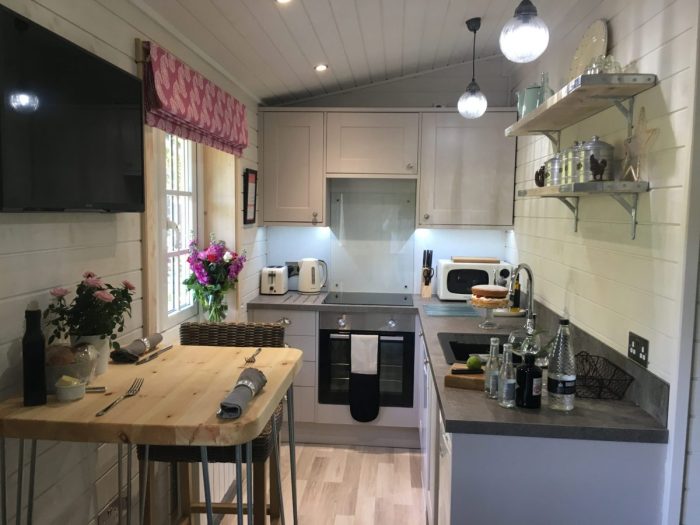
HOME COOKING: the kitchen at Hedgerow
As idyllic country retreats go, Hedgerow takes some beating. It’s spotless, stylish and cosy, a purpose-built luxury cabin with wood-lined rooms decorated in rural chic style and its own kitchen, shower room and separate bedroom off the living room, complete with private garden area and parking.
BREAKFAST AL FRESCO: the view towards the ridge
It’s discreetly hidden to one side of the 17th-century thatched cottage that is Katrina and Charlie’s home, giving guests an open outlook over their own section of garden.
BELOW THE RIDGE: the Ridgeway is an ancient route
Nestled below the treeline, Wainhill comprises 20 acres of meadow and pasture which house friendly Herdwick sheep, a number of horses and an eclectic collection of classic caravans and other vintage vehicles Katrina hires out for for TV, filming, photoshoots and corporate events.
RETRO COLLECTION: one of Katrina’s caravans
One of those intriguing vehicles is Alice, Katrina’s original 1955 English Eccles caravan, which has been lovingly restored and provides Hedgerow guests with a lovely space to enjoy during the summer months, just by their front door.
TRUE ORIGINAL: Alice dates from 1955
It’s a glorious spot and perfect for trips to places like Oxford, Henley and Marlow, visiting local vineyards or exploring the Midsomer Murders trail.
Take a weekend wander along the footpath to Chinnor and you could be treated to the sight of a steam engine tootling along a restored section of the old Watlington branch line from Princes Risborough which originally closed to passengers back in 1957.
Head off in the other direction towards the treeline, and you’ll quickly discover the Ridgeway national trail, a route used since prehistoric times by travellers, herdsmen and soldiers.
ANCENT TRACK: walkers have traversed the ridge for centuries
The 87-mile national trail follows a ridge of chalk hills from Avebury in Wiltshire to Ivinghoe Beacon and from your bed at Hedgerow the ancient track is about a quarter of a mile away.
WARM WELCOME: Katrina Rowton-Lee
For those wanting to tackle a longer section of the route, it’s an indication of Katrina’s “nothing is too much trouble” approach that she will cheerfully drive walkers to a suitable starting point from which they can walk back to Wainhill, allowing them to use the Hedgerow as a central point for a few days of exploring.
TOURING BASE: routes fan out in all directions
Routes fan out from here in all directions, criss-crossing the Chilterns AONB and allowing walkers access to miles of unspoilt countryside, so often overlooked by tourists in favour of the Cotswolds.
Visitors with pets even get home-made dog biscuits and their furry friends may get the chance to rub noses with the resident pack: Tilly the yellow labrador and a pair of teckels, or working dachshunds.
FURRY FRIENDS: Wainhill is a dog-friendly destination
We saunter out of the back gate for a quick circuit up to the Ridgeway, and quickly discover it’s an immensely restful landscape and a welcome escape from city hubbub.
True, there’s a light drizzle on the weekend we visit, but it does nothing to dampen our spirits on a first brief foray up to the ridge and back, pausing only to greet the occasional dog walker or runner showing a similar disregard for the elements.
SEAT IN THE SUN: Hedgerow is ideal for walkers
But even over such a rainy October weekend it’s not long before the sun’s out for long enough to show just how relaxing the garden must be in the summer months, far away from the sound of speeding traffic or aircraft noise.
Later, as dusk falls, with only the hooting of the owls to disturb the clear evening air it’s clear we will have no problem getting a great night’s sleep in our cosy wood-lined bedroom.
SMALL TOUCHES: cake and flowers
With no light pollution, it’s also a spectacular place for stargazing, and as the clouds clear we wander outside for a little to marvel as the heavens stage a dazzling display of planets and constellations.
It’s a fitting finale to a restful stay in a lovely location where those little touches like the fresh flowers and phenomenal Victoria sponge have made all the difference, as the comments in the guest book reflect.
Accommodation is available year round – check out the Wainhill website for details and prices.