Chris Dunn graduated in 2008 with an illustration degree from Bath Spa University and began working life as a freelance illustrator producing portraits and conceptual illustrations mainly for editorial clients.
“The commissions were varied in style and content, however, they were not in the traditional watercolour style that I wished to pursue,” he says. “I set about entering open competitions that specialised in representational art, preferably with a watercolour bent.”
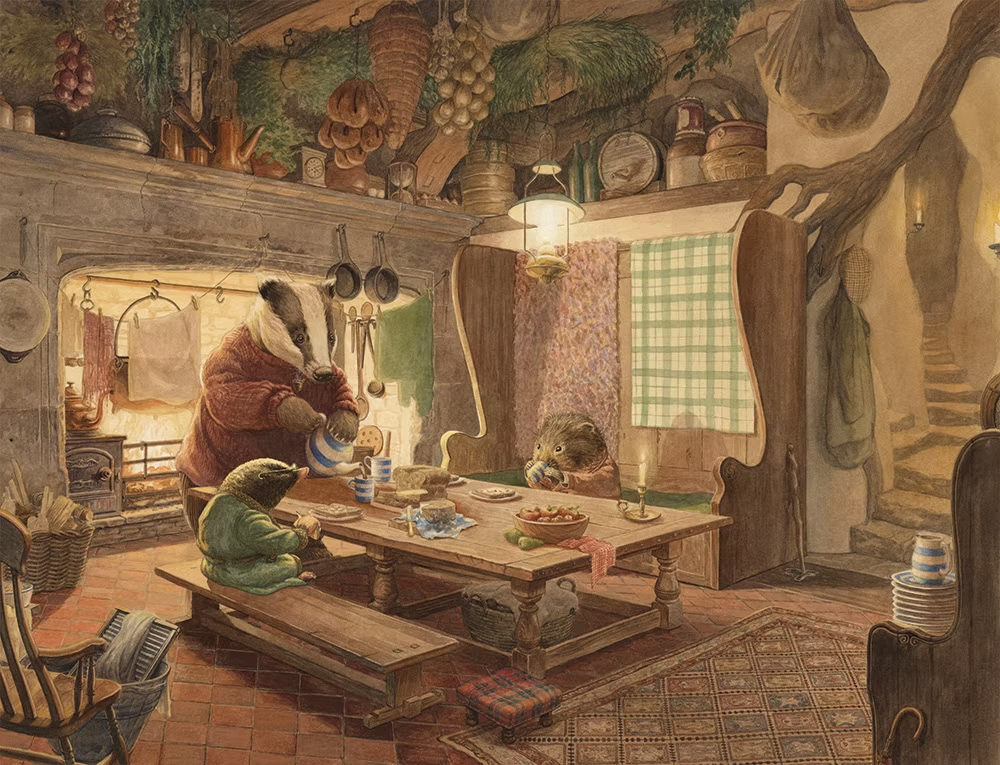
HOME FROM HOME: Badger’s Kitchen ARTWORK:Chris Dunn
The process was a valuable groundwork for his career, but his big break came in 2013 with a large commission from Galerie Daniel Maghen in Paris.
“Until that point I was illustrating for magazines and producing private / gallery commissions while working part-time in a Bath gallery,” he recalls. “Soon after beginning work for the gallery I was offered a chance to teach a children’s book illustration course at a local summer school.
SEASON’S GREETINGS: Carol Singing Mice ARTWORK:Chris Dunn
“I had an inkling The Wind in the Willows would be a perfect story for students and myself to illustrate, so I picked up a copy, made notes as I read and thought one day I’d like to illustrate the unabridged version for a publisher.”
Galerie DM approached him with an offer to paint a series of watercolours based in the world of The WInd In the Willows and his love affair with all things Ratty, Mole, Badger and Toad was cemented.
The paintings successfully exhibited in Paris in 2016, followed by another Galerie DM series commission, this time to illustrate Willows properly.
“I finally became a full-time artist specialising in traditional children’s book watercolour illustration,” says Chris.
The publisher Caurette had strong links with Galerie Daniel Maghen and it made sense to work together to produce a book and an exhibition of the originals to coincide with the book launch.
TASTE FOR ADVENTURE: Mole in the Wild Wood ARTWORK:Chris Dunn
Unfortunately the grand exhibition and book launch never happened due to the coronavirus lockdown and everything was launched and sold online. But Chris’s career was firmly established.
Since then he has worked on a variety of other children’s books and an animal retelling of The Night Before Christmas.
But Ratty and Mole have a special place in his heart, allowing him to explore the world on the periphery of the riverbank sometimes hinted at by Grahame.
WOODLAND FRIENDS: Walking Through The Village ARTWORK: Chris Dunn
“It was a rich seam to mine illustrating an imaginary (alas) world of woodland animals interacting at home, in the trees, city, sea coast, school and even in the air,” he recalls.
Chris has given permission for his pictures to be used on The Beyonder to illustrate some blog entries and our review of Matthew Dennison’s biography of Grahame.
His galleries and shop can be found at his website.
THIS week’s picture bids (a hopeful) farewell to winter with a snowscape by the late 19th-century French impressionist Claude Monet.
One of the pioneers of Impressionism, Monet captures a solitary black magpie perched on a gate with the light of the sun casting blue shadows on the freshly fallen snow.
The Magpie by Claude Monet
Completed in 1869 when the artist was staying in Normandy with his girlfriend and newborn son, he was able to experiment with the art of painting “en plein air”, which the landscape painter Eugene Boudin had introduced him to in the 1850s.
The pair spent the summer of 1858 painting nature together and both men came to prefer painting outdoors rather than in a studio, using natural light.
The Magpie is one of more than a hundred snowscapes produced by Monet and is his largest winter painting, but its timeless quality and intimate observation has a captivating simplicity for nature lovers often transfixed by the smallest of details.
IT’S not every day you get to see one of nature’s most dazzling wildlife spectacles without having to travel to a distant nature reserve or coastal resort.
But this week’s picture focus captures a spectacular starling murmuration over Tring, a lot closer to home than some of the more famous locations for such displays.
DAZZLING DISPLAY: starlings over Tring PICTURE: Lesley Tilson
Lesley Tilson’s mesmerising shots capture the drama of the swoops and swirls against the evening sky in a constantly shifting pattern.
Murmurations happen across the UK from the Somerset levels to Brighton pier, from the Nortfolk fens to wetland nature reserves, and occur between November and February when flocks are boosted by migrant visitors from colder climes.
HOME TO ROOST: starlings swoop and swirl PICTURE: Lesley Tilson
Scientists think they offer safety in numbers from predators but are still not completely sure how each bird knows which way to turn without bumping into the others.
Murmurations form over the birds’ communal roosting sites as the number of birds reaches its peak and the last of the daylight begins to fade.
SAFETY IN NUMBERS: the joy of homecoming PICTURE: Lesley Tilson
It’s a sight which has captivated artists too, like Oxfordshire artist Sue Side, whose work is often inspired by local landscapes and who became fascinated by the behaviour of starling flocks as they settle in their treetop roosts at RSPB Otmoor Nature Reserve.
“It is only close up you see the pattern, the purpose and togetherness of these starling flocks,” she says. “A little like family, a starling murmuration is a story of protection, sharing, gossiping and the joy of homecoming on darker winter days.”
TIME TO REST: flocks prepare to roost PICTURE: Lesley Tilson
Lesley’s pictures certainly capture the drama and astonishing fluidity of those aerial displays, when an unspoken signal seems to tell the group to funnel towards the ground with one last sweeping motion and calming whoosh of wings.
“They are reducing in numbers now but Startops car park is the best view, so worth a visit,” she says.
HOWEVER much you love the rolling contours and ancient ridges of the Chilterns, sometimes we all need a change of scene.
SEASIDE RENDEZVOUS: beach huts at Herne Bay PICTURE: Gel Murphy
Whether that means a glorious sunset in the Lake District, a misty day on Dartmoor or the remote grandeur of a Scottish glen, the UK has a startling range of different landscapes to explore.
But as we’ve discussed before, perhaps the one view that those who live in the landlocked Chilterns miss the most is the chance to gaze out to sea and soak up the sound of crashing waves and the smell of salt in the air.
LOOKOUT PERCH: seagulls on the sea front PICTURE: Gel Murphy
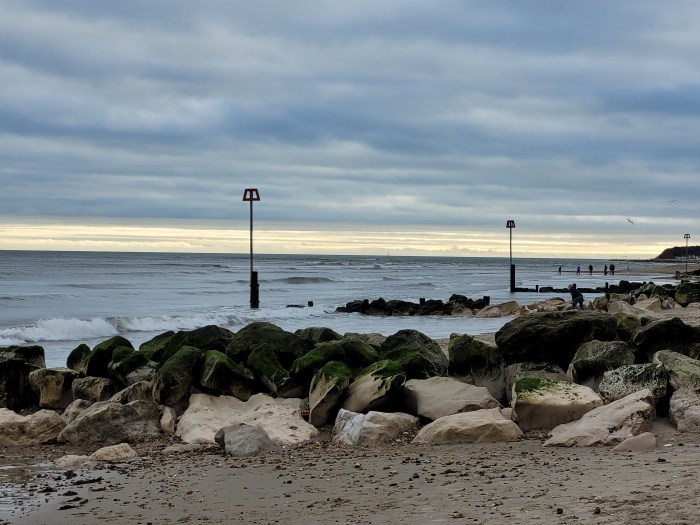
Whether that’s on a glorious white sandy beach in the Outer Hebrides or on a Cornish clifftop, as an island nation with more than 11,000 miles of coastline, there’s no shortage of different seaside habitats to choose from, as we discovered back in 2022 on our exploration of some dramatic coastal landscapes.
From shingle strands to smugglers’ coves, from golden sands to rocky outcrops, our journey took us from the wilds of Norfolk to the Moray Firth. But what about destinations closer to home, within a couple of hours’ drive?
ISOLATED: the pier at Herne Bay PICTURE: Gel Murphy
Good transport links put half a dozen counties inside that arc, from the beach huts of Dorset and Essex to the seaside towns of Kent and Sussex.
But our outing this week takes us to Herne Bay in North Kent in the company of regular Beyonder contributor Gel Murphy.
The town rose to prominence as a seaside resort during the early 19th century after the building of a pleasure pier and promenade by a group of London investors, and reached its heyday in the late Victorian era.
COLOURFUL: beach huts on the seafront PICTURE: Gel Murphy
A later replacement pier became the second longest in the country after Southend-on-Sea, complete with electric tramway, theatre and pavilion, but the central section was torn down by a storm in 1978, leaving the end of the pier isolated in the sea.
At the time it held a sports centre, opened in 1976 by former Prime Minister Edward Heath, but the centre was demolished in 2012, leaving a bare platform. Multi-million pound plans to reconnect the derelict pier head have so far failed to come to fruition, leaving the eerie landmark most visitors recognise today.
ALL AT SEA: the pier end PICTURE: Gel Murphy
It’s in stark contrast to those lovingly decorated colourful beach huts that line the front.
But if it’s genuinely eerie you’re looking for, maybe it’s worth a longer trip across to the other side of Kent and the wilds of Dungeness, that flat, desolate headland where fishermen’s huts lie in the shadow of a nuclear power station, an extraordinary landscape which we explored in 2020 in the company of artist Tim Baynes.
OUR picture highlight this week takes us to the night skies and a couple of spectacular shots of January’s Wolf Moon taken by two of our regular contributors.
Clear January skies offer stargazers and nature photographers some great opportunities to turn their cameras skywards, and their shots reflect some of the amazing colour contrasts to be seen at this time of year.
Anne Rixon‘s stunning shot of the Wolf Moon rising perfectly captures the timeless appeal of that striking vision when the moon shows its “face” to the earth.
TIMELESS APPEAL: January’s Wolf Moon PICTURE: Anne Rixon
It also provides a flashback to the same time last year where another of her photographs summed up why the full moon was so significant in past centuries to different civilisations around the world.
Wolf moons and snow moons, blood moons and strawberry moons, harvest moons and worm moons…long before calendars were invented, ancient societies kept track of the months and seasons by studying the moon.
For millennia, mankind has been fascinated by the night sky, all the more vividly lit up in those times before stargazers had to contend with light pollution from cities and the movements of aircraft and satellites.
BLUE MOON: peeping through the clouds PICTURE: Carol Ann Finch
But even contending with those modern challenges didn’t stop Carol Ann Finch producing another brilliant shot of the Wolf Moon emerging from the clouds.
The full moon happens about once every 27 days when the moon and the sun are on exactly opposite sides of Earth. The moon looks illuminated because we see the sun’s light reflected from it.
TheOld Farmer’s Almanacexplains variations in the names, comparing those of Native American tribes with names imported by colonial settlers.
The term ‘wolf moon’ is thought to have been coined by Native Americans because of how wolves would howl outside villages during the winter. Different tribes may have had other names for it around the world – spirit moon, goose moon or even bear-hunting moon, for example.
These days, such near-monthly events are popular with photographers around the world hoping for clear skies so that they can stake out some of the most iconic backdrops, from mountains and coastlines to landmarks like Stonehenge and Glastonbury Tor.
OUR picture choice this week takes us to Oxfordshire and a series of shots celebrating the unusual architecture of Blenheim Palace.
The country house at Woodstock – one of the largest in Britain – is the seat of the Dukes of Marlborough and was home to the Churchill family for 300 years.
FAMILY SEAT: Blenheim Palace PICTURE: Jo Galloway
Designated a Unesco World Heritage Site in 1987, it’s the only “palace” in England not home to the Royal family or a bishop.
It was built between 1705 and 1722, named after the 1704 Battle of Blenheim and originally intended as a reward for John Churchill, 1st Duke of Marlborough, for his military triumphs in the War of the Spanish Succession.
NATIONAL MONUMENT: the baroque palace PICTURE: Jo Galloway
Designed in the relatively rare English Baroque style favoured by Sir Christopher Wren (St Paul’s Cathedral) and William Talman (Chatsworth House), it was conceived by Sir John Vanbrugh as a national monument first and a comfortable family home second, prompting arguments with the Duchess which led to his resignation in 1716.
English Baroque style was less flamboyant and extravagant than continental preferences, with a more solid, understated appearance, though there’s nothing low-key about the style of this Grade I listed building, with its gilded state rooms and priceless collections.
STATESMAN: Churchill was born at Blenheim PICTURE: Jo Galloway
It’s where Winston Churchill was born in 1874 and spent much of his childhood, even proposing to Clementine during a party there in 1908 in a small summer house in the grounds known as the Temple of Diana.
But the dukedom was facing near bankruptcy when his close friend and first cousin the 9th Duke of Marlborough inherited the title in 1892, prompting him into a marriage of convenience with American railroad heiress Consuelo Vanderbilt, which helped to save Blenheim from ruin.
PASTORAL STYLE: the gardens at Blenheim PICTURE: Jo Galloway
Little remains of the original landscaping, because in the mid-18th century Lancelot ‘Capability’ Brown redesigned the entire 2,000 acres of gardens and parkland in his pastoral style of seemingly natural landscapes of woods, lawns, and waterways.
One of the most successful landscape architects of his time, Brown arrived in 1764 and faced a mammoth task.
NATURAL LOOK: Capability Brown took charge in 1764 PICTURE: Jo Galloway
The Grand Bridge had been the subject of more than a few critical remarks previously due to the rather underwhelming streams that ran underneath it. The famous poet Alexander Pope joked that minnows in the stream “took on the grandeur of whales as they swam underneath it”.
Brown’s solution was to widen the trickling river Glyme by digging out a valley, flooding it then damming it, creating a stunning lake with the lower storeys of the Grand Bridge, featuring 30 secret rooms, deliberately submerged under water.
GRAND CASCADE: Brown’s man-made waterfall PICTURE: Jo Galloway
He also engineered a man-made waterwall, the Grand Cascade, as an overflow section to the dam across the valley.
It was all done by hand, dug and shaped by labourers with the soil lined with a watertight layer of clay – and on such a scale that when the lake was eventually flooded, it took over a year to fill it.
LABOUR OF LOVE: the lake at Blenheim PICTURE: Jo Galloway
Brown’s transformation of the gardens and parklands took 11 years and the landscape has remained largely unchanged over the centuries since, perhaps a reflection of his talent for creating such a natural, idyllic style of English garden that it looks as if it has always been there.
King George III was so impressed by the timeless view of the Grand Bridge stretching out across the still and shimmering water of the lake when visiting in 1786 that he remarked: “We have nothing equal to this!”
RELAXED SURROUNDINGS: the Blenheim gardens PICTURE: Jo Galloway
The photo study is the work of amateur photographer Jo Galloway from the West Midlands, a regular visitor to Blenheim over the years.
“I took Mum there a few times and it was my first time back without her. Because I go out on my own I want to feel safe and it’s only about an hour from home, a lovely place to photograph with different areas,” she says.
DIFFERENT AREAS: the gardens offer plenty of variety PICTURE: Jo Galloway
Having taken up photography as a hobby some years ago, buying a Canon EOS600D, retirement has given here more time to enjoy it, she says.
“Retirement has allowed the time and space to start using it properly with upgraded lenses and a better understanding of how to get the best from the camera,” she says – and she’s enjoyed the process of learning about ways of moving from “taking snaps” to creating better quality photographs.
SMALL DETAILS: leaves in close up PICTURE: Jo Galloway
“Photography is very personal, however for me it brings great pleasure from the minute I pick my camera up, to roaming around new and old places through to creating the image and sharing it with others, hopefully for their enjoyment too.”
Sir Winston Churchill would doubtless approve of the desire to capture Blenheim on camera. He wanted to be buried at nearby St Martin’s Churchyard in Bladon, within sight of the palace, and his wishes were honoured when he died in 1965 at the age of 90.
After the state funeral service at St Paul’s, his body was taken by train to Oxfordshire for a private burial where only relatives and close friends were present. His beloved wife Clementine was buried alongside him in 1977.
FOND FAREWELL: the lake at Blenheim PICTURE: Jo Galloway
TODAY’S picture is a modest ‘still life’ marking an auspicious day in the life of a favourite aunt.
Born, like the late Queen, when George V was still on the throne, she was a toddler during the abdication crisis and a child during the war.
BIG DAY: a birthday toast at 90
In the decade when she was born, the average life expectancy for women was a little over 60, so as a young woman she could hardly have expected to be toasting this day with a slap-up Indian meal, cabernet sauvignon and chocolate cake.
But by the late 80s there were 200,000 people in the 90s club and today the figure is three times that.
We’re out and about in that part of North Kent which was swallowed up into Greater London in 1965 and where my aunt has spent her married adult life.
FAMILY ROOTS: Findochty on the Moray coast
It’s more than 600 miles from the tiny Scottish fishing village which was home to her parents, but both of them were Salvation Army officers and always on the move.
PAUSE FOR THOUGHT: the harbour at Findochty
Religion has always played a powerful role in small fishing communities where jobs are dangerous and so reliant on nature and perhaps it should come as no surprise that the Salvation Army was swelled by recruits from such places, even if their mission was often to bring succour to the poor and homeless of Britain’s big cities.
FISHERMEN’S FRIEND: the words of Psalm 107
The “battle” began on the streets of East London in 1865 when Methodists William and Catherine Booth abandoned the traditional concept of a church pulpit to take God’s word directly to the most vulnerable and marginalised people.
Their work included setting up shelters for people who were homeless, running soup kitchens, helping people living in the slums and setting up rescue homes for women fleeing domestic abuse and prostitution.
As the youngest of three daughters, my aunt recalls a childhood of disruption and new beginnings as her parents travelled the country performing their Army duties, from Camberwell, Peckham and Nunhead in London to distant cities like Sheffield and Norwich.
Born in the 1890s and married in 1917 in the local Salvation Army hall, they both died in London, in 1962 and 1979 respectively. But then one of the penalties of living to a grand old age is to lose so many of your nearest and dearest along the way: her eldest sister in 1979, middle sister in 2014 and beloved husband in 2017, after more than 60 years of marriage.
But she is straight-talking and unsentimental, with a laconic sense of humour that has survived the passing decades. A talented pianist and supremely efficient PA, her fingers must have formed a million shorthand outlines and hundreds of glorious tunes in a household that was once always filled with music.
Raising a glass of cabernet, she chuckles over past adventures and expresses regret that she may not now be able to revisit the beautiful Scottish fishing village which has played such an important part in her life, and where her parents’ graves can be found, high on a cliff looking out over the Moray Firth.
OPEN OUTLOOK: Hillhead Cemetery at Findochty
But the moment passes and for now, there’s still plenty to toast. All those happy memories, for a start – of friends and family, outings and adventures – and the simple luxury of being well enough to still get out and about at 90…
THIS week’s picture choice is a fabulous splash of colour to brighten the dull opening days of January.
The portraits were taken in Beaconsfield by Lesley Tilson, a regular contributor to the Beyonder’s Chilterns Year series of monthly articles chronicling the changing seasons, and show one of the most beautiful birds to be seen in the UK, the waxwing.
WINTER VISITOR: the colourful waxwing PICTURE: Lesley Tilson
Berry-loving waxwings are winter visitors from the coniferous forests of Scandinavia and eastern Russia, the pinkish, starling-sized birds heading for the UK in years when there is a poor crop of berries in Sweden and Finland.
“Waxwing winters” when many hundreds of the birds visit the UK are relatively rare but sizeable visits were recorded by British ornithologists in 2012/13 and 2016/17.
HUNGRY GUEST: waxwings love berries PICTURE: Lesley Tilson
The birds have swooping crests, distinctive black “eyeliner” and orange, grey and lemon-yellow tails. They get their name from the red tips of their wing feathers, which look like drops of sealing wax.
Their preference for red berries often brings them into contact with people, and 2023 was hailed as being the best “irruptions” for more than a decade, with flocks of more than 500 being recorded by enthusiasts in Scotland in November.
INVASION: the birds have been seen across Bucks PICTURE: Lesley Tilson
By the end of December, the colourful visitors were being spotted across Buckinghamshire in such numbers that local ornithologists stopped trying to record all the sightings.
The plump arrivals adore rowan and hawthorn berries, but also cotoneaster and rose, their liking for the colourful berries of ornamental trees drawing them into city centres, supermarket car parks and out-of-town shopping areas.
FEW people know the quiet lanes, secret footpaths and pretty villages of the Peak District quite as well as Suzanne, the photographer best known as ‘Peaklass‘ to her army of followers on social media.
The writer and wanderer loves nothing more than escaping into the hills and dales that surround her home base in Hathersage.
And our picture choice to kick off the New Year shows a quartet of her stunning images showing the changing seasons across that glorious landscape.
An avid runner, walker and explorer, she’s never happier than when she’s outdoors and she’s passionate about every aspect of the Peak District National Park – its wildlife and communities, as well as the scenery.
MISTY MORNING: The Promise PICTURE: Peaklass
Undeterred by bad weather she’s out and about in all seasons, eager to communicate her joy in the beauty of the place and its hidden treasures through daily pictures and musings.
Much of her content features on the Let’s Go Peak Districtindependent visitor website where she and a team of other photographers and local experts showcase the beauty of the Peak District National Park to the world.
It also features in calendars, prints and cards that she sells through her own online shop.
But her social media feeds offer a more intimate, personal glimpse of the landscape she loves so much, with its weathered stone walls and inviting gates to mist-covered paths and frosty fields.
ANCIENT LANDSCAPE: Entice PICTURE: Peaklass
“The more I read the news, the more I retreat to the woods,” she says. “Nature is undemanding, quietly performing complex, beautiful daily miracles, whether or not we notice.
“Out here with the trees, there’s an odd reassurance that comes from feeling how insignificant we are, how fleeting.”
From picturesque villages to tranquil valleys or deserted footpaths, Suzanne knows where to find the perfect shot to capture the essence of place, savouring the quiet of winter mornings, the delicate beauty of hoar frost or the silence among the trees when the only movement is that of the mist rising to meet the sunlight.
It’s not hard to see why she loves the national park either, with its ancient woodlands, curving valleys and windblown moors, along with those picture-postcard villages where the locals know everybody’s business and where stone cottages with smoking chimneys still line the twisting lanes just as they did 400 years ago.
WINTER TREES: The Silent Woods PICTURE: Peaklass
She’s written more than 70 Peak District walks, many bespoke routes for pubs, hotels or holiday accommodation providers, and is excited about the opportunity to inspire others to explore the local countryside, especially children.
She confesses to finding the dark of winter days very difficult, writing with delight of the winter solstice: “From tomorrow, the sunset ticks later minute by tiny minute and the light gradually returns, ready to coax awake the sleeping seeds and fill the forests with gold again.”
But equally, there’s little to beat the “feel-goodness” of a winter walk, she insists, “wrapped up warm, breath clouding, footsteps crunching, knowing there’s a hot chocolate waiting at the end”…
Winter may rage with wild winds and rattling branches, but its fading colours, rusting bracken and sullen skies have their own beauty, and Christmas lends a special magic to the picturesque villages of old stone cottages, the sparkling lights and decorated trees making homes look cosy and inviting.
Freshly fallen fluffy snow soaks up the sound waves from cars and people, softly blanketing the woodland floor and leaving only the bleating of sheep or the croak of jackdaws to disturb the peace.
AUTUMN PALETTE: Falling PICTURE: Peaklass
Autumn feels like a quiet season too, she reflects, compared with the riot of birdsong and bursting colours of spring and summer. “Autumn is slow, peaceful, as if Nature is gathering her thoughts, musing on the year and tucking in for the night,” she says.
Whether it’s the lamps coming on one by one across the valley or a little church sitting “like a boat adrift on a sea of mist” with the distant hills watching on, waiting for the village to wake, she brings a touch of poetry to the scene, as well as those startling images.
Lingering a while by the brook in Padley Gorge, where your breathing slows to match the soft push and pull of the water between rocks, or standing under giant beech trees as the soft early morning light turns gold, she is adept at capturing the subtle nuances of the landscape, and encouraging others to find room to escape the interruptions of the real world.
“When the world is too noisy and sad, it helps to walk into the kaleidoscope of an autumn country lane,” she reflects. “To hear nothing but your footsteps and the leaves falling, and to feel the solidity of old trees arching their boughs over you. I hope everyone can find their lane…”
Suzanne’s photographs can be found on her website and social media accounts, including Twitter and Instagram.
OVER the years, how many youngsters have dreamed of getting a train set for Christmas?
Across the generations, from the wooden, tin and clockwork models of the Victorian and Edwardian eras to the OO gauge electric models popularised in the 60s and 70s, countless children must have awoken to the excitement of a toy train on Christmas morning.
But although our picture choice this week shows a model railway, this is no ordinary train set.
WORK OF ART: recreating the past in miniature PICTURE: Chris Nevard
It’s more like a work of art, a carefully crafted diorama using scale models and landscaping to recreate an authentic glimpse of a bygone era – and it’s the work of professional modeller, photographer and blogger Chris Nevard from Guildford in Surrey.
What makes Chris’s models come to life is a combination of painstaking research, artistic flair and an expertise born of over 40 years’ experience of building prize-winning model railways.
BEHIND THE LENS: Chris Nevard
He creates scenes so lifelike that it’s often hard to be sure that they really are models.
From collieries and quaysides to branch lines and even a cement terminal, his creations are often surprisingly small and transportable for such convincing landscapes, springing up at exhibitions or commissioned by individual customers.
TRUE TO LIFE: a colliery scene PICTURE: Chris Nevard
As well as writing about model making and undertaking photographic commissions for the UK-based Model Rail magazine and several manufacturers, in recent years Chris has also built model railways on a commercial basis.
If that wasn’t enough to keep him busy, he also plays in a band, enjoys fine ale and actively pursues an interest in social and industrial history.
The fascination with railways began as a “spotty teenager” living in Sweden in the 1970s, he says, and a particular fascination with the Somerset & Dorset Railway was stoked by the pictures taken by the prolific railway photographer Ivo Peters during the postwar steam era.
LAYOUT COMMISSION: Neath Riverside PICTURE: Chris Nevard
Conjuring up the “perfect English railway” running through Chris’s favourite part of the country, the appeal was perhaps inevitable. even if he was too young to travel on the line.
But the influence of Ivo Peters is perhaps particularly significant. “Ivo lived in Bath and photographed the line and people extensively,” says Chris. “Through his eyes and lens he captured more than just images of trains and stations – he captured the soul behind the railway.”
That’s the same fascination Chris shares when he sees an inspiring picture in a book.
SENSE OF PLACE: atmosphere is crucial PICTURE: Chris Nevard
“I then want to read about the people and the location, trying to work out what it was really like to live and exist in the portrayed scene,” he says. “Understanding more than track geometry and what engines were used is vital if I’m going to have a successful stab at recreating something from the past in miniature which has atmosphere and a feeling of time and place.
“To achieve that I need to know about the personalities and the fabric that made or makes up the community.”
Intricate modelling and clever photography allows him to adapt scenes to the seasons, capturing the mood of a misty morning or chilly evening, but it’s not just the fascination with historical detail which marks out his layouts, but also his delight in the characters who inhabit them.
MISTY MOOD: morning in the colliery PICTURE: Chris Nevard
Regular tongue-in-cheek blog entries capture moments frozen in time from the miniature worlds he’s created, with a cast of tiny individuals living out their dramas in front of a growing audience of thousands on social media.
It’s all a far cry from that day in 1978 when he bought his first engine by mail order from Hattons of Liverpool, but then the modelling world has been transformed in that time too.
“Modellers more than ever before are realising that there is a lot more to realism than ‘correct’ flange-ways, bolts and exact scale gauge,” he says. “Influences from the USA and mainland Europe where model makers frequently embrace the overall scene equally is at last starting to have a real effect over here too.
FIERY SKIES: sunrise at Catcott Burdle PICTURE: Chris Nevard
“The internet and more recently social media have created a highly effective platform for people to share and exchange ideas. This ‘real time’ tool is really making modellers push the boundaries, which in turn is producing some really exciting new model railway projects and layouts!”
KERRIE Ann Gardner’s love of nature shines through in her words as well as her pictures.
A writer and poet as well as an artist and photographer, her social media accounts reveal a young woman “enchanted by the natural world, angered by our treatment of it” and “always happier outside”.
COUNTRY LANES: running is “like a prayer” PICTURE: Kerrie Ann Gardner
A keen runner, she relishes early mornings when the air is cold and the sun casts an amber glow over the landscape, or at nightfall when the indigo darkness descends on the lanes round her home in East Devon as the rooks and jackdaws return to their roosts.
“Running, I think, is my favourite way to pay attention,” she writes. “For a time, I tried to run faster, to challenge myself, break records. But I soon realised that this is not the reason I run. Running, for me, is not a competition. It is, in fact, more like a prayer.”
WINTER OUTLINES: January Rooks PICTURE: Kerrie Ann Gardner
Kerrie studied fine art at A-level, and loved taking photographs as a teenager, but it wasn’t until more recently, when she acquired a Nikon D7000, that she started getting the sort of photographs she had always dreamed of.
Whether that means snatching the briefest glimpse of an owl or woodcock, marvelling at the rare glory of the aurora borealis or simply catching the morning mist lingering over the local landscape, those early starts and dusk outings provide the perfect opportunities to see the local landscape at its best.
PURPLE GLOW: a rare glimpse of the aurora PICTURE: Kerrie Ann Gardner
“Our home is nestled within the beautiful borderlands of Dorset, Devon and Somerset, which affords me ample opportunity to get outside and capture some breathtaking scenes,” says Kerrie.
“I am an avid lover of the British countryside and the wildlife within it and want little more than to be outside experiencing it as much as possible.”
SOFT SPOT: a pair of tawny owlets PICTURE: Kerrie Ann Gardner
It might be a pair of tawny owlets capturing her attention, delightfully fluffy hungry siblings out in open sunlight begging for food.
“I have a soft spot for owls,” says Kerrie. “They have always beguiled me. I think it’s their eyes – those unfathomable, obsidian-like eyes, Guinness-dark and knowing in ways I can only imagine.”
EVENING MEAL: a barn owl hunting PICTURE: Kerrie Ann Gardner
But it might as well be an unusual cloud formation, or a long-deserted road through the woods which conjures up thoughts of the clatter of ancient cart wheels and all the feet which once walked there: drovers, animals, vagabonds and priests.
As well as her passion for photography, her interests range from horticulture to sea swimming, astronomy to dinosaurs.
COLD COMFORT: Swirling Rooks PICTURE: Kerrie Ann Gardner
She enjoys growing her own food and is fascinated by birds and folklore, interesting weather, fungi and the night sky, as her blog, poems and Twitterand Instagram profiles reflect.
From silhouettes of winter trees to hard frosts and full moons, her interests are reflected in her delicate artwork too.
SILHOUETTE: Winter Woodcock PICTURE: Kerrie Ann Gardner
But although she always had a love of art, formal study stifled her creativity, making it hard for her to translate the scenes in her imagination onto the page.
Social media can be an inspiring and engaging place, but it can also sap your confidence, she believes. “On bad days, it can seem like every other artist is producing amazing work while your own stuff never meets the mark.”
DREAMSCAPE: Going Home PICTURE: Kerrie Ann Gardner
Now 38 and a full-time artist and writer, the former ecologist switches the mediums she uses quite regularly, but often uses a blend of soft pastel and acrylic paint for the haunting landscapes that feature as fine art Giclée prints in her online shop.
Recurring images include the bare bone silhouettes of winter trees. “A lot of my inspiration comes when I’m running the lanes near our house,” she says. “I find movement invaluable for that. It stills my mind and allows me to see with more clarity so ideas can amalgamate.”
PAINTED STONE: Fox Fires PICTURE: Kerrie Ann Gardner
“As for social media, it’s been brilliant for getting my artwork seen which I am very grateful for, and I’ve had opportunities arise as a result, like being asked to contribute a piece to the BTO’s Red Sixty Seven book, which wouldn’t have come about otherwise.
“But it can be a difficult tool to negotiate during periods when you haven’t created much, as it can feel like everyone else is making while you’re falling behind.”
Her work for sale includes original drawings, prints and painted stones, the latter mainly focusing on birds.
BIRDS IN THE HAND: Welsh Ravens PICTURE: Kerrie Ann Gardner
And as well as revamping her online shop for 2024, she promises we’ll see more of her photographs too.
“I don’t really buy into the whole New Year’s resolution thing, especially as to my mind the winter months are a time for hibernation and deliberation,” she says. “And yet, I do think it’s good to voice intention in these darker months. It’s like planting a bulb the right way up, making it easier for the ensuing plant to break the soil and reach the light.
NEW YEAR’S RESOLUTION: Kerrie Ann Gardner
“So I’m sending down roots to remind myself that next year there needs to be more photography in my life and that it needs to be shared, because it’s not much use stuck on a hard drive.”
OUR picture choice this week takes us “across the pond” to New Hampshire and a world of photographs and micro poems celebrating the natural world.
This is the work of Catherine Arcolio, a 62-year-old whose Leaf and Twig blog began more than a decade ago as a practical way of helping her to recover from depression and addiction.
WORLD OF COLOUR: detail from Morning Meditation PICTURE: Catherine Arcolio
As she revealed in a frank features interview this week, the pairing of poetry and photography began after she moved from the city to a tiny rural community and became an important daily ritual that provided a foundation for her recovery.
In around a dozen words, her poems celebrate both the natural world and the human condition, while the images focus on the landscapes, wildlife, flowers and insects around her home, close to the state border with Vermont.
FISHING TRIP: At The Elegant Edge PICTURE: Catherine Arcolio
Her blog subscribers celebrate her ability to “take the ordinary things of this world…and in one image and a few perfect words reveal them as magical”, with many posts receiving dozens of likes.
“Your photos and prose are like little delicious sweets for the soul,” writers one reader. “Your poems always take me to a quiet, peaceful place of bliss,” says another.
WHITE OUT: detail from Sighs In The Hay PICTURE: Catherine Arcolio
Remarkably, there’s been a post very day since July 2011, and Catherine’s archive provides a searchable database of those entries, all 4,000-plus of them.
She confesses: “This daily art-making saves me. I’ve been training my eye to always be on the lookout for beauty as I listen deeply for all the languages of nature so I can translate them into poetry and share them.”
MOMENT OF PEACE: detail from Spirit Guide PICTURE: Catherine Arcolio
And she goes on to explain to her subscribers: “I’ve constructed a kind of life raft that keeps me from being pulled under by the ugliness, grief and disappointment that is inevitable in life. There is room on that raft for everyone. Especially you.”
FOR Catherine Arcolio, nature wasn’t always a refuge – but it was to become a genuine life-saver.
“There came a time when I had nothing left but hopelessness and despair,” she recalls on her website Leaf and Twig.
“Each day was an abyss. All the colour, light, purpose and connection had drained out of my life. I’d spent decades self-medicating my depression until eventually, my ‘solution’ became an addiction.
TOUGH JOURNEY: Catherine Arcolio
“Together, depression and addiction held me hostage for a number of years and then brutally robbed me of the will to live.”
It took support from her family and friends and a move from the city to a tiny rural community in New Hampshire for Catherine to find the resources that could help with the hard process of managing her depression and recovering from addiction.
SMALL-TOWN THERAPY: detail from Perspective PICTURE: Catherine Arcolio
“I found comfort in the quiet of the woods and in the peacefulness a lack of cell service imposes,” she says. “Nature asked nothing of me but my respect. I could be exactly as I was. Slow. Speechless. Sparkless. My spirit was in tatters.”
Lying across the river from Vermont and just a few hours from the Canadian border, her chosen place of refuge proved the ideal place to reclaim her life, she reflects.
SAFE REFUGE: detail from Asylum PICTURE: Catherine Arcolio
“It’s a very rural area. Our “town” features a stop sign, post office and tiny market,” she says. Immersed in nature, she was able to get out and about in all weathers, soak up the sunshine and rain and appreciate the particular beauty of each season and the natural processes of birth, ageing and death, savouring the eternal return of spring.
“A model of the whole, complicated, entwined, gloriousness of life,” she says. “That second spring I started to notice colours again. So many shades of green! A sky so blue you could practically splash it on your face.”
SECOND SPRING: detail from Visitor PICTURE: Catherine Arcolio
After living such a desolate grey monochrome existence for so long, the contrast was dramatic, but the transformation did not happen overnight.
“The healing was happening in infinitesimal increments, too small to notice daily or even monthly,” Catherine explains. “And then suddenly, like in the Wizard of Oz, the world was full of colour once again.”
WORLD OF COLOUR: detail from Morning Meditation PICTURE: Catherine Arcolio
Darkness wasn’t banished, but there was definite progress. The question was, how to keep moving toward the light?
Trawling the internet, Catherine stumbled across the work of Satya Robyn, an author, Buddhist teacher and psychotherapist who advocated writing short poetic observations or “Small Stones” as a way of engaging with the world in all its beauty.
POETIC SNAPSHOTS: detail from Destination Spring PICTURE: Catherine Arcolio
“I followed her prompt of writing a short observation each day for a month – and then just never stopped,” she recalls. “I decided to take a photograph of what I observed as I communed with nature each day and pair it with my words.
“Later I would learn this pairing is an ancient art form called ekphrastic poetry. All I knew was that it was helping me stay connected, aware, hopeful and grateful.”
COLD COMFORT: detail from Winter Work PICTURE: Catherine Arcolio
Now 62, she started posting on her Leaf and Twig website back in 2011, garnering dozens of “likes” for her short poems and making a “very modest” revenue stream from subscriptions, supplemented by occasional sales of fine art prints and greetings cards through her pixels.com and fineartamerica shops.
TASTY TREAT: detail from Break Time PICTURE: Catherine Arcolio
The poetry and photographs became something of a daily ritual, she explains: “One day at a time for over a decade I’ve built a foundation for my recovery and a body of work that honours and celebrates the natural world and our human condition.
“It happened organically, not as a grand plan. Just a practice to keep connected, to focus my mind towards gratitude rather than despair. This daily art-making saves me. I’ve been training my eye to always be on the lookout for beauty.”
SUNNY OUTLOOK: detail from Dreaming Porch PICTURE: Catherine Arcolio
In a “loud world” that moves faster and faster, she aims to transport viewers into a peaceful and intimate space, an opportunity to “linger in the renewal, nourishment and wonder of the natural world”.
And, like the woods, her website has been a refuge too, a “lovely community” of people who share their views through the comments, she says.
“That has been so healing to me, that the response to my work echoes the spirit in which it is offered.”
FIERY FINISH: detail from Flames from the Night Sky PICTURE: Catherine Arcolio
The internet can be a mean place, but Catherine’s website has been a sanctuary where supporters have found themselves drawn to her images and words, and the promise of beautiful daily encounters that they offer. And long may that continue.
WHAT a difference a month makes. Our picture choice this week takes us back to the end of October, when Olivia turned one of her original artworks into a greetings card for our online shop.
The colourful portrait went on to become the face of her Etsy shop too.
At the time, we mentioned how she had been dreaming of adding a real dog to our Beyonder family for years, checking on rescue sites and Facebook groups on a daily basis but never quite finding the perfect four-legged friend.
In the meantime, drawing dogs would have to suffice, and another fun portrait of an Afghan hound was added to the collection.
But that was before we heard about Teddy, a not-so-small energetic bundle of fun in the shape of a gorgeous four-month-old black labrador, living only half-an-hour away.
NEW ARRIVAL: Teddy the labrador
The rest, as they say, is history: though despite all the years of research, the practical reality of becoming first-time labrador owners will doubtless pose plenty of challenges.
Yes, we know about the chewing, the love of fox poo, the desire to jump up, the leash-pulling, the need to lead an active life (but not too active before those bones and joints have fully developed).
But I’m sorry, I can’t stay here chatting: there’s important puppy business to attend to in the park….
WHAT could sum up the spirit of November better than Gel Murphy’s spectacular shot of changing leaf colours in Finch Lane, Amersham?
MORNING GLORY: autumnal colours in Amersham PICTURE: Gel Murphy
It’s a fantastic foretaste of the November highlights coming soon in our monthly calendar feature, as well as a reflection of the talents of those local photographers like Gel who are out and about in all weathers capturing the beauty of the Chilterns landscape.
This is the month of woodsmoke and fireworks, first frosts and misty mornings, as nature puts on its own glorious fireworks display before the trees get stripped bare for winter, and we can’t wait to sort out a selection of your atmospheric pictures summing up the month in all its technicolour glory…
WE DON’T normally like to blow our trumpets here at The Beyonder, but this week’s picture choice is the latest original artwork that my lovely wife Olivia has been able to turn into a greetings card for our online shop.
It’s a suitably autumnal portrait of a rather gorgeous fox who looks as if he’s stepped out of a fairytale, and it’s the seventh piece of art Ollie has been able to transform into a smart greetings card with the help of Tom Allnutt at Amersham Business Services.
Other portraits include a couple of inquisitive badgers, a duck, teddy bear and a pair of endearing dogs, much of the artwork notable for its vibrant colours and celebration of the natural world.
The cards are also for sale on Ollie’s new Etsy shop, where she explains how she has only recently rediscovered her love of painting while struggling to recover from Long Covid.
“It has been such a tonic for me to be able to paint peacefully and prayerfully for just a few minutes each day,” she says. “I have found the process of working with colour to be very restorative and restful as well as uplifting.”
She adds: “I haven’t been able to get out and about in the natural world as much as I would like recently, so escaping into nature via paintbrush and canvas has lifted my spirits.”
Her cards are also stocked in a small number of select local outlets, including Bella Luce in Watlington and The Good Earth Gallery in Chesham.
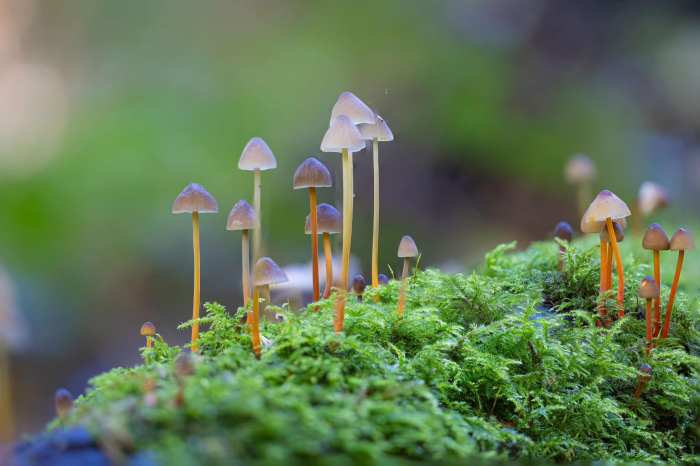
IT’S a joy to be relaunching our Picture of the Week feature after an extended break, and to kickstart the new series we have a delicate portrait of a saffrondrop bonnet mushroom taken by regular contributor Graham Parkinson.
MUSHROOM MAGIC: a saffrondrop bonnet PICTURE: Graham Parkinson
It’s one of a series of recent fungi photographs he’s posted on local nature and wildlife forums, some of which featured in our October calendar feature about the Chilterns.
Inspired with a love of wildlife as a child, Graham found that lockdown in 2020 proved the perfect opportunity for him to explore his longstanding interest in photography, and in the past three years his pictures have proved a big hit with nature lovers.
SPREADING SPORES: common puffballs PICTURE: Graham Parkinson
Birds and insects feature prominently, but his great pleasure has been embarking on seven- to 10-mile walks exploring new areas around his Marlow home and capturing what he can of the local flora and fauna.
Using his Ordnance Survey OS Maps app to plan new routes, his journeys have taken him from local favourites like Homefield Wood and Quarry Wood to Bisham, Burnham Beeches and beyond, from the banks of the Thames to the many walks between Ibstone and Christmas Common.
MINIATURE MARVELS: clustered bonnets PICTURE: Graham Parkinson
“It’s been extremely rewarding, capturing wildlife I’ve never seen before,” he says. For a long time he didn’t bother with fungi, lacking a good lens that would enable him to take “interesting” shots.
“I’ve now got a macro lens and From a photography point of view what has interested and challenged me is trying to create a lovely photo of them rather than just a record shot,” he says.
PURPLE HUE: an amethyst deceiver PICTURE: Graham Parkinson
“They’re fascinating organisms, really quite beautiful. It’s sort of like landscape photography in miniature.
“I was out again yesterday in beautiful woods and sunlight. It’s quite magical walking through the woods trying to first find fungi and then find ones where I can make a nice shot.
“An added bonus is that there’s always something else to see. Yesterday I watched two bats hunting all around me, in bright sunshine at 1pm.”
CAN a walk in the woods help you cope with chronic pain? Gel Murphy thinks so.
And our picture choice this week reflects the way that photography has transformed her life since she stepped back from her teaching career.
FIRST STEPS: walking can offer new perspectives PICTURE: Gel Murphy
As a busy deputy headteacher in London, her working life was dominated by meeting other people’s needs. But in August 2020 the long-term pain stemming from an old back injury forced her to give up her job and retire.
“I loved my job and in total worked 30 years in education,” she says. “Work had always been my crutch and others’ needs mattered before mine. I had no time to exercise; I had medical treatment to keep me at work.”
But chronic pain takes a heavy toll on your emotions and mental wellbeing, she admits. “Every day I suffer chronic pain, pain that is always there, lurking in the background,” she says.
COPING STRATEGY: a woodland ramble can lift the spirits PICTURE: Gel Murphy
And that’s when the great outdoors started to play a bigger role in her life.
“To take control and with the support of my wife, family, and friends, I began to manage my pain, through walking, healthy eating and learning about pain,” she recalls. “I still have pain every day, but I built a toolbox of coping strategies.
“One of these strategies to understand the connection between physical and mental pain is mindfulness and walking.
WELCOME ESCAPE: a footpath near Amersham PICTURE: Gel Murphy
Accompanied by her four-legged friend Obi-dog, and often in the company of fellow rambler and photographer Sue Craigs Erwin, Gel soon found herself spending hours in the woods around Amersham, taking pictures on her phone on the way.
“I walk every day,” she says. “I walk two to three miles in the beautiful Buckinghamshire countryside and take photographs on my iPhone. I don’t have a camera, my phone is my camera.
“I had never taken photographs before. Being in nature helps me forget about my pain and taking that time to stop has opened my eyes to the colours, light, beauty and changes all around.”
FABULOUS FUNGI: nature provides a welcome distraction PICTURE: Gel Murphy
Through a pain management program she was introduced to photographer Jo Bradford , who has written a number of books about smartphone photography.
“She is inspirational,” says Gel. “I was also fortunate to meet her and spend a magical morning taking photos on Dartmoor.
“I never realised the seasons had so much depth, or the magic of the light. Every day is a new picture.”
CLOSE CALL: a clip-on lens displays more detail PICTURE: Gel Murphy
Armed with a clip-on macro lens, she has also started to take close-ups of insects and plants, sharing them on a variety of local Facebook nature and wildlife groups, as well as becoming a regular contributor to The Beyonder’s calendar feature, chronicling the changing seasons in the Chilterns.
Spurred on by the members of an emotional wellbeing group which sprang up online during lockdown – organised by Christine Moran, a mental health specialist and founder of Positive Energy Being – she gained confidence in her photography and the belief that things could and would get better.
“I enjoy walking and being outside,” she says. ” We are blessed living in the Chilterns, an area of outstanding beauty. There are many amazing places to walk, I just had to start.
POLLEN COUNT: a busy bee caught on camera PICTURE: Gel Murphy
“I began walking, while listening to my sad music. It was how I felt: I was stuck in my head. Then with the support, I began listening to the sounds around me and taking time to look at the beauty around me.
“I began to see the beauty of nature, the change in the seasons and felt the warmth of the sun on my face. I took photos of what I saw, I shared them and they were applauded.
“Taking photos of nature has distracted me from my pain and led me to create my blog. I hope my photos make people smile.”
THIS month’s picture choice is a stained-glass window in rural France which captures the essence of the Christmas spirit.
The tiny window is one of a series which can be found in the Church of Reconciliation at the Taizé Community, an extraordinary monastic fraternity which has become a place of pilgrimage for young people from all over the world.
While thousands of young people descend on Taizé at Easter and during the summer holidays, Christmas is traditionally much quieter – so much so that on our last visit in December 2019, we were virtually alone with the monks on the coldest of winter nights.
Flash forward three years and a gruelling pandemic and we’re finally able to return, once again on a frosty winter’s day…but this time classes and discussion groups have resumed and a few dozen young people are able to join the monks for the afternoon service.
It’s a very special place at any time of year, but at Christmas it’s a particular pleasure to rediscover the peace of this extraordinary community where, as Brother Roger put it “kindness of heart and simplicity would be at the centre of everything”.
It’s also a delight to revisit a luxurious hotel only a few miles away which provides a perfect touring base for this beautiful part of Burgundy.
Firmly ensconced by the roaring fire at the Chateau D’Igé, we can banish memories of those icy roads in northern France and relax over an excellent three-course meal.
The food is excellent, the service impeccable and our room extremely comfortable: a perfect overnight break for anyone tackling the gruelling 1,000-mile journey from the UK to the south of France.
OUR November picture choice takes us back to Waddesdon Manor and a moving portrait by Lesley Tilson featured in our calendar feature for that month.
IN MEMORIAM: silhouettes at Waddesdon Manor PICTURE: Lesley Tilson
But while the silhouettes formed part of the Remembrance Day commemorations, staged each year to provide an opportunity to remember those who died in battle, the figures had a particular resonance in a year which saw the death of so many famous UK faces, most notably the Queen.
Hundreds of thousands turned out to pay tribute to Queen Elizabeth II, with a 10-day mourning period during which around a quarter of a million people queued to file past the Queen’s coffin at Westminster Hall the previous month.
But the intense public mourning which marked the Queen’s death was only the most memorable outpouring of grief in a year which also saw the passing of hundreds of iconic figures from actors and musicians to politicians and pop stars.
From Robbie Coltrane, Olivia Newton-John and Angela Lansbury to Sidney Poitier, Meat Loaf, Pele and Shane Warne, the list extended to stars of the small screen like June Brown and Bill Treacher from EastEnders, Dennis Waterman, Bamber Gascoigne and Bernard Cribbins.
The political world lost Mikhail Gorbachev and Japan’s former prime minister Shinzo Abe, while the year came to a close with the death of the former pope, Benedict XVI.
OCTOBER is the month when the woods play host to a quirky magical kingdom, a colourful world of unfamiliar shapes and hues where every rotting tree stump suddenly seems to be coated in new life.
This is the time of the year for fungus forays and foraging, when the leaf litter is suddenly awash with mushrooms and toadstools, brackets and puffballs, mosses and lichens.
FUNGUS FORAY: woods are suddenly awash with mushrooms PICTURE: Gel Murphy
We’ve written before of our fascination with these amazing organisms, with their spine-tingling names and beautiful shapes and colours, and we’ve even set out on a quest to find out more about how to identify the most common types.
But with literally millions of species of fungi on the Earth – as many as 10 times the estimated number of plant species – there’s plenty more to discover!
AT FIRST glance it looks like a very ordinary bench on a very ordinary path: but for those who love a good mystery, there’s nothing “ordinary” about Cannock Chase.
A former royal forest now managed by Forestry England, this area of outstanding natural beauty is a good two-hour drive from the Chilterns.
But although a sunny September evening is a perfect time to see the Chase at its best, this picturesque part of Staffordshire is perhaps best known for its folklore, and mysterious sightings of black dogs, big cats, werewolves, UFOs and even a British Bigfoot.
It also gained notoriety in the late 1960s for the horrifying “Babes in the Ditch” murders, when the remains of three young girls were found on the Chase after going missing from areas along the A34 road to Birmingham. (A motor engineer from Walsall died in prison after being convicted of one of the murders in 1968.)
Periodically since then, local newspaper headlines have seized on a range of mysterious sightings, from demonic ghost dogs to UFOs and a mysterious “black-eyed child”.
One man who’s been investigating the area’s ghostly goings-on for more than a decade is paranormal investigator and author Lee Brickley, who clearly believes there’s plenty of evidence to support his claims that the 26-mile-square forest is the UK’s most active supernatural hotspot.
A string of his short books detail tales of the area’s ghosts, werewolves and UFOs, drawing visits from ghost clubs, paranormal researchers and others determined to establish whether big cats and ‘werewolf-type creature’ really prowl around the woods.
Declassified Government documents have revealed Ministry of Defence concerns about the area being a hot-spot for reported UFO activity, with accounts of silent balls of light circling Pye Green Tower, cigar-shaped tubes flying over Burntwood, and a 10ft light hovering over the Stafford Road.
More recently, Lee embarked on a new line of inquiry, to establish whether documentaries that had enthralled him as a child about Bigfoot sightings in America had ever been matched by similar tales from the British Isles.
Predictably, almost all reports of a “British Bigfoot” come from the Cannock Chase area, and his 2021 book pulled together accounts of some of the most credible local sightings.
Back at the Iron Age hill fort at Castle Ring, looking out over Rugeley, the sunlight is fading but the chill in the air has no particular feel of foreboding about it.
This is a popular place for walkers because of the spectacular views on a clear day, along with a real sense of history: almost 2000 years ago, members of the Cornovii tribe may have looked out from this fort at the sight of Roman soldiers advancing across the land.
It’s also identified by Lee Brickley as hotspot for mysterious sightings and paranormal activity, but on the evening of our visit, there’s no indication of anything amiss.
It’s quite a view, though. And the beauty of the forest makes it worth a detour, even there aren’t any cryptids, werewolves or flying saucers around to add a frisson of excitement to the ramble.
OUR August picture choice is an atmospheric shot of rusting locomotives and wagons taken outside Clearwell Caves in the Forest of Dean.
One of a series of shots chronicling our summer break in Gloucestershire, it harked back to the industrial heyday of the forest, when an intricate network of railways and tramways were used to harvest the heavy minerals that gave the area its wealth.
Stone, coal, iron ore and even gold were extracted from the earth in huge quantities but by the 20th century deeper mining was abandoned as reserves of ore and coal became uneconomic to work.
The picture was only one of more than two dozen focusing on different aspects of life in the forest, but we have a particular fascination with abandoned places and equipment it seems, especially if it has anything to do with railways.
Hence how a casual post in a Facebook forum for fans of “abandoned rails” generated more than 600 likes and 18 shares.
Twitter feeds focusing on urban exploring and abandoned places tend to have anything from 110,000 to 150,000 followers, and perhaps it’s not so surprising that we get a creepy thrill from finding out what happens when nature takes over derelict buildings and forgotten railway lines.
From lost civilisations like Easter Island or Macchu Picchu to cities looted, flooded or burned to the ground, our fascination with romantic ruins is nothing new: and from deserted asylums to abandoned funfairs, urban explorers have reinvigorated our interest in lost and forgotten places.
Railway enthusiasts have always enjoyed the allure of a deserted trackbed or forgotten viaduct, relishing the rediscovered history associated with such journeys back in time, along with the reinvention of a rail route as a footpath or cycleway.
Such small-scale examples of abandonment may reflect changing transport or technological habits rather than a cataclysmic event like an earthquake, volcanic eruption or nuclear blast. But all such landscapes hold a fascination for us, whether it is a village lost beneath a reservoir, a closed underground station or an abandoned hospital.
As a society we are grimly fascinated by death and decay, but we also find a rare beauty in historical ruins – and possibly our recent experience of the Covid-19 pandemic changing people’s lifestyles and behaviour overnight gave us a rare insight into the just how quickly a place can fall into disuse and disrepair.
Cities like Chernobyl and Detroit hold a particular fascination because of the scale of the devastation they have suffered but there’s been a boom in the popularity of abandoned places as unlikely tourist destinations, from deserted gold rush towns to closed schools, theatres and hospitals.
Whether it’s a town in the desert flooded with sand (Namibia), an underwater city (China), a town destroyed by a tornado (Montserrat) or a deserted factory in the Amazon, there are plenty of articles and videos about grim destinations and “dark tourism”.
From empty houses in the woods to wartime pill boxes, closed stations or moss-covered remnants of deserted crofts, closed churches or ruined abbeys, the sight of trees growing through concrete, deserted mine shafts reclaimed by nesting birds and ghost towns in the middle of the jungle remind us about the perseverance of nature – and while some such sites are creepy, scarily and downright disturbing, others have an eerie and moving beauty that’s impossible to ignore.
OUR July picture choice is a spectacular shot of a deer among poppies captured by regular Beyonder contributor Lesley Tilson.
COLOUR CONTRASTS: a deer among poppies PICTURE: Lesley Tilson
Lesley’s “lucky” shot was one of a series of photographs taken between February and June which featured in our Spring 2022 calendar roundup.
Normally a month-by-month pictorial round-up of the local landscape through the changing seasons, this year’s selections were delayed by events in Ukraine.
HOT on the heels of Oxfordshire’s Artweeks comes the chance to see hundreds more artists at work during June’s Bucks Art Weeks event.
Once more local artists, makers and designers across the county up throw their studios open to guests and get ready to discuss what inspires their work.
WOODCUT WITH WATERCOLOUR: Bee friendly garden by Helen Taylor
And the lockdowns of recent years have meant much of the work can be viewed all year round in galleries on the organisers’ website.
This month’s featured artist is Helen Taylor, primarily a printmaker working in woodcut and etching who likes to explore and amplify the natural world of trees, plants and flowers.
Showing the incredible variety of colour and shape, the sheer diversity of what can grow in our own back gardens and local places, Helen’s work is inspired by well known botanical and architectural ‘meeting’ places such as Kew and Oxford Botanic Gardens, familiar to many, but also hidden places in her local area.
See the main Bucks Artweeks website for more details and galleries.
The Beyonder features short profiles of a score of artists who draw their inspiration from the Chilterns countryside. Find out more here.
OUR picture choice this month comes from the Oxfordshire workshop of Jayne Ford and marks the 40th anniversary year of the country’s oldest and biggest open studios event.
May is the month when visitors flock to see the work of hundreds of artists, makers and designers in studios, pop-up galleries, glorious gardens and ancient churches across the county.
Like many of the creatives showing their work this year, Jayne frequently finds herself inspired by local landscapes, although being born and raised in North Wales surrounded by hills and valleys and living close to the sea, these influences all permeate her work too.
“My studio is a log cabin based in my garden,” says Jayne. “It is a serene and peaceful place to work surrounded by trees and flowering plants.”
Watch out for Christmas events too, with details normally announced in October. Plans are already underway for next year’s events, which take place from May 6-29 2023, starting in South Oxfordshire (May 6-14) before moving on to North & West Oxfordshire (May 13-21) and Oxford city (May 20-29).
See the main artweeks website for more details, showcases and access to a newsletter.
The Beyonder features short profiles of a score of artists who draw their inspiration from the Chilterns countryside. Find out more here.
OUR picture choice this month takes us back to the seaside, and a celebration of Britain’s glorious coastline.
PICTURESQUE: the beach and harbour at Cullen on the Moray Coast
It’s a theme we picked up at the start of the year, but in landlocked Buckinghamshire that yearning for sea air is a regular distraction, and we’ve been fortunate enough this year to enjoy a wonderful cross-section of the country’s coastal scenery.
ANOTHER month of bloodshed in Ukraine, and another month in which street artists around the world have coloured cities yellow and blue in their pleas for peace.
From Berlin to Warsaw, Rome to Buenos Aires, urban artists sent their own messages of solidarity to a country under siege with an array of heartbreaking images.
Like the Cardiff mural by Mydogsighs highlighted last month, many of the works gained a viral following on social media, from Seth Globepainter‘s Paris mural of a little girl crushing tanks under her feet to portraits ridiculing Putin or Berlin-based street artist Eme Freethinker‘s picture of two children — one Ukrainian and one Russian — embracing each other in a declaration of solidarity and peace.
Many were also used to raise funds, as well as sending messages of support to Ukrainians that their agony was shared by millions of ordinary people around the world.
Can street art speak louder than bombs? If anyone would appreciate the impromptu galleries, it’s the people of a country whose capital became a showcase of huge murals in the wake of the Euromaidan protests of 2013.
The current offerings may not be on quite such a grand scale as those covering many storeys of the Soviet-era apartment blocks in Kyiv, but the messages they send are just as attention-grabbing.
Ukraine’s suffering may be continuing, but like the blue and yellow flags fluttering outside so many homes around the world, the street art spells out to Ukrainians that their struggle has not been forgotten.
IT WAS a month that started like any other, with the prospect of war in Europe unthinkable.
NO WORDS: the attention-grabbing Cardiff mural by Portsmouth street artist My Dog Sighs
Yet just weeks later, Russian tanks were rolling into cities across Ukraine and millions of families were on the move, fleeing the advance of Putin’s war machine.
And if any one image could sum up the unfolding tragedy, it was a striking work by Portsmouth street artist My Dog Sighs, aka Paul Stone.
It may have been hidden down a back alley in Cardiff, but the “No words” mural featuring the colours of the Ukraine flag and its capital Kyiv rapidly captured attention around the world when it appeared on his Twitter feed on March 1.
The prolific artist from Portsmouth originally trained as a primary school teacher but turned to street art when he was 30 and has since had commissions (and sell-out exhibitions) around the world, from America to China.
Known for using a vast array of reclaimed materials, including oil drums, bottle caps and tin cans, Paul started out by making works of art at home and leaving them on the streets once a month as part of his home city’s Free Art Friday project.
Many immediately recognise his giant paintings of eyes, which feature pictures in the pupils. “I see eyes as windows into the soul,” he says. “I hide stories inside the eyes and leave it up to people to decide what they can see and what the stories represent – dreams, wishes, wants.”
Another Welsh offering comes from Jenks, an artist in Llanelli who acknowledged that while Ukrainians were unlikely ever to have heard of his hometown, he hoped his Pray for Ukraine piece would help them not to feel isolated, and “know people are on their side during this terrible time for them”.
SHOW OF SOLIDARITY: Pray for Ukraine by Jenks in Llanelli
SUE Graham’s love for live leapt off the canvas in the joyful colours of her oils and acrylics.
JOYFUL COLOURS: Sue in her Buckinghamshire garden
It was equally evident in the enthusiasm with which she welcomed visitors into her studio during Bucks Art Weeks events and only too obvious in the excitement with which she embraced her family’s ambitious rewilding project on the Scottish island of Gigha.
Typically, it also shone through in the upbeat optimism with which she faced up to her cancer treatment, playing down the pain, nausea and fear associated with the relentless hospital visits.
LOCAL LANDSCAPES: Sue in her home studio in Buckinghamshire
“This cancer thing and the shadow it inevitably casts makes me live quite intensely,” she said last August.
But a few short months later, her family wrote on her Facebook page: “It is with utmost sadness that we share the news that Sue Graham passed away on 16th January 2022. We know she was loved by so many of you and that this news may come as a shock.”
The shock was only too clear in the tributes which followed, to “a magical human and utterly beautiful person” whose art brought so much joy to so many.
MOVING TRIBUTES: Suedied in January 2022
Many of her paintings are inspired by the local landscape and a series of her oils which she started back in 2008 reflected her love of the dawn chorus and paved the way for the Gigha rewilding project, as we wrote in April 2020.
Sue was quick to spot the declining volume of local birdsong, long before the loss started to hit the national headlines.
CAUGHT ON CANVAS: Sue’s painting, And Birds Were Singing, To Calm Us Down
The missing songbirds were not only to feature in a vivid series of paintings, but reflected broader environmental worries increasingly affecting the lives of the artist and her research scientist husband Gabriel Waksman – a professor of biochemistry and molecular biology.
Vibrant, positive and inspirational, it was typical that Sue felt driven to do something more for the planet – and thousands of young saplings on a remote Scottish island bear testimony to her determination and fortitude.
CALL OF THE WILD: Gabriel officially launched his tree-planting charity in 2019
“You think, ‘How much time have I got left?’ and of course it was always a project we should have started 20 years ago,” Sue admitted.
But she also insisted: “Planting trees is the best thing we can do for the future. I know it’s a drop in the ocean in terms of carbon capture, but I needed to sleep better at night.”
ONE OF the (very few) drawbacks of living in the Chilterns is our distance from the sea.
For those who love the sound of crashing waves and the smell of salt in the air, it can seem a long haul to the nearest beach (if you ignore Ruislip Lido, that is).
But if you find yourself dreaming about sandcastles and beach huts, it’s perhaps not quite as much of an expedition as you might think to dip your toes in the surf or hear the cries of the gulls.
Depending on your exact home location, an array of coastal resorts claim to be well within a two-hour drive, from Kent and Essex to Sussex, Hampshire and Dorset (where these pictures were taken).
Fancy a breath of sea air at Southend or Sheerness, Brighton or Bournemouth? Get your bucket and spade out.
“Humans are naturally drawn to the water,” Megan McCubbin tells us in Back To Nature, the new book she has co-written with stepdad Chris Packham. “Studies show that being near a water body – the ocean, rivers or lakes – has a positive impact on our minds, boosting creativity and lowering anxiety and stress.”
It’s this “Blue Mind” phenomenon which draws us to the seaside, but as Megan goes on to point out, we are our own worst enemies: the crowds descending in droves on popular resorts often leave tonnes of rubbish in their wake and local communities in despair.
Dorset litterpicker, beach cleaner and outdoors lover Anna Lois Taylor posted on Twitter at the height of the 2020 invasion: “So much litter. I’m done sacrificing my own time to clean up an area that’s repeatedly abused. We cleared it yesterday evening and returned today to find ourselves right back at the beginning. I cried all the way home.”
UNDER SIEGE: Durdle Door on the Jurassic Coast PICTURE: Anna Lois Taylor
It doesn’t have to be that way, of course. At this time of year many beaches are in pristine condition, winter storms notwithstanding, and it takes little effort for all of us to try to follow the much-quoted travel mantra “take away only memories, leave only footprints”.
Now, more than ever, the concept of treading lightly on the landscape is crucial to our future existence. Yet our main roads are lined with litter and it often feels as if our countryside is under siege.
Nowhere is this more clearly displayed than at the seaside, where however remote the location the debris of modern living is washed in with the tide from around the world.
The bay in the north of Scotland where I played on holiday as a child looks as beautiful today as it did half a century ago, but keeping our beaches clean is a constant battle.
By all means let’s continue to enjoy the timeless allure of spending days at the seaside. But even better if no one can tell that we were there at all.
FEW names are quite as evocative of past centuries as the names given to each full moon of the year by different civilisations around the world.
Anne Rixon‘s stunning shot of this month’s Wolf Moon perfectly captures the timeless appeal of that striking vision when the moon shows its “face” to the earth.
WOLF MOON RISING: January’s full moon PICTURE: Anne Rixon
Wolf moons and snow moons, blood moons and strawberry moons, harvest moons and worm moons…long before calendars were invented, ancient societies kept track of the months and seasons by studying the moon.
For millennia, mankind has been fascinated by the night sky, all the more vividly lit up in centuries before light pollution from cities and the movements of aircraft and satellites.
The full moon happens about once every 27 days when the moon and the sun are on exactly opposite sides of Earth. The moon looks illuminated because we see the sun’s light reflected from it.
The Old Farmer’s Almanac explains variations in the names, comparing those of Native American tribes with names imported by colonial settlers.
The term ‘wolf moon’ is thought to have been coined by Native Americans because of how wolves would howl outside villages during the winter. Different tribes may have had other names for it around the world – spirit moon, goose moon or even bear-hunting moon, for example.
The space.com website explains the phases of the moon, and 2022 dates for catching the full moon in the northern hemisphere.
These days, such near-monthly events are popular with photographers hoping for clear skies so that they can stake out some of the country’s most iconic backdrops, like Stonehenge and Glastonbury Tor.
Next month’s full moon – the chilly-sounding February “snow moon” – is due to appear on February 16 around 5pm GMT.
HER Twitter feed has already featured in these pages, but this week’s image from shepherdess Alison O’Neill’s @woolismybread account is for anyone needing a little “collie therapy” at the start of 2022.
VIEW FROM THE HILL: the outlook from Shacklabank PICTURE: Alison O’Neill
No one would claim running a hill farm in the Yorkshire Dales is easy, but Alison insists the spectacular scenery of the Howgill Fells in Westmoreland makes up for many of the harsher challenges of farming life.
Certainly her 35,000 Twitter followers find solace in sharing her love of her flock and her snapshots of a lifestyle city dwellers can hardly contemplate.
TIME FOR TEA: taking a break with Shadow the sheepdog PICTURE: Alison O’Neill
“I am blessed with a rare freedom,” she writes. “I work quietly in the old way, woven to my landscape.”
What that means is trying to offer an antidote to fast fashion and intensive farming, whatever practical challenges small-scale hill farming might pose for a country girl “reared on fresh air and freedom”.
FIRESIDE GLOW: Shadow settles down for the night PICTURE: Alison O’Neill
Her love of nature shines through her posts from the farm that’s been her home for the past 20 years, with her straight talking and love of simple pleasures helping to inspire and delight her online audience.
Just as much of a media star is her loyal sheepdog Shadow, of course, whether spread out in front of a roaring fire, keeping a watchful eye on Alison’s beloved Rough fell, Swaledale and Herdwick sheep or modelling a home-made Hebridean sheep wool dog lead with stag horn whistle.
Alison’s website, shop and media and video links can be found here.
SOMETIMES it’s hard not to despair at the destruction we humans wreak on our beleaguered planet.
But if there’s one man able to provide us with a sense of hope at the start of a new year, it’s Sir David Attenborough.
VOICE OF CALM: Sir David Attenborough PICTURE: Sam Barker/BBC Studios
No one is better placed to understand the scale of the challenge. With over 60 years of wildlife documentary-making under his belt, he’s visited some of the most spectacular places on earth and encountered some of the world’s most remarkable animals.
Last year, he told us in his hour-long film Extinction: The Facts: “Only now do I realise just how lucky I’ve been. Many of these wonders seem set to disappear forever.”
This year he’s back on our screens with another stunning series, The Green Planet, this time focusing on the life of plants.
LIFE OF PLANTS: Sir David hosts a new series for 2022 PICTURE: Paul Williams/BBC Studios
But rather than use one of the stunning images from his TV programmes, our picture choice this week reminds us of the extraordinary achievements of the man himself: now in his mid-90s but still a soothing and reassuring voice, despite the increasing starkness of his message.
It’s only too tempting to lash out in anger at the state of our planet. In our anthrocene epoch, there are no shortage of targets for our wrath, from the multinational companies ripping the rainforest apart to the flytippers leaving household debris scattered across our countryside.
GREEN PLANET: the beauty of nature PICTURE: BBC Studios
Sir David, who, like the Queen, has been on our planet for almost a century, has spent that lifetime telling us in his distinctive hushed tones about the beauty of the natural world and must know those frustrations better than most.
His latest series reflects on the importance of plants to every breath we take and every mouthful we eat, gently reminding us that we can’t afford to take nature for granted.
It’s Attenborough at his best: awe-struck, full of wonder and curiosity. A natural storyteller, he finds it easy to enthral an audience of all ages and he knows it’s that education and engagement that holds the key to our shared futures.
Shouting apocalyptic warnings might make us switch off in horror. Showing us at first hand the wonders of our planet might just make more of us want to protect it, before it’s too late.
OUR final picture choice of the year is an apocalyptic winter solstice sunset taken by one of our regular contributors.
ORANGE GLOW: the December sun sets over the Icknield Way PICTURE:Anne Rixon
The stunning shot was taken just off the Icknield Way by Anne Rixon, a keen walker and amateur photographer who loves wildlife and has posted on a number of local wildlife forums since taking up photography as a hobby.
“I walk a lot and take the camera with me trying to capture the beauty of the Chilterns as I go,” says Anne, who lives in Princes Risborough.
Along with Sue Craigs Erwin and Lesley Tilson, her pictures have also featured regular in our monthly calendar depicting the changing seasons across the Chilterns, A Chilterns Year.
Another keen photographer with an eye for detail is travel writer Mary Tebje, whose own blog sets out to share stories of the people and places that have shaped the Chilterns. More links to some of her most memorable rambles can be found on our Local Walks page.
Two enthusiastic local wildlife photographers whose work has brightened the pages of The Beyonder immensely are Graham Parkinson and Nick Bell.
Fascinated by the range of different birds visiting his garden in Marlow, Graham was eager to explore more of the local countryside, and lockdown proved the perfect opportunity to explore his longstanding interest in photography.
CHOCKS AWAY: a red kite launches into action PICTURE: Graham Parkinson
Nick Bell’s love of birds is matched by a fascination with insects and the challenges posed by their small size and frantic movements.
His photographs featured in a three-part series of articles last year and both photographers have provided a range of startling images which feature in the carousel of pictures appearing on the header pages of The Beyonder as visitors navigate their way around the site.
UNDER COVER: a ladybird potentially unaware of its prey PICTURE: Nick Bell
In a year which has seen more than 10,000 visitors checking out our pages, another popular “regular” was guest writer Lucy Parksrecounting her adventures with Cypriot rescue dog Yella, who has been adjusting to a new life in the Chiltern Hills.
HOME FROM HOME: rescue dog Yella PICTURE: Lucy Parks
Thank you, as always, to all of our regular contributors (and guests!) who have helped to spread the word about the beauty of the great outdoors in what has been such a challenging year for so many. Our Picture of the Week feature has been running for more than a year now, and we hope to see many more of your amazing images in 2022.
WANDER around St Albans and the centuries just roll away.
One moment you’re gazing at the intricate mosaic floor of a large Roman town house – complete with sophisticated underfloor heating system – and the next you’re staring at the ornate carvings that adorn one of the country’s great cathedrals.
The Hypocaust in Verulamium Park is a marvel of Roman engineering that reminds us that this area just outside the modern city of St Albans was the third biggest town in Roman Britain after London and Colchester, with much of the ancient city unexcavated to this day.
Nearby lies Watling Street, a historic route used by ancient Britons and paved by the Romans, running in a line from the Kent coast at Dover, crossing the Thames in London and heading north towards Manchester and Wroxeter in the north west, then the fourth largest Roman settlement.
It was one route among the network of thousands of miles of road built when Britain was part of the Roman empire, that extraordinary period from AD43 to 410 when Roman influence stretched from Hadrian’s Wall to Morocco, Egypt and Syria.
And it was here in the third century that one local citizen gave shelter to a stranger fleeing from persecution: a Christian priest now known as Amphibalus. Inspired by how important faith was to the priest, Alban asked to be taught more about Christianity.
By the time the Roman authorities caught up with Amphibalus, Alban’s new-found faith would not allow him to surrender his friend. Instead, he exchanged clothes with the man to allow his escape. Threatened with the same punishment intended for the runaway, Alban refused to renounce his beliefs and was led up to the hillside above the town, where he was beheaded, and soon hailed as Britain’s first saint.
Alban’s grave on this hillside quickly became a place of pilgrimage and it is said King Offa of Mercia founded a monastery here in 793. After the Norman invasion a new church was commissioned built from bricks and tiles saved from the ruins of Roman Verulamium and completed in 1115.
The medieval Abbey was famous as a place of learning but it did not survive the Reformation, when Henry VIII ordered the destruction of the monasteries.
Centuries later, wealthy Victorian benefactors paid for the building to be repaired, so that by 1877 what had previously been a local parish church became a cathedral and the seat of the Bishop of St Albans.
Nowadays the soaring pillars and intricate carvings provide a visually overwhelming backdrop to the story of an ordinary man doing an extraordinary thing, and a fitting reminder that his shrine is the oldest known place of Christian pilgrimage in the country.
LAST week’s picture choice highlighted the discovery of a batch of old photographs from almost half a century ago recalled a glorious summer holiday exploring the railways of the Lake District.
The year was 1974 and for five railway-mad teenagers, the perfect destination for a first summer break away from home was a dream cottage just feet from the West Coast main line near Shap Summit.
From there, it was just a short drive to explore the spectacular scenery of the famous Settle & Carlisle route, or venture westwards to find out what was left of the long-closed Cockermouth, Keswick & Penrith Railway.
The Settle-Carlisle line is the 73-mile-long section of the old Midland Railway main line running through glorious scenery in the Yorkshire Dales and the North Pennines and boasting a number of notable tunnels and viaducts, making it one of the UK’s most popular routes for steam charter trains and specials.
Much loved by railway photographers for its glorious backdrops, the line links towns like Settle and Appleby-in-Westmorland with a number of rural communities along the route.
At the time of our visit, the line still boasted old-fasioned Midland “totem” signs, like those at Appleby West, where the Midland line crossed the old North Eastern Railway route to Kirkby Stephen, the Eden Valley line.
This was a time in the line’s history where services were not exactly flourishing, but thankfully the route survived closure attempts in the 1980s after a spirited campaign mounted by rail groups, enthusiasts, local authorities and residents.
Just as well. Passenger numbers have soared since then, with closed stations reopening and quarries being reconnected to the line, allowing passengers to continue to savour what has been consistently voted one of the world’s “ten greatest train journeys”.
Armed with old local Ordnance Survey maps, our mission was to track down the routes of the lost lines which once linked the surviving routes in a rainbow of colours on our pre-grouping atlas, the book which so helpfully shows the ownership of lines before the 1923 amalgamation into four major systems: the LNWR, LNER, Southern Railway and Great Western.
After a visit to Carnforth – then and now a place of pilgrimage for railway enthusiasts and the station where the film Brief Encounter was partly filmed in February 1945 – there was time to meander back past the closed Midland stations at Halton, Caton and Hornby before rejoining the line to Hellifield and head north to Settle.
This is a landscape of evocative place names and stunning scenery, from the 1.5mile-long Blea Moor Tunnel to the towering 104ft-high Ribblehead viaduct. But back in 1974 many of the station buildings were in poor condition or privately owned.
Onwards to Dent, Hawes Junction and the signal box at Ais Gill summit and into Kirkby Stephen, where the East station still had its overall roof, though the goods yard and shed had been removed. Thankfully this is another location to get a new lease of life, courtesy of the Stainmore Railway Company.
If the West Coast mainline had its thundering Class 86 and 87 electric-hauled expresses barrelling up and down the main line between Euston and Glasgow, the Settle line still boasted a rich collection of the diesels of the era, particularly the “Peak” class locomotives whose names echoed the contours of the British landscape.
Originally numbered D1-D10, D11-D137 and D138-D193, the Class 44, 45 and 46 diesels rolled off the production line at Derby and Crewe from 1959 and were withdrawn from the end of the 1970s right through the 1980s.
Class 45s replaced steam as the main traction on the Midland Main Line from 1962 and had a 20-year heyday there until they were relegated to secondary services following introduction of high-speed trains on the route.
Back in 1974 they were still in their element on the main line as we meandered north through Long Marton, New Biggin and Culgaith to Langwathby, Lazonbury & Kirkoswald and Armathwaite, some proudly bearing their new computerised numbers introduced the previous year, like 45009 at Hawes Junction, others still bearing the original numbers, like 21 at Horton-in-Ribblesdale or 24 and 31 at Appleby West. The D prefix was dropped in 1968 when the last steam engines were withdrawn.
There are other diesel interlopers we stumble across on our wanderings too, naturally. A couple of Class 25s crossing Blea Moor viaduct, with others at Ormside, Long Marton and Culgaith. And even the smell of steam to be recaptured at the Lakeside & Haverthwaite Railway near Ulverston.
There are Class 50s galore over at Oxenholme, Kendal, Ulverston, Dalton and Barrow, not to mention the odd Class 40 wandering around Newbiggin and Culgaith.
But if the pictures predictably provide a visual record of railway comings and goings around the Lakes in the mid-1970s, they also offer a vivid reminder of a remarkable week of youthful exploration and discovery.
Rediscovering the shots when the slides were finally burned onto CD in 2019 provided a chance to look back through the notebooks and discover exactly where we ended up on that memorable Shap holiday.
Scrupulous notes and diagrams record what buildings and tracks remained on some of the closed lines, faithfully following the route of the Cockermouth, Keswick and Penrith route from Workington to Penrith, and then working east again from Kirkby Stephen towards the now-infamous Barnard Castle.
The Cockermouth line closed west of Keswick in April 1966 and the Keswick to Penrith section followed in March 1972, which meant that there was still plenty of evidence to be found of platforms, old station buildings and signalboxes. Today, much of the latter section is maintained as a cycle and walking route.
As for the old North Eastern Railway line east from Tebay, the tracks had long been lifted at Gaisgill, Ravenstonedale, Barras and Bowes following closure in the 1960s.
Not as insightful and amusing as Adrian Mole’s teenage diaries, perhaps. But a wonderful glimpse back into a time of innocence and adventure set against the timeless scenery of the Lake District landscape.
IT’S funny how a photograph has the power to sweep the years away in an instant.
This chance discovery from almost half a century ago recalled a glorious summer holiday in the Lake District while studying for A levels.
As a party of railway-mad teenagers, our destination for that break in July 1974 was a dream cottage, literally feet from the West Coast main line near Shap Summit.
And as well as offering the chance to watch the electric-hauled express trains thundering past the door, it provided the perfect touring base to explore the glorious Settle & Carlisle line south towards Leeds, or the long-closed Cockermouth, Keswick & Penrith Railway west towards Workington.
But if the holiday was SO memorable, how come the pictures remained hidden for almost 50 years? The answer, in part, lies in changing technology.
For these pictures were taken as colour slides, which might have been perfect for showing on the school’s slide projector – but not owning one at home meant it was never really possible to see what the pictures actually showed.
With exams to prepare for – and the excitement of university beckoning – it wasn’t long before the small collection of a few dozen slides was consigned to a little box at the back of a cupboard, surviving a succession of house moves, but their contents never seeing the light of day.
Flash forward to 2019 and the chance to get the slides burned onto CD finally provided the opportunity to see those shots from almost 50 years ago.
Predictably, perhaps, most might be only of interest to railway enthusiasts, with many of them chronicling the stream of Class 86 and 87 electric locomotives barrelling up and down the main line between Euston and Glasgow.
It also showcases some spectacular Lake District scenery – this part of the route over bleak Shap Fell was hacked out by thousands of tough navvies using picks and shovels in an amazing piece of Victorian engineering from 1844 onwards.
But what of that cheeky smile in the signalbox mirror? Although in the year below the rest of us at school, Pete – or Charlie as he tends to be known these days – was a sufficiently dedicated railway enthusiast to be welcomed along for the week-long adventure.
Nice, then, to discover that Charlie never lost his love of railways – or his equally affectionate memories of that break in the Lake District all those years ago. As he said in 2019 when the pictures first came to light: “I often look out of the window when I’m heading north to see whether I can see that cottage. I spend my life playing with trains…… busman’s holiday really.”
And what of that glorious Settle & Carlisle line? More of that next week, perhaps.
So I somehow think Banksy might approve of this London graffiti being repurposed to permit a reflection on the start of Advent by art expert and seminarian Patrick van der Vorst.
The artwork in Leake Street Tunnel underneath Waterloo railway station, a designated graffiti area which celebrates urban art, was only visible for four months between May and August 2008 and depicts a council worker jet-cleaning a prehistoric cave painting.
As van der Vorst reflects: “In typical ironic fashion, Banksy is thus making a point that art is often destroyed by those who don’t understand it.”
The painting was soon covered with other graffiti works, given the ever-changing nature of art in the tunnel.
Says van der Vorst: “We as a viewer can see immediately that the cleaner shouldn’t be jet blasting the ancient cave paintings. We feel like shouting ‘stop’. It is almost as if the council worker is committing an act of vandalism by removing the cave painting. But then the graffiti work itself by Banksy can be seen as vandalism too. So we are torn as a viewer and share in the artist’s irony.”
The seminarian, whose website links daily Gospel readings with an array of thought-provoking works of art, accompanied by a short personal commentary, adds his own message to the graffiti too.
“Advent is a quiet, reflective, prayerful season,” he says. “Jesus recognises that we can become so absorbed by our daily activities that we lose sight of the daily need for prayer. During our daily chores of cleaning, working, talking, walking…we are asked to be alert to Our Good Lord’s presence everywhere.”
For van der Vorst, Advent is a time for looking back, in order to look forward. “Over the next weeks, the nights are getting longer, darkness sets in, but in our cities and streets, Christmas lights will be switched on. Candles will be lit,” he explains.
“Advent tells us that the world lay in darkness before the Light of the World was born. The Advent wreath will be lit, one candle a week. Light will gradually enter our churches and homes…”
A religious message, hidden in graffiti under a London railway station? Banksy is better known for political and social commentary than religious reflections, but maybe the irony would appeal.
THERE can’t be many London landmarks that have provided a backdrop for so much of the city’s history as the distinctive dome of St Paul’s Cathedral.
Gazing out over the Thames from its lofty perch on Ludgate Hill at the highest point of the City of London, it was completed in the wake of the Great Fire of London, designed in the English baroque style by Sir Christopher Wren and completed within his lifetime.
As a teenager, I remember visiting the famous Whispering Gallery more than half a century ago, when a favourite uncle was acting as tour guide to my French exchange counterpart, Pascal. Last week, I slipped back inside the building for the first time for a brief lunchtime eucharist staged beneath that awe-inspiring dome.
I’ve pounded the surrounding streets on countless occasions, leading journalism students down to the nearby Old Bailey or the crypt at St Bride’s (below). But I’ve never returned to see that glorious interior, perhaps deterred by the crowds of tourists scattered like pigeons over the steps of St Paul’s in the summer months.
It’s remarkable that the cathedral was completed in Wren’s lifetime – and 19th-century legend has it that he would often take the trip to London to pay unofficial visits to check on the progress of his “greatest work”.
On a grey November day, the building is still full of visitors from all over the world, but it’s relatively peaceful under the dome, where semi-circles of chairs are laid out for the brief service, which on my visit recalls the memory of Edmund the Martyr, king of East Anglia back in the 9th century.
That throwback across the centuries seems all the more appropriate here, where people have been worshipping for more than a millennium: the original church on this site dates from AD 604.
Hundreds of years of history are recalled on the St Paul’s website, from the funerals of Admiral Nelson and Winston Churchill to the use of the Cathedral’s steps in the set for the iconic Feed the Birds song from the 1964 Disney film version of Mary Poppins.
All around the cathedral the saints and apostles Look down as she sells her wares Although you can’t see it, you know they are smiling Each time someone shows that he cares
Maybe down in the crypt Wren is smiling too. He was laid to rest in 1723 and the inscription in Latin on his memorial reads: “Here in its foundations lies the architect of this church and city, Christopher Wren, who lived beyond ninety years, not for his own profit but for the public good. Reader, if you seek his monument – look around you.”
THINKING SPACE: the sun’s rays captured at Chesham PICTURE: Lesley Tilson
Working on the frontline for the NHS as a midwife and nurse during the pandemic, photography became her passion, providing a welcome escape from the stresses and strains of working life.
“Pacing the Chiltern hills with my furry friends offered me opportunities for reflection and peace,” she says. “The countryside provides so much natural beauty and thinking space and supported me with my coping strategies at such a difficult time.”
PRICKLY CUSTOMER: thistles in the frost PICTURE: Lesley Tilson
It wasn’t long before she discovered how to take a ‘not bad’ mobile photograph using her iPhone, and winning a competition which attracted more than 200 entries was a welcome confidence boost too.
Her shot of a stag drinking scooped the mobile category prize in the contest, organised by the Chesham Wildlife facebook group.
Since then her photos have been regularly selected for the local newspaper, with family and friends saying how much they enjoy seeing them.
PEACEFUL PORTRAIT: a deer captured at Grangelands PICTURE: Lesley Tilson
“I love landscape and wildlife, in particular the wonderful deer,” says Lesley. “I regularly visit nature reserves and National Trust properties in the Chilterns, many advertised in The Beyonder.
“Some of my favourite walking spots are in Great Missenden, Coombe Hill and Grangelands. More local walks are down Shardeloes and the River Misbourne. “
EARLY START: dawn over the Misbourne PICTURE: Lesley Tilson
When a close work colleague was diagnosed with breast cancer at the start of the pandemic, she found therapy and recovery in painting Lesley’s photos.
NATURAL THERAPY: open country near Latimer PICTURE: Lesley Tilson
“I was very humbled when she told me my photography offered her healing opportunities through painting,” says Lesley. “She is now in remission. We have since completed a 2022 charity calendar and we are raising money for Breast Cancer Now and Thames Valley Air Ambulance. We’ve sold 60 so far, so I’m really delighted.”
MISTY MORNING: a woodland ramble at Coombe Hill PICTURE: Lesley Tilson
So what plans does she have for the future?
“I was recently gifted a Nikon Z7 and very much look forward to learning how to use it properly, taking my passion to another level,” she says.
“The pandemic does have some positive outcomes and with retirement planned for 2022, I am planning to explore our beautiful countryside in much more detail.”
THIS week’s spotlight falls on the pictures taken by Sue Craigs Erwin, a regular contributor during the past year to our series highlighting the Chilterns landscape through the changing seasons.
NOSE FOR MISCHIEF: Ted is “beautiful but very inquisitive” PICTURE: Sue Craigs Erwin
Most of Sue’s pictures are taking on her walks between Amersham and Little Chalfont with her mischievous rambling companion Ted, an inquisitive four-year-old spaniel.
“After losing my husband four years ago when I was 58 I decided I needed some company,” says Sue. “My husband was a keen amateur photographer and we spent most weekends travelling the countryside and taking pictures.
EYE FOR DETAIL: a spider’s web PICTURE: Sue Craigs Erwin
“Having Ted has given me back the opportunity to get out and get walking again.”
Using a Fujifilm FinePix HS10 camera, or sometimes just her phone, Sue’s pictures have appeared frequently on local wildlife forums, attracting plenty of praise and attention, though she is modest about her photography skills.
OVER THE RAINBOW: a colourful display outside Amersham PICTURE: Sue Craigs Erwin
“I have been told many times that I have an artistic eye, but to me it’s just sharing the beauty of nature as I see it,” she says.
Over the past year, that shared beauty has delighted Beyonder visitors and Amersham locals alike, from her spring bluebells and May poppies and buttercups to her harvest scenes and September sunsets.
SIGN OF THE TIMES: September sunlight PICTURE: Sue Craigs Erwin
“As I’ve always been a bit of a free spirit my favourite places to walk are the woods,” she says. “I love the changing colours and the sounds of the wildlife and Ted loves digging about in the autumn leaves.”
Husband Ed would undoubtedly approve. “I’m sure he’s looking down smiling,” she says. “We were together for 37 years and always had animals. Ed was a lover of the great outdoors. We spent many holidays in a remote cottage in Snowdonia photographing the landscape. It was our favourite place.”
THE final portrait in our short series of pictures taken beside the Thames comes from the blog of Mary Tebje, whose posts have chronicled some four years of rambling around the Chilterns.
What began as a year-long project celebrating life in the Chilterns – that extraordinary space between London and Oxford that has such a rich heritage and such a variety of landscapes to explore! – turned into a much longer and more meaningful venture.
TIMELESS THAMES: the view of the river from Danesfield House PICTURE: Mary Tebje
A Year in the Chilterns started life as a quiet celebration of people and places with quirky and unusual stories to tell, but soon turned into a labour of love, a journey of exploration and self-discovery charting the changing seasons and extraordinary beauty of local landscapes.
Says Mary: “I thoroughly enjoy tramping around the Chilterns, looking, listening, loitering even and meeting lovely people.”
Nothing gives her more pleasure, she maintains, than “capturing the beauty in the mundane, the small things that the locals have stopped noticing”.
RIVER OF ADVENTURE: Cliveden Reach PICTURE: Mary Tebje
As a tourism marketing professional she also began to realise that her pride in living and working in the area could translate into a way of helping to sustainably support the local businesses and destinations featured in her pages.
The pandemic only served to emphasise the importance of the Chilterns landscape and the businesses it supports, and Mary’s posts have continued throughout, providing a kaleidoscope of beautifully illustrated rambles stretching from Bedfordshire to Berkshire.
LOCAL LANDSCAPES: several of Mary’s rambles can be found on our Local Walks page
From haunted houses to tales of scandal and intrigue, her stories help to bring people and places to life, regularly echoing many of the aims and enthusiasms that we share at The Beyonder.
Whether visiting a historic manor house or ancient hill fort, her journeys have been accompanied by stunning pictures and even video diaries, social media feeds on Instagram and Twitter and even a range of Chilterns gifts.
TALES OF THE RIVERBANK: exploring Marlow PICTURE: Mary Tebje
“I am part of lovely community celebrating. collaborating and sharing what we know and love about where we live,” says Mary.
And so say all of us. Check out Mary’s latest posts on her blog here.
ONCE again, this week’s picture choice focuses on that extraordinary stretch of the river bordering the famous Cliveden Estate.
Back in 1939, the river-loving Astors owned a varied collection of river craft here, ranging from skiffs and canoes to punts and even an electric canoe.
In 1908 the river had been brought to life in Kenneth Grahame’s well-loved children’s classic, The Wind in the Willows.
A regular visitor to Cliveden, it is believed Grahame was inspired to write the book by spending time on Cliveden Reach – as well as providing a place of sanctuary and escape from the harsher realities of life.
Grahame’s experiences living at Cookham Dean were not always happy ones, but his legacy has encouraged hundreds of families to mess about in boats like Ratty and Mole once did.
And today, just as they did in past centuries, visitors are as keen as ever to take to the water during the summer months, when Boating at Cliveden offers daily skippered cruises and self-hire vessels between April and the end of October.
OUR belated post this week pays tribute to Cliveden Reach and a famous stretch of the Thames that has featured from time to time in these pages.
Renowned as one of the prettiest spots on the Thames, this is a glorious section of the river that runs alongside the famous Cliveden Estate, nowadays owned by the National Trust.
Set high above the Thames with far-reaching views, Cliveden’s impressive gardens and majestic woodlands capture the grandeur of a bygone age, and past articles have focused on the outlook enjoyed by the late Duke of Sutherland from his lofty perch among the trees at Cliveden and the peaceful war cemetery to be found in the grounds.
While visitors to the estate can wander in the footsteps of dukes, earls and royalty, in the summer months guests can venture out onto the water and view the estate in the way that so many past generations have seen it.
Boating on the Thames was a late Victorian and Edwardian craze in most social classes. And sitting on one of the prettiest stretches of the river, Cliveden Reach had the heaviest traffic of any up-river lock: on one single day in 1894, a record 129 launches and nearly 1,000 smaller craft passed through it.
Today that view of Cliveden House is every bit as spectacular. But more about that next week in the second of our series focused on this extraordinary stretch of the Thames.
OUR picture this week takes us back to West Wales in the company of exiled Beaconsfield artist Tim Baynes, who moved to the town of Laugharne on the south coast of Carmarthenshire in May.
Tim explains how bus journeys on the busy A4066 out of town onto the A40 from Carmarthen to Fishguard had given him only fleeting glimpses of some extraordinary views.
That prompted him to get the bus to drop him off outside Laugharne, a mile or so up the road at Cross Inn.
“Most of the 2.6 miles has no footpath by the side of the road. I wore some hi-vis and fearlessly faced the oncoming traffic, art bag with board and paper and crayons in one hand. The other hand was free to give a thumbs-up approbation to each car as it passed,” says Tim.
“The countryside is wonderful. The ribbon of the Afon Taf is only seldom out of view, reflecting as it did yesterday the grey skies above. Further still and above the river is a ridgeline of hills which were shrouded in mist.
“Pylons march across this calm landscape. Close by, their offspring, the telegraph poles, take their wares to the farms and houses hereabouts.
“Breaks in the hedgerows, entrances to fields, provide wonderful views out across the landscape and the opportunity to use the top of a five-bar gate as an easel on which to rest my board.
“In these same hedgerows are the first signs of autumn. Plenty of blackberries, purple scabious, a few yellow dandelions, tangles of old man’s beard, the skeletons of sheep’s parsley, the seed heads of vergeside grasses and other colourful berries all are on parade.
“I make several drawings and, having forgotten my pen, my mark making was bold and colourful. I cross the Taf, the bridge is quite narrow for a pedestrian and a car. Drivers avert their eyes.
“Into St Clears and outside St Mary Magdelene I enjoy a good drink of water and soon the bus home pulls up for me.
“Once home I add some detail to my work. It is a great way to recall the excitement of what I have seen and the realisation that wonderful scenery can only be enjoyed on foot.”
IF ONLY trees could talk, what stories they could tell.
And nowhere is that truer that at Burnham Beeches, a national nature reserve and site of special scientific interest where one can feel pretty insignificant surrounded by trees which have been towering over visitors for hundreds of years.
Wandering through these woods, it’s hard not to be swamped by images of the past, especially given that the landscape is dotted with ancient monuments like Hartley Court, a medieval moated farmhouse built in an age before the Black Death ravaged the land.
A long-term Beyonder haunt, this is a place which has provided a welcome refuge for families throughout the more recent pandemic – so much so that additional parking restrictions have been in place for most of the past year to prevent damage to the sensitive habitat.
This is the home of wood ants, owls, hornets, moorhens and an array of other woodland creatures, not to mention grazing cattle and ponies; a place where fungi flourish and a huge array of mushrooms and toadstools can be discovered.
And at this time of year, of course, it’s also the perfect place to take pictures of the annual autumn fireworks display as the greens of summer start changing to a stunning area of browns, reds and golds – which explains why it’s our picture choice of the week.
There’s even a rare chance to pick up a few tips from one an expert photographer whose portfolio of shots taken in these woods is simply stunning. Although Paul Mitchell moved away to the Dorset/Hampshire border about 18 months ago and has swapped Burnham Beeches for local woodlands nearer his home, he returns to his old stamping ground to share some of his secrets on a three-hour wander in November.
We can’t compete with Paul’s startling landscapes, but those same tree-lined paths provide a constant and ever-changing source of delight to ramblers, dog walkers and amateur photographers alike.
AHOY there, pirates! This week’s choice is not about the quality of the picture itself, but all about the place – Ruislip Lido, to be precise – and the childhood memories associated with it.
For a more fastidious modern parent stepping over the bird poo or wrinkling their nose at the prospect of toxic algae in the water, the sandy beach at the edge of this 60-acre lake might not immediately look like the perfect place for a picnic, but for generations of Londoners the Lido provided the most memorable of playgrounds.
Those childhood days are firmly etched in the minds of locals sharing their recollections on the official Lido website.
Built as a reservoir in 1811 to feed the Grand Union canal and provide water for Paddington, it became a “lido” in the 1930s, offering boating, swimming and fishing.
Almost a century later crowds still flock to that beach on the summer to enjoy a woodland walk or picnic, visit the playground or have a ride on the miniature railway.
But while locals had used it in the 1920s for skating in the winter and swimming in the summer, it was only in 1936 that it was officially opened as the Lido, complete with art-deco style main building and a concrete swimming area flanked by piers in a horseshoe shape.
With a cafeteria and changing rooms in the main building, the lido boasted rowing and paddle boats as well as the children’s playground, beach and miniature railway. It even became known as a base for water skiing, with the world championships being televised from there.
In its heyday during the 50s and 60s, the place attracted visitors from across West London and the setting was even immortalised in the 1961 film The Young Ones, the first of a string of musicals which would shoot Cliff Richard to stardom.
Fond memories date back to the earliest days of the lido, with one local recalling: “My first memory of visiting the Lido was in the big freeze of 1947 when I, as a nine-year-old, walked across the reservoir with my father to the beach area, where shortly my father was to be responsible for importing hundreds of tons of sand.”
For youngsters escaping the war-torn city of the 1950s, this was truly a place of adventure, as another visitor explains: “You have to understand how poor the country was in the aftermath of the war. Rationing was still in force, TV was a rarity and very few people owned cars so having an amenity like the Lido close by was a wonderful treat, especially for us children.”
From donkey rides to picnic sandwiches, waiting for the 158 bus at Ruislip Manor Station or sneaking through the woods in the hope of bypassing the turnstiles, locals vividly recall the highs and lows of lido life during those halycon days.
From first fishing or birdwatching expeditions to rinsing off lake water under freezing cold water taps on the beach or falling through the ice in winter, from watching American servicemen playing their portable radios at the lakeside to Saturday night dances before the war, this was a place which played a formative role in many young people’s lives.
“It was an incredibly fantastic place to grow up in,” one woman recalls. “My brother and other friends in the road would all take to our bikes and cycle through the woods, damming up little streams, climbing trees, haring around like kids do. Going to the Lido was a regular thing, either on foot or our bikes.”
Not that all memories were happy ones, of course. The cleanliness of the water – or lack of it – had always worried some parents, and the polio scare of the mid-1950s deterred all but the most hardy from swimming for a while.
By the 1970s the lido was in serious decline. There were stories of drowning accidents and youngsters shared terrifying tales of encountering “Naked Norman” running naked through the woods. Traders deserted the lake and the beach became litter-strewn.
As one Twitter user recalled: “Was talking about open-air swimming with my 87-year-old father this week. ‘We took you to Ruislip Lido once,’ he mused. ‘It was Hell.’
But although the main building was damaged by fire and knocked down in 1994, the lido got a new lease of life in the 1990s and more investment since then. There may still be no swimming or boating, but there’s still a sandy beach, railway, play areas and pleasant views and walks through the surrounding woods.
On the lake, overwintering birds include wigeon, common pochard and gadwall ducks, with a dozen other species from geese and swans to moorhens, grebes and egrets.
Meanwhile Ruislip Woods National Nature Reserve is ‘ancient semi natural woodland’ and some parts are a remnant of the Wildwood that once completely covered England after the last ice age, about 8,000 years ago.
There’s no admission charge to Ruislip Lido but there is a charge to ride on the railway and to park your car, which can be tricky at busy times. Although access is available 24/7, certain facilities like the cafe, railway and toilets are normally only open during official opening hours, from 9am to 4-9pm depending on the time of year. The Water’s Edge pub operates normal pub hours.
RAILWAY enthusiasts may have a particular affection for Andrew Keenleyside’s gloriously colourful paintings of the countryside in and around Harpenden.
For one of his favourite sources of inspiration is the “Nickey Line” – a long disused line which once linked the towns of Hemel Hempstead and Harpenden, but much of which has been redeveloped as a cycle and walking path.
The Harpenden to Hemel Hempstead branch railway ran for almost nine miles between the West Coast main line from London to Birmingham and the Midland main line from London to Leicester.
With a nickname shrouded in obscurity – there are numerous theories about its origins – passenger demand was never high and further declined in the years between the wars.
By the end of 1946 the only regular passengers on the Harpenden train were a handful of schoolchildren and when passenger services were “temporarily” suspended because of national coal shortages, the service was never reinstated.
Although the last passengers travelled on the line in June 1947, the route remains popular with cyclists and walkers, as reflected in Andrew’s paintings, which use vivid colour and expressive impasto textures to try to capture the essence of the changing seasons.
“I admire Pissarro and Sisley in terms of their compositional themes, along with Henri Mattise and the Fauves with the vivid and exciting use of colour in their palette,” says Andrew, whose work has been exhibited at the Royal Academy of Arts in London and is also represented in private collections in the USA, the Far East, South Africa and Europe.
Freight services continued to run over part of the route until 1979, but while some of the line has disappeared under houses and roads, sections of the route remain recognisable, including some bridges and sections of embankment which feature in Andrew’s pictures.
Back in August 2020, it was one of his paintings which was used to kick-start our Picture of the Week series. He is a regular exhibitor at the annual Herts Visual Arts open studios event, which this year again includes a wide range of virtual galleries and demonstrations.
Events run from until October 10, with more than 60 venues opening their doors to visitors. The full programme can be found on the Herts Visual Arts website.
HERTS Open Studios returns this week, the event which prompted the launch of our weekly Picture series just over a year ago.
And to celebrate the anniversary, today’s picture choice seems particularly appropriate as it features a self-taught oil painter who only rediscovered the love of painting during lockdown.
Blue Birch Waters by Leon Barnes was inspired by the work of TV art legend Bob Ross
The work itself is a homage to Bob Ross, the soft-spoken American art legend whose Joy of Painting TV series still enthrals millions today on Youtube.
And Stevenage artist Leon Barnes has even produced a video tutorial demonstrating the trademark wet-on-wet technique of the man whose “happy little trees” proved an inspiration to so many.
As a DJ and karaoke host for the past 16 years, Leon found his business swept away overnight by the lockdown restrictions.
Feeling lost and depressed, and lacking funds for a family birthday present, he stumbled across a stored loft gift from 2009 of an oil painting set and some old canvases, and embarked on a new artistic journey.
“Thanks to Bob Ross and The Joy of Painting, I found a new purpose, a hidden talent and lifeline,” says Leon.
Sunset Lake, an original oil on canvas landscape by Leon Barnes
This month, Leon is one of dozens of artists featured in this year’s Herts Open Studios event, which brings artists, artisans and art-lovers together for three weeks of inspiration and discovery in communities across Hertfordshire.
Events run from September 18 to October 10, with more than 60 venues opening their doors to visitors and a variety of local area art trails offering a range of free events from working studios and demonstrations to group exhibitions.
Running for more than 30 years, it is the largest county-wide art event with every venue free to enter and offering visitors a unique opportunity to meet artists and to enjoy and discuss their work.
Sunset Stream, an original oil on canvas landscape by Leon Barnes
Artists also offer online demonstrations and tours, allowing virtual visits to take place 24 hours a day.
“With many new artists joining our event alongside long-standing participants, there is just so much to explore,” said Herts Visual Arts chair, Sally Taylor. The full programme can be found on the Herts Visual Arts website.
OUR picture of the week this week takes us back to the fair, and the lost skill of fairground art.
As we revealedlast October, although the coronavirus lockdown hit travelling funfairs hard, Joby Carter of Carters Steam Fair wasn’t prepared to sit back and do nothing over the long summer months when shows had to be cancelled.
Instead he launched a series of online courses passing on his traditional signwriting techniques to people from over the world from his paint shop outside Maidenhead.
Flash forward 12 months and once again people can enjoy at first hand the wonderful old rides, vintage heavy lorries and magnificent living wagons with their cut-glass windows, lace curtains and gleaming wood interiors.
With the show’s famous 1890s gallopers and other rides once again open to the public at a series of local venues until mid-October, visitors can see for themselves what the fuss is all about – and why this unique “steam fair” has earned such a warm place in the hearts of local communities for the past four decades.
Details of Joby’s online signwriting courses can be found here.
OUR picture spotlight this week is not an individual artist or photographer, but a very special and unusual place.
Stoke Common is a remarkable patch of ancient heathland that comes to life in the summer and autumn when the heather and gorse are in full bloom.
There may be times of the year on a drizzly day when this landscape can seem a little bleak, but when the butterflies are dancing and the blackberry blossom is blooming, it’s a very different story.
Yes, there may be a rumble of distant traffic from the motorway if the wind is blowing in the wrong direction, or the roar of boy racers testing out the surrounding back roads, but for many this 200-acre oasis is a reminder of what much of Buckinghamshire might have looked like in centuries past.
Owned and run by the City of London Corporation, with the help of volunteers and supporters like the Friends of Stoke Common, the common is a perfect retreat for walkers and runners trying to get away from it all.
Since many of the plant and insect species recorded here are rare, visitors need to stay on the signposted paths, which means youngsters wanting to explore and build dens are better advised to head for nearby Black Park or Burnham Beeches.
But for those who enjoy the chance to escape the crowds, there are few better places to “get back to nature” among the spiders and stonechats, cinnabar moths and butterflies.
After last month’s explosion of ragwort, now it’s time for the common to start looking more like a Scottish heath than somewhere a stone’s throw from Slough, as reflected in our Beyonder blog entry last summer.
It’s also the perfect place for dramatic sunsets and fascinating cloud formations, as we reflected in another summer postcard a year ago.
There’s even the faint chance of spotting an elusive adder, though a lot more likely that a dusk rustle in the gorse is actually one of the score of burnished brown Sussex cattle that do their bit to protect the heathland by grazing the common, and look very smooth, velvety and healthy on their prickly diet.
Created by a combination of poor, acidic soils and careful land management, the heathland is designated as an important Site of Special Scientific Interest (SSSI).
Its beauty may not always be immediately obvious to the casual visitor, but catch the sunlight on the heather at this time of year, or the cloud formations at dusk against a spectacular sky, and you could be in a far distant land.
AFTER two weeks “on vacation” in Dorset enjoying the striking wildlife paintings of Sam Cannon, it’s almost time to return to the Chilterns.
However there’s still time for a final quick visit to an extraordinary oasis of tranquillity which we featured in our Further Afield section last month.
Here, you can enjoy a picnic with friends in glorious countryside and take in an extraordinary exhibition of modern sculpture at the same time.
The 26 acres that provide the setting for Sculpture by the Lakes have allowed sculptor Simon Gudgeon and wife Monique to create an environment for enthusiasts that blends nature’s beauty with inspiring works of art, free from the space constraints of a traditional gallery.
Carefully landscaped the aim of enhancing the aesthetic qualities of each sculpture, the park features paths which meander round the lakes, each turn revealing a different vista and new work of art, many by Simon and some by guest exhibitors.
The park at Pallington opened in 2011 and is home to some of Simon’s monumental finished pieces, as well as housing studio workshops. He sculpts primarily in bronze, and occasionally in marble, granite, glass or stainless steel.
For more information about the park and the range of sculptures to be found there, see our full feature here and Simon’s website for details about entry, upcoming exhibitions and other news.
OUR picture choice this week provides a postscript to our recent article about Dorset artist Sam Cannon and her extraordinary wildlife paintings.
Last week we wrote about Sam’s art, and how her decision to include lettering in some of her paintings had prompted an explosion of interest in her work, which nowadays attracts a substantial and enthusiastic following on Facebook and Instagram.
Howver the artist, based near Lyme Regis in Dorset, still talks of herself as “just being a mum who also paints in between all the other things life throws at me”.
Despite her modesty, it’s clear that her paintings provide a source of solace and inspiration to many, not least her remarkable Shepherd’s Hut, a moonlit woodland scene which incorporates a quote from the Russian playwright Anton Chekhov.
The words are those of Sonya in Chekhov’s 1898 play Uncle Vanya: “We shall find peace. We shall hear angels. We shall see the sky sparkling with diamonds.”
The words are beautifully juxtaposed against a peaceful woodland backdrop, the cool blues and greys of the moonlit shadows offset by the warmth emanating from the shepherd’s hut and the brown-and-white forms of two late-night visitors.
Like most of Sam’s paintings, the work combines her love of wildlife with an understanding of tyopgraphy honed during her years of study at Reading University.
When Sam referred to our original article in a post to her 43,000 followers on Facebook, along with her reflections about her week and current difficulties in selling original work, it prompted an outpouring of affection and support from her fans.
Despite the satisfaction of working as a full-time artist, setbacks range from a summer slump in the market for original pieces to export problems when dealing with customers in North America.
Sam stopped shipping to North America earlier in the year because of the hit-or-miss nature of dealings with customs and the US postal system.
She wrote: “Every time an item is severely delayed or lost, it all falls back on me. I lose customers and money. I’d rather offer no service than a hit-or-miss one.”
She has had similar doubts about spending 30 to 40 hours working on a painting just to see it sit in a folder, instead deciding to concentrate on smaller tasks. “I’ve been painting wooden hearts,” she posted. “And whilst things remain so quiet for me, I’ll be continuing to focus on small things like wooden hearts, slates and pebbles in the hope that my paintings will once again start to find homes.”
Her fans have been quick to offer their support, with hundreds of likes, shares and comments responding to her original post, many of which Sam has responded to in person. Among the words of encouragement are those who appreciate her honesty in talking about such matters on her site.
“Your words are beautiful and calming . . . just like your painting,” wrote one. And, with reference to Reflections, another wrote: “It’s a beautiful painting Sam, one which will help many people reflect on the last year or so.”
Sam Cannon’s painting can be found on her website and instagram feed. As well as original works, she also sells limited edition giclée prints, greeting cards and calendars.
ANIMALS feature hugely in the life of Dorset artist Sam Cannon, so it’s not surprising they should become the central focus of her art.
Her daily routine starts with a trip round the field clearing up horse poo and checking on her beautiful piebald cob, now 28 and needing feeding every four hours to keep his weight on.
“I do this with my mum and generally by the time we’ve finished we’ve put the world to rights, got out our frustrations with the males in the family and fully woken up,” Sam told readers in one of the short newsletters she started producing last year.
But it’s not only horses that Sam cares about. Badgers and foxes feature prominently in her paintings, along with birds, bumblebees and mice – well, all kinds of wildlife, really.
Living in the Marshwood Vale, close to Lyme Regis in Dorset, Sam is self-deprecating about her work, despite its popularity.
“I’ve always thought of myself as just being a mum who also paints in between all the other things life throws at me,” she says.
She had always loved drawing, encouraged by her grandad, but after A levels enrolled on a course at Reading University in typography and graphic communication.
“It’s an amazing course, the only university course like it in the country,” she explains. Four years on and she knew all about typographic design, the history of printing and typography, and had been on trips to Rome, Florence, the Netherlands, Belgium and Germany – but drawing wasn’t a part of the course.
Having worked in a variety of office jobs, including the family business, she spent a couple of years trying to be an artist back in the 90s, specialising in horse-racing pictures, but struggled to make a living, and returned to office work.
But in 2010 when Sam and her parents moved to Dorset she decided to to give art another go. After a couple of years of painting various subjects without success, she decided to incorporate some lettering into her work.
“And as it turns out, it’s the lettering that turned things around for me,” she recalls. “It was only when I started combining lettering with paintings that things started to change. And my pictures with words are nearly always my most popular ones.”
Not that everyone likes this style – and in her posts on Instagram and Facebook, Sam has spoken of the hurt that a chance remark or email can cause.
“I know that some people hate that I combine them – lots have told me so and it is disheartening. But I can’t please everyone,” she says.
“I love painting and I really enjoy painting letters. Planning them out, changing shapes. I spent four years studying letterforms: I’m grateful I get to use them in this way.”
And it’s since then that things have got busier and busier for Sam. At last she is a full-time artist, living near the sea close to Lyme Regis, painting and drawing pictures and turning them into greetings cards, prints and calendars to sell online or through shops and galleries throughout the UK.
Her son is soon off to university and she’s looking forward to learning about how best she can continue to transform the eight acres where they live.
Colmers Hill –The owl and the badgers by Sam Cannon
“We’ve been gradually learning about this amazing place where we are located. We’ve stopped taking hay from the field and year on year, seen the orchids flourish,” she says. “The wild flowers are growing back thicker year on year (yarrow, bird’s-foot trefoil, fleabane, honeysuckle, vetch, meadowsweet etc).
“The butterflies and solitary bees are increasing in numbers. We are only cutting the hedges every three years and then sparingly (and in places where the horses eat them, not at all). We’ve introduced red mason bees and seen terrific harvests of fruit on our trees. And apples are left on the ground in abundance for the birds to feed on over winter.
“Bird numbers have really increased too. More blackbirds and thrushes. More of the birds that love the thick hedgerows and dive down into our wild flower meadow to eat the grasshoppers and beetles that are thriving there. Eight acres isn’t a lot but we’ve seen real change. And it inspires my work every day.”
Sam’s time is spent juggling various priorities: running the business, painting new work, nurturing the beautiful place where she lives, and of course, caring for Dylan. “Though not necessarily in that order,” she says.
Part of the steep learning curve has been learning when to say “no” to commissions, exhibitions or other commitments which are simply too much to handle without taking on staff or becoming a much bigger business.
“It doesn’t get any easier to say but if people are kind and understanding, they get it,” she says.
Her subject matter has developed too. “When I first started these lettering pictures it was all about the local Dorset locations. But now, more and more, it’s about nature. I love animals and I’ve tried really hard to get better at watercolour painting and learn new things all the time.”
It would come as no surprise to those who know her that spotting a young seagull entangled in netting above a Bridport shop would end in an avian rescue mission that involved long days of two-hourly feeds, bandages and pecked arms and legs.
But a few weeks later the juvenile was ready to be socialised with other rescued gulls before being released.
Says Sam: “On our way back from taking him to the very kind chap who does this work, we then found a dog lost on the roads too. The whole trip (including reuniting the elderly dog with its owner) took just over five and a half hours. This is why I struggle to get things done!”
Sam Cannon’s painting can be found on her website and instagram feed. As well as original works, she also sells limited edition giclée prints, greeting cards and calendars.
Her mention of last week’s article on her Facebook page prompted more than 600 likes and 60 shares, but it was the warmth and range of the responses that was most inspiring.
Our selected image, Moonlit Bay, obviously resonated with dozens of her customers, many of whom spoke of receiving it as a present or of having it on their bedroom wall.
“Wonderful evocative work. I could lose myself in it,” wrote one. “I love it. I could look at it for hours,” said another.
Poignantly, another added: “This is in my bedroom wall to urge me on to my future home by the sea.”
Jo’s prints span all four seasons and reflect landscapes from the Chilterns to the Scottish Highlands, but what is it exactly that makes the vibrant paintings so popular?
“A lot of people remark about the sense of calm they feel when looking at my paintings,” says Jo. “I think they have developed quite a therapeutic appeal. People say that they can walk right into them and imagine themselves there, listening to the birds singing or the waves crashing against the shore.
“They also seem to provoke a sense of nostalgia too, bringing back memories of paths walked and views seen. This therapeutic value has been further enhanced during the last couple of years with all the stress around the pandemic.”
Jo was born and brought up on a farm in West Berkshire, which she believes gave her a love of nature and the English landscape. She worked in graphics for 14 years but began creating home-made greetings cards after taking time out to have her two children.
“As this brought in only a small income, I started to work on developing my painting style,” she says.
Nowadays she uses mainly acrylics, in particular a brand of decorative paint which boasts a vivid and distinctive palette. Her Etsy shop has become her main source of income, alongside custom orders, original sales, and licensing.
So how has her family reacted to the increasing demand for her art? “As my business has grown my family are my Number One fans, especially my sister who is collecting my canvas prints with a view that if she covers her walls with them then there is no need to re-decorate,” says Jo.
“My mother-in-law and her friends delight in spotting my licensed products in the shops such as my cards and calendars. Unfortunately, both my parents died some years ago now so never saw my success as an artist, but I am sure they would have been very proud.
“I think my husband has been pleasantly surprised by my success as he was quite sceptical at first.”
Lockdown had an enormously positive affect on her business – perhaps because of the therapeutic appeal of her pictures. It has also meant more time spent processing and packing orders, although she does try to paint as regularly as she can.
“I also have family commitments which must be juggled around my business,” she says. “I really love working for myself as the flexibility means I can still be there for my family. I paint at my easel in my conservatory which provides amazing light but for a few weeks in the year becomes too hot to paint in as the paint dries before I even get it on the canvas. I then decamp to my kitchen table to paint on slate panels.”
Life’s ambitions? “I have never really painted au plein air and this is something I wouldn’t mind trying as I would have to work quickly and observe more,” she says.
Many of her striking originals are on sale as prints in her Etsy shop, while others have been licensed for greetings cards, prints and more recently cross-stitch kits and objects ranging from aprons to lampshades.
“I never initially thought about licensing but it is a direction that found me and it’s lovely to see my work as cards and other products,” she says.
Jo’s portfolio, including original paintings and a range of prints and other products can be found on her website.
Jo Grundy’s stylised, whimsical paintings have just such an effect – as those buying her works are quick to testify.
MOONLIT BAY: a print on paper of the sea at night from an original acrylic by Jo Grundy
Jo says that being born and brought up on a farm in West Berkshire gave her a love of nature and the English landscape which she tries to capture in her vibrant, colourful paintings.
“I have always been creative and it was inevitable that I would choose a career based around art so I trained as a graphic designer which was an easier option to earn a living from, at that time, than a fine artist,” she says.
DOWN SUMMER LANE: a print from an original acrylic by Jo Grundy
Working in graphics for the next 14 years clearly influenced her use of colour and composition and after taking time out to have her two children, she initially began creating home-made greetings cards.
“As this brought in only a small income, I started to work on developing my painting style,” she says. “To begin with all my paintings were in mixed media and I used everything from paint and paper to stitching and beads to create highly textured and ornate pieces.”
WINTER AT KINGFISHER COTTAGE: a print from an acrylic original by Jo Grundy
Nowadays she uses mainly acrylics, in particular a brand of decorative paint which boasts a vivid and distinctive palette designed for use on a variety of surfaces including wood and glass as well as paper and canvas.
“My main inspiration comes from the ever-changing seasons of the English landscape, with my favourite season being winter as I love to see the structure and detail of trees and hedgerows,” she explains. “My winter scenes are very popular with many selling before they are even finished.”
SNOWY LANDSCAPE: a print on paper from an original acrylic painting by Jo Grundy
Many of her striking originals are on sale as prints in her Etsy shop, and buyers have been enthusiastic in their praise.
“Beautiful, and hanging in my home office where I can see the “countryside” every day. LOVE it!” said one. “It is truly beautiful, and brings me so much joy,” said another.
WESTBURY HORSES: a print on paper from an original acrylic painting by Jo Grundy
Says Jo: “I have been selling my work, mainly online for over seven years and have many of my images licensed for greetings cards, prints and more recently cross-stitch kits.
“I never initially thought about licensing but it is a direction that found me and it’s lovely to see my work as cards and other products.”
Jo’s portfolio, including original paintings and a range of prints and other products can be found on her website. And the picture choice proved so popular, Jo’s work was featured for a second week.
EVERY picture tells a story – and for art expert Patrick van der Vorst, the best paintings can speak volumes.
STAR SEEDER: graffiti art by Morfai in Kaunas, Lithuania
As a senior director at Sotheby’s in London, the Belgian-born auctioneer and dealer had become an industry expert with a huge accumulated knowledge about the world of art, antiques and collectibles.
He even featured as a winner on the TV programme Dragons’ Den when his antiques-valuing website Value My Stuff was backed by both Deborah Meaden and Theo Paphitis.
But the entrepreneur’s life took a new twist in 2019 when he enrolled as a seminarian with the Diocese of Westminster, studying at the Pontifical Beda College in Rome to become a priest.
And it’s now a couple of years since he launched a new website linking daily Gospel readings with poignant and reflective works of art, accompanied by a short personal commentary.
From Old Masters to street artists like Morfai, whose work is our picture choice this week, the website features an extraordinary range of artworks spanning the centuries, allowing visitors to consider the daily reading from a new perspective.
The French impressionist painting Picking Peas by Camille Pissarro, for example, was looted by the Nazis during World War Two when France was under German occupation, and was only returned to its rightful Jewish owners in 2017.
It sold at auction for €3.3 million in March this year, and Patrick uses it to reflect on the spiritual harvest referred to in Matthew Ch 9, when “the harvest is rich but the labourers are few”.
Likewise his choice of Star Seeder, a piece of graffiti art which went viral after it appeared on a wall in Lithuania’s second-largest city, ties in with Luke’s explanation of how, with the crowds gathering around him, Jesus recounts the parable of the sower spreading his seed on different types of land, to see much of it trampled on, eaten by birds, withered or choked. Only the seed falling into rich soil grows to produce a successful crop.
Patrick explains: “At first there was simply the bronze statue created by Bernardas Bučas (1903–1979) in Kaunas, the art deco capital of Lithuania. The sculpture embodies the interwar period where the peasant is sowing grains, working for his country.
HIDDEN MESSAGE:Morfai‘s street art only makes sense at night
“Fast forward to 2008. Street artist Morfai sprayed the wall behind the sculpture with stars. The composition works only at night, as then with the light which is shining upon the monument, a shadow of the sculpture is cast onto the wall, which then corresponds with the stars being sown by the shadow silhouette of the sower… The grains have become stars…”
During the day, the street artwork makes no sense – and likewise with parables it may be that they make little sense at first sight, Patrick suggests. “It is only at certain times, or when our own personal circumstances change, or a certain light is shining upon a certain aspect of our lives that the parables make sense,” he writes.
Ironically, the original artwork was overpainted and it was only eight years later that Morfai was invited to restore it, this time incorporated black granite stars onto the wall behind the statue.
Patrick’s website offers a daily news letter by email with the Gospel reading of the day, alongside an appropriate work of art and short reflection.
THE insects in today’s picture choice are so vivid and lifelike that it’s hard to believe they were painted more than 350 years ago.
But the painting on copper panel actually dates from 1657 and is the work of Jan van Kessel the Elder, a versatile Flemish artist known for his meticulous studes of insects and flowers (along with marine and river landscapes).
METICULOUS DETAIL: van Kessel’s extraordinary painting from 1657
Born in Antwerp in 1626, van Kessel belonged to a dynasty of famous painters and a couple of his works are in the National Gallery.
But despite the vivid realism of the colours in his sprig of redcurrants lying alongside an elephant hawk moth, ladybird, millipede and other insects, to modern eyes the study may feel uncomfortably lifeless.
But of course that stems from our ability to capture the natural world in all its splendour without trapping, killing and impaling them in cabinets of curiosities, as early natural history enthusiasts were prone to do.
NATURAL WONDER: the spectacular peacock butterfly PICTURE: Graham Parkinson
Ironically van Kessel – a keen observer praised in his day for his precision and attention to detail – was perhaps more radical in his artistic approach than we might initially appreciate as 21st-century observers of his work.
“Cabinets of wonder”, as they were also known, were early forerunners of museums – private collections of notable objects which emerged during the 16th century and helped to establish the socioeconomic status of their curators.
Filled with all kinds of disparate objects, from preserved animals, horns, tusks and skeletons to minerals, sculptures or clockwork automata, such collections often helped to promote scientific advancement when their contents were publicised and discussed, and the desire to collect and categorise the natural world inspired artists to achieve the same in painted form.
By the Victorian era, the pursuit of collecting was held in high esteem and formal parlours functioned as private museums with which to impress and amaze guests, the age of scientific exploration and discovery fuelling the popularity of taxidermy as an all-consuming obsession.
But for van Kessel way back in the 17th century, a collection of studies of flowers and insects engraved and published in 1592 in Frankfurt was to influence his work, and his studies differ from the dispassionate approach of predecessors who arranged flora and fauna in rows, as if they were specimens in a collector’s cabinet.
UNDER COVER: a ladybird potentially unaware of its prey PICTURE: Nick Bell
Van Kessel created a more dynamic arrangement of insects, where his message of nature as a mirror of God’s power would not have been lost on contemporary audiences.
As art expert and seminarian Patrick van der Vorst wrote in a recent reflection on the work: “The juxtaposition of Van Kessel’s animated painted insects with the redcurrants and two moths delights the viewer. There is a certain cheerfulness that emanates from these paintings.”
WILD ENCOUNTERS: nature comes alive in words and pictures @DrawnIntoNature
Perhaps that means van Kessel’s painting from 1657 has more in common with the vibrant portraits in modern nature journals than the grim drawers favoured by Victorian collectors, who kept their insects and butterflies so neatly and systematically arranged and ordered.
ARTISTS and makers across Buckinghamshire throw open their doors in June to showcase their work.
But even when the event is over, online galleries give visitors the chance to explore the work of dozens of creative souls from all over the Chilterns throughout the year.
MINDFUL MOMENTS:Sharon Bailey draws inspiration from the Chilterns landscape
The Bucks Arts Weeks project – which follows similar events across Oxfordshire in May – allows the public a unique opportunity to hear artists, sculptors, printmakers, photographers and jewellery makers talk about their work and see them in action.
The open studios scheme has been running in Buckinghamshire since 1985 and all the events are free to the public – including exhibitions, pop-up displays and dozens of working studios.
From calligraphy to ceramics and sculpture to digital art, the skills on display include printmaking, jewellery, drawing and painting, metalwork and photography.
For wildlife and nature lovers, highlights include many works inspired by or reflecting the natural world, including animal portraits and sculptures, and paintings rooted in the local Chilterns landscape.
Many of the local artists, from Anna Dillon and Jane Duff to Sue Graham and Christine Bass, have featured in The Beyonder’s Picture of the Week series and can be accessed through out Local Landscapes page.
ANIMAL MAGIC: Highland Moo visits Pitstone Windmill by Katie Nathan
Geographically the open studios and exhibitions stretch from Milton Keynes and Buckingham in the north to Aylesbury, Chesham, High Wycombe, Chorleywood, Henley and Maidenhead, on the southern edge of the county.
Some towns like Princes Risborough, Amersham and Chesham organise their own trail maps during the live event and exhibitors are grouped geographically to make it possible to visit a number at a time.
And while many artists draw inspiration from the Chilterns countryside, subject matter ranges from portraits to seascapes and abstract works.
LIGHT AND DARK: oils provide a favourite medium for Joe Little
During the fortnight of displays and demonstrations, visitors can buy or commission work – or even try their hand at some of the skills or sign up for classes. Prices range from postcards and small gifts costing a few pounds to major pieces of original artwork or sculpture costing hundreds.
Any artist or maker interested in taking part next year should contact the organisers on admin@bucksartweeks.org.uk.
ARTISTS and makers across Buckinghamshire throw open their doors in June to showcase their work.
But even when the event is over, online galleries give visitors the chance to explore the work of dozens of creative souls from all over the Chilterns throughout the year.
MINDFUL MOMENTS:Sharon Bailey draws inspiration from the Chilterns landscape
The Bucks Arts Weeks project – which follows similar events across Oxfordshire in May – allows the public a unique opportunity to hear artists, sculptors, printmakers, photographers and jewellery makers talk about their work and see them in action.
The open studios scheme has been running in Buckinghamshire since 1985 and all the events are free to the public – including exhibitions, pop-up displays and dozens of working studios.
From calligraphy to ceramics and sculpture to digital art, the skills on display include printmaking, jewellery, drawing and painting, metalwork and photography.
For wildlife and nature lovers, highlights include many works inspired by or reflecting the natural world, including animal portraits and sculptures, and paintings rooted in the local Chilterns landscape.
Many of the local artists, from Anna Dillon and Jane Duff to Sue Graham and Christine Bass, have featured in The Beyonder’s Picture of the Week series and can be accessed through out Local Landscapes page.
ANIMAL MAGIC: Highland Moo visits Pitstone Windmill by Katie Nathan
Geographically the open studios and exhibitions stretch from Milton Keynes and Buckingham in the north to Aylesbury, Chesham, High Wycombe, Chorleywood, Henley and Maidenhead, on the southern edge of the county.
Some towns like Princes Risborough, Amersham and Chesham organise their own trail maps during the live event and exhibitors are grouped geographically to make it possible to visit a number at a time.
And while many artists draw inspiration from the Chilterns countryside, subject matter ranges from portraits to seascapes and abstract works.
LIGHT AND DARK: oils provide a favourite medium for Joe Little
During the fortnight of displays and demonstrations, visitors can buy or commission work – or even try their hand at some of the skills or sign up for classes. Prices range from postcards and small gifts costing a few pounds to major pieces of original artwork or sculpture costing hundreds.
Any artist or maker interested in taking part next year should contact the organisers on admin@bucksartweeks.org.uk.
ARTISTS and makers across Buckinghamshire throw open their doors in June to showcase their work.
But even when the event is over, online galleries give visitors the chance to explore the work of dozens of creative souls from all over the Chilterns throughout the year.
MINDFUL MOMENTS:Sharon Bailey draws inspiration from the Chilterns landscape
The Bucks Arts Weeks project – which follows similar events across Oxfordshire in May – allows the public a unique opportunity to hear artists, sculptors, printmakers, photographers and jewellery makers talk about their work and see them in action.
The open studios scheme has been running in Buckinghamshire since 1985 and all the events are free to the public – including exhibitions, pop-up displays and dozens of working studios.
From calligraphy to ceramics and sculpture to digital art, the skills on display include printmaking, jewellery, drawing and painting, metalwork and photography.
For wildlife and nature lovers, highlights include many works inspired by or reflecting the natural world, including animal portraits and sculptures, and paintings rooted in the local Chilterns landscape.
Many of the local artists, from Anna Dillon and Jane Duff to Sue Graham and Christine Bass, have featured in The Beyonder’s Picture of the Week series and can be accessed through out Local Landscapes page.
ANIMAL MAGIC: Highland Moo visits Pitstone Windmill by Katie Nathan
Geographically the open studios and exhibitions stretch from Milton Keynes and Buckingham in the north to Aylesbury, Chesham, High Wycombe, Chorleywood, Henley and Maidenhead, on the southern edge of the county.
Some towns like Princes Risborough, Amersham and Chesham organise their own trail maps during the live event and exhibitors are grouped geographically to make it possible to visit a number at a time.
And while many artists draw inspiration from the Chilterns countryside, subject matter ranges from portraits to seascapes and abstract works.
LIGHT AND DARK: oils provide a favourite medium for Joe Little
During the fortnight of displays and demonstrations, visitors can buy or commission work – or even try their hand at some of the skills or sign up for classes. Prices range from postcards and small gifts costing a few pounds to major pieces of original artwork or sculpture costing hundreds.
Any artist or maker interested in taking part next year should contact the organisers on admin@bucksartweeks.org.uk.
ONE OF the great delights of art is its capacity to transport us to different landscapes.
And while so many of the images featured on this site capture the familiar surroundings of the Chilterns, today’s choice takes us to the south of France and the extraordinarily beautiful French hilltop village of Saint-Paul de Vence.
Hidden down a backstreet here is an unassuming chapel which was once the home of a brotherhood of pious laymen who did good works to earn forgiveness for their sins.
Today it houses some remarkable works created by the Belgian artist Jean-Michel Folon, who was commissioned by the town’s mayor to renovate the building.
It was to be the artist’s final commission before his death in 2005 at the age of 71, and it turned into a sanctuary of light and serenity encapsulating the work of the Pénitents Blancs while at the same time immortalising Folon’s love for the village.
Known for his illustrations and posters for Unesco and Amnesty International as well as large-scale sculptures in Brussels and Lisbon, Folon’s vision was completed posthumously by a select group of artisans and master glassmakers.
One wall is dominated by an immense mosaic of the village (above), while other murals and stained-glass windows evoke the theme of giving, in keeping with the vocation of the Penitents.
The first traces of the brotherhood in Saint-Paul date from 1581 and they existed in the village until the 1920s. Their charity work with the underprivileged included caring for the sick, handing out clothing and food, and giving grain to farmers in trouble. They would also offer food and shelter to lost travellers and penniless pilgrims. Similar religious congregations of penitents are known by the different colours of their habits – white, black, blue, grey, red, violet and green.
Formally opened in 2008, the chapel is a light-filled joyous place, from the stunning baptismal font (below) to the pastel walls and striking sculptures – but these works also hark back to earlier themes about the preservation of the environment, which is why his work seemed so well suited to being featured in the pages of The Beyonder.
It’s almost 30 years since Folon brought together a series of engravings and posters in an exhibition called Notre Terre which ran in several small towns in France, followed by a collaboration in Italy addressing the same subject – and leaving a legacy of large posters covering the walls of Italian cities for several years afterwards.
Today, the artworks in the Folon Chapel provide a welcome oasis of peace in the heart of the village, which became such a focus for artistic endeavour almost exactly a century ago.
Artists first started frequenting Saint-Paul at the beginning of the 1920s. The trail blazers – Paul Signac, Raoul Dufy and Chaïm Soutine – set up their easels attracted by the colours and rich, intense light, and were soon followed by visitors like Matisse and Picasso.
The artists enjoyed the company of Paul Roux – a painter, art collector and the owner of the famous Colombe d’Or restaurant, whose walls are still adorned with their paintings today.
By the 1950s and 1960s, the village had become a melting pot of talent, with poets, artists and writers rubbing shoulders with the movie stars drawn to the French Riviera by the Victorine film studios in Nice and the Cannes Film Festival.
Find out more about the Folon Chapel on the village website.
STUNNING. That’s the word which springs to mind when you first glance through Paul Mitchell’s amazing portfolio of pictures chronicling the different seasons in one of Britain’s most famous woodlands.
It’s a magical world which is constantly changing through the year, as Paul demonstrates in his startling shots of Burnham Beeches – that tiny remnant of the ancient woodlands which once covered so much of the country.
Paul’s ‘album’ contains dozens of uncaptioned photographs of the woods throughout the year – draped in snow, dappled by sunlight, looking mystical and enchanting, sometimes intriguing and welcoming, sometimes otherworldly and even scary.
He explains: “The portfolio is my response to this world of wonder and features images made in the icy grip of winter, the vibrancy of springtime, the green canopy of summer, through to the richness of autumn.”
Burnham Beeches was bought by the City of London Corporation in the latter part of the 19th century to safeguard the area from property developers and to protect its future for generations to come.
As Paul explains, the landscape of the Site of Special Scientific Interest was created by human management going back many centuries and has provided grazing land for livestock and fuel via the pollarding of beech and oak trees which has not only helped to prolong the lives of the trees, but help to give them their characteristic gnarled appearance.
Born in East Yorkshire, Paul studied graphic design at art college and soon after began his design career in London. He now lives in East Dorset as a professional landscape photographer and specialist book designer.
A respected photographic judge and lecturer, he has staged numerous exhibitions and has had articles and images published in many photographic magazines. His website can be found here.
HAPPY LITTLE TREES: American TV art legend Bob Ross inspires a new generation of artists
THERE could hardly be a painter whose geographical sources of inspiration are further removed from the gentle landscapes of the Chilterns than the soft-spoken American cult art legend Bob Ross.
But budding artists don’t need to focus on the mountains and log cabins in Ross’s pictures to pick up some handy technical tips from the inspiring host of the US TV program The Joy of Painting, which aired from 1983 to 1994 and still enthrals millions today on Youtube, as well as being screened on the BBC.
There are plenty of “happy little trees” in Black Park, after all, and dozens of Ross’s video tutorials to choose from for anyone tempted to crack out the titanium white and give his trademark wet-on-wet technique a shot.
Perhaps part of Ross’s timeless appeal is the fact he was himself a convert to art after attending a painting class in Anchorage during his 20 years in the US Air Force and honed his own techniques at the feet of another TV artist, the German painter Bill Alexander.
Ross’s enduring popularity stems in part from his distinctive laid-back style, quaint catchphrases and eternal upbeat positivity, and in part from the sheer speed and ease of his quick-painting technique. If you’re ever tempted by the idea of painting but never got round to giving it a try, check out Ross’s official Youtube channel, which has around four million subscribers, or the current BBC4 season of repeats.
The Slough-based photographer has contributed a number of pictures to a gallery linked to the Friends of Langley Park website – and the story of one major photography project is told in an old profile article in Amateur Photographer.
NEW DAWN: the gnarled tree in Langley Park by Kevin Day
“I often get up at five or six in the morning and go to the park, which is a ten-minute walk away,” says Kevin in the article. “It’s the light that interests me, and the way it affects the landscape. It’s constantly changing, at different times of the day, different times of year.”
His studies of a gnarled tree in Langley Park showed how you can return to the same subject again and again and get a different picture every time. But Kevin goes on to explain how the tree was also a symbol of his photographic renaissance.
Today, his personal work continues to complement his professional output and a selection of his nature pictures reflect this. “It’s more of a little hidden gallery occasionally people stumble across!” he says.
For those who share Kevin’s love of those two local parks, it’s a real treat – with dozens of pictures to choose from – and the option to purchase copies too.
OUR picture choice this week doesn’t focus on an individual artist or photographer, but a place –Temple Gardens in Langley Park, in fact, where May sees the rhododendrons back in full glorious bloom.
This is the month when visitors are guaranteed a spectacular fireworks display of colour, and it’s these pathways which provided the image that has graced the home page of The Beyonder for the past three years.
In mid- to late May it’s a startling spectacle, and you arrive early enough in the morning or on a weekday, you may have those winding paths pretty much to yourself, apart from the odd jogger or dog walker.
It’s one of many local walks featured in the drop-down menu on our What’s On pages, and the park itself is one of more than 50 destinations for family days out in our at-a-glance guide, as well as being the subject of a longer article in the Our Visits section.
“This past year my inspiration has been found very close at home in the hedgerows and woods, fields and skies of Eynsham,” says Alice. “Daily dog walks have provided me with the opportunity to watch the seasons unfurl and glow.”
Alongside oils, monotypes, collage and pencil work she has been experimenting with applying watercolour with a calligraphy nib.
“It has proved an ideal technique for capturing the dancing light and canopy of leaves,” adds Alice, who studied at Edinburgh College of Art and has been teaching all kinds of art to adults and children for almost 20 years.
She says: “Many themes inspire me both from the human and natural world; plants and architecture, landscapes and rooftops. I see patterns everywhere and light and colour in their infinite combinations are an endless source of inspiration and challenge.”
Having lived and exhibited in Oxfordshire for more than two decades, Alice says she likes to approach the same subject in multiple ways, playing with different combinations of colour and composition.
“Like most artists I make art about the things I love,” she says. “As I find peace and healing when out in nature I try to create art on that theme in ways that will uplift and inspire.”
A PASSION for plants has driven the art career of Julia Loken, a watercolour artist based in Eynsham outside Oxford.
Without any formal training, Julia worked for 20 years as a freelance botanical illustrator, preparing pen and ink drawings for botanical textbooks. Then, in 1980, she began to paint seriously, when her love of plants naturally led her to choose them as her favourite subjects.
Living with her husband in a 220-year-old cottage with beautiful flower and vegetable gardens, she also enjoys painting a variety of country landscapes, both at home and abroad.
This weekend she is one of hundreds of local artists featured in the annual May festival organised by Oxfordshire Artweeks, where artists across Oxfordshire throw open their doors to the public.
A fellow of the Society of Botanical Artists, Julia participates regularly in their annual exhibitions in London and, having lived in Eynsham for over 50 years, has hosted Artweeks exhibitions since 1985.
“I am very fortunate in having a large garden, where I can indulge my passion for plant collecting, and cultivate many of the plants that I wish to paint,” she says. “I also enjoy painting local landscapes.”
For more than 35 years Julia has volunteered to spend one morning each week teaching plant drawing to young children at her local village school. She has also tried to instil in them a sense of wonder at the beauty of the natural world in our increasingly technological age.
“I am endlessly fascinated by the beauty and diversity of plant forms,” she says. Her exhibition runs from 11am-6pm on May 7 until May 9.
OXFORDSHIRE comes to life in intricate detail through the paintings of Jill Smith, our latest featured artist.
Born in London but living and painting in Oxfordshire, her “traditional” style makes her landscape paintings instantly recognisable – often the epitome of English life so often popularised through jigsaws and biscuit tins.
But if her portrait of Childrey Pond in the Vale of Oxford looks as quintessentially English as you could get – and a flashback in time to a past century – all is perhaps not quite as it seems.
Although the Downland village close to Wantage has been known for its pond for centuries, by 2005 all was not well, with the village website describing it as a “smelly, muddy puddle with green weed and slime, which even the ducks shunned”.
A major restoration project was needed to restore the pond – and Jill’s portrait certainly portrays the village in all its glory and in the sort of fine detail for which she is perhaps best known.
As an industrial chemist who later moved into IT, she says: “I think my ordered scientific background bleeds through in that my landscapes, flower studies and pet portraits are mostly realistic in style and quite detailed but from time to time I rebel from the traditional to let rip, splash paint about, see what happens and take it from there.”
Only too happy to try new techniques, Jill works in a variety of media from acrylics and oils to watercolours and linocuts and is largely self-taught – supported by attending various evening classes, painting workshops and the membership of local art societies.
“When painting I aim to capture those fleeting light effects on the landscape or colour combinations that transform a scene and make it special,” she says. Frequently inspired by local landscapes, Jill is one of hundreds of local artists featured in the forthcoming May festival organised by Oxfordshire Artweeks.
Traditionally May is the month when hundreds of artists across Oxfordshire open their doors to the public and many of those exhibiting have had their work featured in past Beyonder features, including Katie Cannon, Jane Duff, Maureen Gillespie and Sue Side.
This year her collection captures landscapes encountered out walking during lockdown, plus scenes from further afield, with a particular focus on her oil and acrylic paintings.
There is the added bonus of a ‘two-for-one’ visit with fellow artist Patsy Jones exhibiting her paintings and prints at the same COVID-secure sheltered outside venue in Patsy’s garden in Wantage.
“I’m lucky to be able to work in a spare bedroom that started out being organised but over time the flotsam and jetsam has spread to cover everywhere except the small desk where I sit to paint unless I’m working at an easel,” says Jill. “I’d love to invite you to view my ‘open studio’ but you’d hardly be able to sidle through the door.”
See the Oxfordshire Artweeks site for details of the venue, days and other artists. Jill’s work is featured on her website and instagram feed. The Wantage venue is open on May 14-16 and 21-23.
OUR picture choice this week takes us back to Oxfordshire and the striking work of artist and printmaker Jane Peart.
Jane is one of dozens of local artists whose work features in an online spring show organised by Oxfordshire Artweeks, a sneak preview of work available to buy during the forthcoming May festival.
Born in London, Jane graduated from the Ealing School of Art and worked in a design studio before moving to Oxford in 1978.
An avid printmaker, her work ranges from colourful acrylics to stunning etchings of birds and animals.
She has been exhibited all over the country and is a member of the Oxford Printmaker’s Cooperative and Oxford Art Society.
She says: “After many years of devoting my time to pencil and pen and ink drawings, I took up etching, which I love, although it is a very challenging and demanding medium. I now devote most of my creative energies to printmaking.”
However her online exhibition this year shows off some of the paintings she has completed during lockdown.
“I have found it difficult this last year to produce any new etchings but I’ve enjoyed doing some different work,” she says. “Some of the paintings are from walks I’ve been on during lockdown. It’s opened my eyes to the beautiful scenery walking through the woods or by the river.”
Her pictures stray much further afield too, from the Pyrenees to Tuscany and even China. A flipbook accessible online contains more than 50 examples of her work.
“For as long as I can remember I have always loved drawing,” she says. “My etchings have always been about trying to evoke the feel and atmosphere of the place that inspires me. When drawing animals and birds I strive to capture their character, endeavouring to show the texture of their fur, feathers and other aspects which make them unique.
“In recent times I have taken up painting in acrylics. One good thing about the lockdown has been the opportunity to work in another medium and discover new exciting things to do and I really love it!”
Many of the other artists exhibitiing at this year’s festival have had their work featured in past Beyonder features, including Katie Cannon, Jane Duff, Maureen Gillespie and Sue Side, with local landscapes proving perennially popular subjects.
Traditionally May is the month that artists across Oxfordshire open their doors to the public.
The Spring Show is a seasonal collection celebrating the natural world as it awakens, awash with vivid greens, blues and golden yellows, hares and songbirds, blooms and blossom. It offers a sneak preview of what’s on offer through May, when more than 650 artists show off their creative talents.
Despite lockdown restrictions, this year there will still be dozens of secure pop-up galleries and studio exhibitions to visit across the county, with another 500 available online.
OUR picture choice this week takes us to Abingdon in Oxfordshire and the work of artist Dougie Simpson, which features as part of the UK’s oldest and biggest open studio eventnext month.
An online spring show organised by Oxfordshire Artweeks offers a sneak preview of work by more than 200 local artists which will be available to buy during the organisation’s forthcoming May festival.
Dougie, who comes originally from Scotland, was relocated to work in Wallingford in 2005, retiring 10 years later.
During a year-long period of rest and recuperation in Venice, he started attending drawing classes and art workshops held at the Bottega del Tinteretto.
“I’m very keen on attending art courses and workshops both here and in Europe,” he says. “Since I started exhibiting four years ago, my work and range of subject matter has developed and increased in popularity.
“Several of my pictures have be found in the USA. Understandably I use the opportunities when I travel to paint outside. So you will find a selection of landscapes and cityscapes amongst my paintings.”
Dougie will be exhibiting with alongside a quartet of other artists known as the Abbey Group in St Nicolas’ Church in the centre of Abingdon, showing a selection of watercolours and pen-and-wash paintings.
The Abbey Group exhibition runs from May 17-22 from 10am-5pm.
Many of the other artists exhibitiing at this year’s festival have had their work featured in past Beyonder features, including Katie Cannon, Jane Duff, Maureen Gillespie and Sue Side, with local landscapes proving perennially popular subjects.
Traditionally May is the month that artists across Oxfordshire open their doors to the public.
The Spring Show is a seasonal collection celebrating the natural world as it awakens, awash with vivid greens, blues and golden yellows, hares and songbirds, blooms and blossom. It offers a sneak preview of what’s on offer through May, when more than 650 artists show off their creative talents.
Despite lockdown restrictions, this year there will still be dozens of secure pop-up galleries and studio exhibitions to visit across the county, with another 500 available online.
THIS week’s picture choice takes us north to Milton Keynes and a quite extraordinary rewilding success story we first featured back in 2018.
Gazing out over a bare field in 1990 it would have been hard to believe that a humble couple of acres of cow pasture could become a veritable wildlife haven.
But Roy and Marie Battell’s transformation of the two acres has been inspiring. Today there are hundreds of trees – plus four ponds and meadows attracting a huge cross-section of wildlife.
Over the years the couple’s website depicting life in the nature reserve has developed something an international reputation.
The woods provide a home for all types of birds, insects and mammals with various trail cameras monitoring the movements of visitors ranging from sparrowhawks and kestrels to foxes, badgers and deer.
Dozens of loyal followers sign up for Roy’s weekly newsletter, which chronicles the changing landscape through the seasons, and his carefully chronicled pictures have appeared in a many wildlife textbooks.
His latest weekly selection is a fairly representative snapshot of life with the “Moorhens”, capturing everything from rooks and magpies gathering nesting materials to hungry squirrels, strutting pheasants and hunting owls.
It’s the quality of Roy’s photographs, coupled with his painstaking attention to detail in chronicling and recording the animals’ movements, which has attracted the interest of enthusiasts and academics around the world.
He sends these out every week to around 100 subscribers, while the archives provide an invaluable day-by-day record of the the extraordinary transformation they have achieved on their doorstep. To sign up for the weekly email, visit their website.
“I CAN barely remember a time when I didn’t paint, or wasn’t thinking about painting,” says Sue Graham.
Last week the Chilterns artist took us to the west coast of Scotland as she reflected on the challenges of a year like no other, and the need to put a remarkable family rewilding adventure on hold because of the pandemic and ongoing hospital treatment for cancer.
But this week’s picture choice takes us to the other end of the country and a hamlet on the edge of Dartmoor called Water.
BABBLING BROOK: Water, Dartmoor, oil on canvas board by Sue Graham
“Some of my favourite paths wind through it, crunching along stream beds, splashing through rivulets,” says Sue. “And everywhere there’s the music of water, gurgling, burbling, dripping. Such a life-affirming place.
“Parts of the trail are not quite stream, not quite path: my walking boots make a resonant crunching splash. There’s a half-derelict cottage on the edge of the path. It has the best location.”
Closer to home, another location with a story to tell is Henley-on-Thames in Oxfordshire.
“This painting marked a bit of a stylistic turning point for me in that it was my first mixed-media piece: I used spray paint, paint diffuser (that’s like a right-angled straw with a hole that you blow into), acrylic ink and acrylic paint,” says Sue.
SOUNDS OF SUMMER: Henley on Thames, Swifts by Sue Graham
Known for her colourful, expressive and atmospheric paintings in acrylics and oils, Sue frequently finds inspiration in natural landscapes and soundscapes.
“There is nothing (other than blackbird song, maybe) that brings me into a state of summery bliss than the screaming sounds of swifts. It’s the sound of childhood summers, of long evenings, of softness in the air, of possibilities as yet undreamed of.
“In this painting I tried to evoke that sense of ethereal joy: to honour the beauty of the bridge at Henley, without being over-literal in its depiction – photographs can do that better. I wanted to convey the the flow of the Thames and capture the sweetness of an early morning in summer, with the human world not yet making its presence felt, just the flow of water below with swifts wheeling overhead.”
IT’S BEEN an extraordinary year in which countless people’s hopes and dreams have been frustrated, shattered or put on hold.
No one knows that better than Chilterns artist Sue Graham, whose family rewilding adventure featured on these pages last spring, when she explained how a series of paintings inspired by her love of the dawn chorus prompted her family to buy a croft and start planting hundreds of trees on a remote Scottish island.
FOND MEMORIES: Argyll Dreaming by Sue Graham, acrylic on poster board
Her painting Argyll Dreaming is our picture choice this week, taking us on a particularly poignant virtual journey back to the beautiful lochside roads that lead from Glasgow to Tayinloan, from where you can catch the 20-minute ferry to the Isle of Gigha in the Inner Hebrides.
It’s the first of two instalments looking at Sue’s most recent work and follows an article in September last year focused on her landscapes from the other end of the country, in Cornwall.
Says Sue: “The painting came to me during Lockdown 2, when (like everybody else) I was longing to get away somewhere. I missed the lochs and the empty spaces of Scotland’s wild west coast.
“When our family planted a native woodland at the croft back in November 2019, we had no idea what challenges lay ahead; for us, for everyone.”
HOPE FOR THE FUTURE: the first wave of planting, back in 2019
Back in those innocent days the worst of their worries was the possibility of voles damaging the tiny saplings – and competition from grass.
Sue recalls: “We planned a schedule of regular island visits to remove grass, check the vole guards, erect perch poles for birds of prey and keep an eye on our nascent Atlantic rainforest. And then two unexpected things happened: serious health challenges for me and a global pandemic.”
Covid restrictions and cancer treatment through the spring and summer of 2020 made it impossible to travel, although a friend on the island – the local ferryman – reported that the trees were ‘growing well’ – but so was the grass.
“Once the first lockdown eased our two sons, Tom and JP, travelled from Glasgow to Gigha and made a valiant start on the great grass cut-back, sowing grass-parasitic yellow rattle in the hope that this will help keep the grass under control in future years,” Sue explains.
OPEN OUTLOOK: the spectacular Gigha coastline
“When Gabriel and I finally got to Gigha in early October 2020 – almost one full year since planting the woodland – the grass was thigh-high in places, with some feisty trees waist-high, and some less rugged species struggling to breathe in vole guards full of grass.”
Despite days of back-breaking work to clear the saplings of grass, the project has been a resounding success, with the young trees enjoying a 95% survival rate to date.
Having added a small orchard and ‘edible hedge’ to the croft, with a view to encouraging pollinators, the family also made two new native tree additions.
Says Sue: “Gabriel and JP joined the Woodland Trust back in 2016 and were sent a native tree each: an oak and a rowan, all of 25cm tall when they came in the post. Now 7ft tall and repeatedly outgrowing their pots, it was high time for them to move north.
TREES IN TRANSIT: an oak and rowan head north
“So while they were dormant we packed them up, just about fitting them in the car (though the rowan was stroking our cheeks as we drove).
Rowans have a long tradition in European folklore – especially for warding off witches. An islander suggested we plant one so it seemed the perfect fit to situate this lovely young tree near the mill leat at the entrance to the croft. No witch infestation here!”
WARDING OFF WITCHES: the rowan in its new position at the croft
Gigha was set to be a bold new chapter in the family story – but of course that was before the coronavirus crisis and personal health setbacks forced Sue to remain in Buckinghamshire for another year.
Working from the top of their home in Long Crendon near Thame, she has missed exhibiting during the pandemic and her ongoing cancer treatment has posed its own challenges.
But those happy thoughts of the west coast of Scotland have provided one source of inspiration and comfort.
HOME FROM HOME: using compression stockings from surgery to secure the oak
“We’ll get back to Gigha to check on everything as soon as we can,” she says. “We can’t wait to see the trees in leaf and see how much they grow this year.
“Whatever considerable difficulties have come our way recently there is an overwhelming positive sense that we are leaving something potentially beautiful behind for the future in this extraordinary place, a good feeling that we’re trying to give something back to the earth.”
Next week: Sue “escapes” to Dartmoor and Henley-on-Thames
OUR picture choice this week takes us to West Oxfordshire and the work of Eynsham artist Eric White.
Morning Frost is one of a number of striking images depicting landscapes within a mile or so of Eric’s home in the small historic village some six miles north-west of Oxford.
Like many of his recent pictures, it was created with an initial foundation in acrylic inks and subsequently built up with layers of soft pastel, reflecting a love affair with pastels dating back decades.
Eric recalls: “Having initially worked in watercolour and oils, my focus changed when I was given an expensive boxed set of 72 pastels. Initially daunted by such a gift I took my first tentative steps into the medium and was immediately hooked.
“That was some thirty years ago and since then the majority of my output has been in pastel in one form or another, from pure pastel to pastels worked over watercolour or acrylics and pastel screen prints.”
Although entirely self-taught, painting and drawing was to become his lifelong interest and passion, endless experimentation and decades of practice helping him to evolve a flexible and personal style.
His galleries range from Cotswolds villages and Oxford townscapes to local landscapes and paintings taken much further afield, from France and Italy to Iceland, Morocco and America.
The locations may vary but his chief goals remain the same, he explains: “to capture the moment and to endow the image with a sense of place and atmosphere”.
“Although I work from sketches and photos the challenge is always holding that sense of place and of the moment to capture the essence of the scene. I go out in all weathers – sometimes holding a pencil in the cold can be the biggest challenge of them all.”
Commissions have resulted in paintings of houses and gardens, from the humble to the grand, cricket club grounds and sporting scenes, along with more abstract work for business premises, and he even tackled a portrait as part of the NHS Portrait for Heroes project during the first lockdown.
Travel opportunities may have been limited this year – some coastal views from north Devon before movement restrictions were in place – but that hasn’t dampened his enthusiasm for the great outdoors.
“There’s beauty to be found everywhere in your local area if you look for it and I always try to make the most of the changing seasons,” he says. “Out walking during the various lockdowns my wife and I have spotted woodpeckers feeding their young, boxing hares and countless varieties of bird including our local abundance of yellowhammers. You can always count on the song of the skylarks to lift your spirits.”
IT’S not every day you come face to face with a weasel.
But that’s certainly one of the most memorable wildlife encounters enjoyed by Nick Bell, the Maidenhead photographer whose pictures have been in the spotlight on this page for the past couple of weeks.
CAUGHT ON CAMERA: a weasel pauses long enough to be pictured PICTURE: Nick Bell
Stoats and weasels aren’t that unusual in the British countryside, but you don’t get to see them very often other than a quick flash as they streak for cover.
Nick recalls: “I was walking along a path in Ockwells Park, early on a crisp, beautiful March day, when the weasel ran across the path right in front of me.
“It jumped up onto the bottom rail of the fence and, when it came to a break in the undergrowth, stopped and looked at me, no doubt wondering if it could make it past me with no undergrowth to hide it, just long enough for me to get its photo.
“I wasn’t sure if it was a stoat or a weasel, so I did some research. I discovered that a stoat is the size of a cucumber and a weasel the size of a sausage. Stoats also have longer tails than weasels.”
HIDE AND SEEK: a grey squirrel appears to be in playful mood PICTURE: Nick Bell
Some animals are more obliging when it comes to posing for the camera, like the inquisitive grey squirrel which looks as if it’s playing a game of hide and seek.
Mustelids like stoats, weasels, badgers and otters all pose more of a challenge because they generally tend to be active at night, which makes them elusive.
Foxes and deer are timid too, but a little easier to stumble across if you are light on your feet and approach quite cautiously.
FUN AND GAMES: young foxes at play PICTURE: Nick Bell
“I get to see occasional foxes during my walks,” says Nick. “The day that I saw two was unusual, though. They were a couple of young foxes. I watched them play fighting for fifteen or twenty minutes. It was a complete delight. They were at the far end of a field, so I couldn’t get the best photos of them, but it was still a great experience.”
WATCHFUL EYE: a fox appears to be staring straight at the camera PICTURE: Nick Bell
Our previous selections have focused on Nick’s pictures of insects and birds, taken in a variety of locations near his home patch in Maidenhead. He was born in Cookham and moved back to the area after taking early retirement at the age of 61.
But mammals pose their own challenges – and rewards.
SPRING SETTING: a roe deer in the woods among the bluebells PICTURE: Nick Bell
Says Nick: “There are some spots in and around Ockwells Park where I know you are likely to see deer. The great thing about photographing them is that they usually stand absolutely still, no doubt thinking that that will prevent you from seeing them.
“My favourite time to photograph them is when the bluebells are out in the woods. Sometimes, they decide to run for it, and leap in the air as they run, which is great for photos.
ON THE RUN: a deer scampers for cover PICTURE: Nick Bell
“One of my most disappointing ‘near misses’ in a photo was when I spotted a very young roe deer kid standing in front of its mother in the woods. I had time for one photo only before they were gone. The photo was, sadly, not in focus. Oh well; you win some and you lose some.”
BALL OF FLUFF: a gosling among the daisies PICTURE: Nick Bell
From cute goslings to fast-moving dragonflies, Nick’s broad range of subjects have provided a lot of pleasure on local wildlife forums.
“I have heard it said many times during the coronavirus pandemic that many of us are using nature for relaxation during lockdowns. That is certainly true of me,” says Nick.
“Wildlife photography has undoubtedly helped with my mental health during these difficult times. Being outside with nature helps to ground me and to relieve stress. I usually get home with a great sense of well-being.”
NATURAL CURE: an early morning walk provides great stress relief PICTURE: Nick Bell
THE great thing about wildlife photography is the extent to which it immerses you in the landscape.
Capturing the perfect shot means being in just the right place at the right time – and no one knows that better than Nick Bell, whose stunning insect photographs were in the spotlight last week.
BIRD ON THE WIRE: birds silhouetted against a huge sun PICTURE: Nick Bell
This week the focus is on Nick’s bird photographs, starting with a quite extraordinary silhouette taken on one of his forays into the countryside around his Maidenhead home.
The picture was taken at dawn in Ockwells Park, part of which is a local nature reserve.
“I think of each trip out as an opportunity to relax with nature, but also as an opportunity for exercise, so I tend to walk two to four miles on every trip out,” says Nick.
MOUTHS TO FEED: a pair of young kestrels PICTURE: Nick Bell
“This means that I move through different types of habitat – eg by water or through woods – and so see different types of wildlife. Get out there early, ideally for sunrise, when there are fewer people around and the wildlife is most active.”
Although Nick is a relative newcomer to wildlife photography, he has thrown himself wholeheartedly into it since his retirement a couple of years ago and has been a prolific contributor to online nature groups like Wild Maidenhead, Wild Marlow and Wild Cookham.
EYE FOR DETAIL: Cliveden House viewed through a water drop PICTURE: Nick Bell
He has also quickly demonstrated his extraordinary eye for detail and for pictures with dramatically different perspectives, like his unusual portrait of Cliveden House in a water drop or of his own reflection in a horse’s eye.
“Look for slight movements or variations in colour, constantly,” he advises like-minded enthusiasts wanting to capture the natural world on camera.
SELF-PORTRAIT: the photographer reflected in a horse’s eye PICTURE: Nick Bell
“Look up, look down, look to both sides. Look in the distance and also look nearby. You can so easily miss a photo opportunity if you’re not constantly alert,” he says. “Don’t be disheartened if you don’t seem to be seeing much. I can walk for two miles without seeing anything. Then, there’ll suddenly be a flurry of activity.
“In time, you’ll get to know where you’re most likely to see wildlife. In these areas, move slowly and quietly. In the best areas, stand still for five or ten minutes or so. The wildlife will come to you. Always creep round corners, in case there’s something just round the other side. Have your camera ready, just in case.
FLYING HIGH: a Canada goose in transit PICTURE: Nick Bell
“When you see something, photograph it immediately, even if it’s far away. Then gradually creep closer, taking more photographs every few steps.
“Photos are more interesting if the subject is doing something. So, for example, when I photograph a robin, I wait for it to start singing before I press the shutter button. A singing robin makes a better photo than a silent one.”
VALENTINE’S DAY: a robin in the snow PICTURE: Nick Bell
It helps if your subject is prepared to pose in just the right place long enough to provide you with the perfect Valentine’s Day portrait too!
But a closer look at some of Nick’s most striking pictures shows that there always seems to be something happening to capture our attention, whether that means a bird gobbling a tasty treat or red kites swooping and tumbling against a clear blue sky.
CHILTERNS FAVOURITE: red kites at play PICTURE: Nick Bell
“Eyes are everything!” Nick is keen to emphasise. “I rarely keep a photo of any animal if I don’t have its eye clearly visible or well illuminated.
“Goldfinches can be quite a challenge, as their eyes often don’t show up well. The same goes for blackbirds and crows. Try to photograph them with their eyes in sunlight. When focusing the camera, try to focus specifically on the subject’s eye.”
THE EYES HAVE IT: a little owl perches among the branches PICTURE: Nick Bell
A zoom lens makes all the difference, he admits: “I started with a 16-300mm lens, then moved onto am 18-400mm lens, then onto a 150-600mm lens. Each lens change resulted in great improvements in my photos.
“I now use the 18-400mm lens for subjects that are close to me, like insects, and the 150-600mm lens for anything further away. 600mm lenses are heavy! I bought a dual camera harness that puts all of the weight on my shoulders, rather than on my neck. It makes carrying two big lenses (one on each side) relatively easy.”
ON SONG: a yellowhammer provides a rousing chorus PICTURE: Nick Bell
The pictures are taken in a variety of locations near Nick’s home patch in Maidenhead. He was born in Cookham, but lived in Gloucestershire and Wiltshire from 1994, until moving back to Maidenhead and taking early retirement at the age of 61.
An active marathon runner, he took up modern jive dancing in 2009. “I have been hooked on it ever since, competing in national competitions the last eight years or so,” he reveals. “I’ve been lucky enough to compete at Blackpool Tower Ballroom several times.”
KNOCK, KNOCK: a green woodpecker searches for food PICTURE: Nick Bell
In comparison, wildlife photography must seem positively sedentary, though Nick will happily roam a few miles in search of the perfect subject.
“Every day out gives me great pleasure,” he confirms. Thanks to his photographs, those are special moments we can all get a chance to share.
TASTY TREAT: a song thrush rustles up breakfast PICTURE: Nick Bell
And that is particularly valuable when such snapshots frozen in time are often hard to capture on family rambles, when our conversation may scare wildlife away, or a sudden rustle in the bushes is the only evidence that an insect, bird or tiny mammal is close at hand.
Depending on the available light, Nick will use a high aperture or fast shutter speed to freeze a movement, especially when dealing with fast-moving insects or birds like goldcrests, which never stop moving.
COLOUR CONTRASTS: starlings stand out against bright red berries PICTURE: Nick Bell
Insects and mammals feature just as frequently in his pictures, but sometimes it can be the early morning sky or the shadows in the woods at dusk that catch his eye.
“Those are the best times,” he says. “When you can stand silently, enjoying warm early morning sunshine, and being alone with nature, with no other people around.”
EARLY BIRDS: geese at sunrise PICTURE: Nick Bell
Next week: Our final selection of Nick’s pictures turns the spotlight on mammals
NICK Bell’s never been one to shy away from a challenge.
His participation in no fewer than 18 London marathons can testify to his energy and a more recent fascination with modern jive dancing has seen him strutting his stuff in national competitions at the famous Blackpool Tower Ballroom.
Perhaps it should come as no surprise, then, that taking up a new retirement hobby a couple of years ago would see him throwing himself with just as much enthusiasm into the world of wildlife photography.
FROZEN IN FLIGHT: a southern hawker dragonfly PICTURE: Nick Bell
His output has been prolific, encompassing such a broad range of subjects that it needs a three-part series to do justice to his new-found passion, starting with a selection of photographs this week focusing on the smallest details of insect life.
“I took early retirement at the age of 61 two years ago,” says Nick. “With the start of the first lockdown, I took up wildlife photography and bought myself a 600mm lens, which I now couldn’t be without.”
That lens has allowed him to capture some extraordinary sights – none more dramatic than our picture choice this week of a southern hawker dragonfly in flight, captured at Stonor Park.
Nick recalls: “There were two or three of them flying over the ponds. They just wouldn’t keep still, so it was really difficult to photograph them. That photo was the best one from thirty minutes of attempting to photograph them. The great light that day helped, too. It was bright enough for me to us a very fast shutter speed – 1/4000th second.”
The large inquisitive dragonflies differ in colour between the male – dark with blue and green markings and the female, which is brown with green markings.
Common across the Chilterns, hawkers prefer non-acidic water and may breed in garden ponds but hunts well away from water, often hawking woodland rides well into the evening.
POLLEN COUNT: fine detail captured on a visiting bee PICTURE: Nick Bell
Other attention-grabbing shots range from flies, beetles and bees to a startling close-up of a wasp spider dangling by a thread.
UNDER COVER: a ladybird potentially unaware of its prey PICTURE: Nick Bell
For the technically minded, Nick explains that the lens which helped to transform his photos is a Sigma 150-600mm f/5-6.3 DG OS HSM Contemporary lens.
READY TO DROP: a bee captured over a poppy PICTURE: Nick Bell
“I also use a Tamron 18-400mm lens for close-up photography. I haven’t really got into macro photography, but it’s something that I want to do,” says Nick.
His studies capture a glorious range of colours and fine detail, as in his portrait of a banded demoiselle damselfly, a large fluttering insect with butterfly-like wings and spectacular metallic colouring.
METALLIC GLINT: a banded demoiselle damselfly PICTURE: Nick Bell
Other insects to catch Nick’s eye include the common darter, one of the most common dragonflies in Europe, but not always as obliging about posing for photographs as this one.
PERFECT POSE: a common darter dragonfly PICTURE: Nick Bell
The pictures are taken in a variety of locations near Nick’s home patch in Maidenhead, with the surrounding fields and woods sometimes taking centre stage too, providing a gorgeous backcloth to the fine detail of the insect, bird and animal studies.
SHADOWLANDS: local woodland provides an atmospheric backdrop PICTURE: Nick Bell
Dramatic colour contrasts range from tiny green aphids exploring a yellow rose to the distinctive body colouring of the wasp spider, a recent arrival in the UK from the continent which has slowly spread over the south of England.
TINY TERRORS: aphids on a rose PICTURE: Nick Bell
It builds large orb webs in grassland and heathland, looking just like a common wasp to keep it safe from predators, even though it is not dangerous itself.
That clever disguise may work with predators but it’s no defence for male spiders coming into close contact with their much larger female counterparts, who are prone to eat the males during mating!
CLEVER MIMIC: a wasp spider keeps predators at bay PICTURE: Nick Bell
Some of the fastest-moving insects and birds pose the biggest tests of both camera and photographer. But then that just adds a bit of spice to the chase for someone who has risen to the different disciplines of marathon running and jive dancing.
“I love taking challenging photos – like fast-moving dragonflies and birds,” says Nick. “In my retirement, I run, dance and take photos – not a bad life!”
Next week: Nick’s focus switches to local birdlife
FACED with another week of lockdown, escapism is the theme of this week’s picture choice – in terms of theme, period and geography.
So while our chilly Chilterns landscape continues to provide plenty of inspiration for local artists and photographers, our weekly feature is taking a trip a little further afield – and a step back in time to the unsettling period between the wars when Eric Ravilious was at the height of his powers.
Train Going over a Bridge at Night, Eric Ravilious, 1935
Raised in Eastbourne, the outstanding British painter and designer is particularly known for his watercolours of the South Downs, and he remains as popular as ever almost 80 years after his early wartime death, when the aircraft he was in was lost off Iceland.
For the definitive story of the artist’s home life, the people and places he knew and the culture and customs of 1930s England, essays by art historian, lecturer and curator James Russell feature in a series of volumes published by The Mainstone Presscollecting many of his most memorable watercolours.
Wiltshire Landscape, Eric Ravilious, 1937
Various other profiles fill in fascinating details about his work and life – including Paul Laity in The Guardian and Frank Delaney – while Henry Rothwell pays frequent tribute to Ravilious in his Twitter account @HenryRothwell.
Russell writes of Ravilious in his blog: “I love the fact that his watercolours and designs are both enjoyable and serious, light-hearted yet powerful, dream-like but rooted in reality.”
Wet Afternoon, Eric Ravilious, 1928
Although he settled in Essex and roved as far afield as Wiltshire and Wales, as captured in his Wet Afternoon portrait from Powys in 1928, Ravilious rediscovered the South Downs in 1934 and over the next five years painted a series of watercolours capturing the beauty of the Sussex landscape.
In a Youtube tribute in 2019, Tom Outdoors embarks on a six-mile circular walk in Essex following in the footsteps of the artist, visiting the church where a war memorial commemorates him and walking through the fields and woods that inspired some of his work.
As an official war artist, Ravilious visited ports, naval bases and airfields around Britain, witnessed the Allied invasion and retreat from Norway and produced watercolours of subjects ranging from the aircraft carrier HMS Ark Royal to the interior of a mobile pigeon loft.
He was only 39 when he died in 1942, yet he had already achieved amazing things. A brilliant wood engraver and designer, he remains best known for those haunting watercolours in which lighthouses, white horses, empty rooms and downland paths came to life.
The Vale of the White Horse, Eric Ravilious c1939 PICTURE: Tate Gallery
Ravilious was an enigmatic figure who made little public comment on his work, but in his books and blog entries James Russell manages to piece together many of the jigsaw pieces of the artist’s short life.
And at a time when so many families have been taking a fresh look at their local landscapes, this seems a good week to spend a few moments in the company of Eric Ravilious; luminous, evocative and timeless, his extraordinary watercolours reflect the talents of an artist now regarded as one of the finest of the 20th century.
Train Landscape, Eric Ravilious, 1939 PICTURE: Aberdeen Art Gallery & Museums
YOU’RE never too young to show an interest in nature – and to prove the point this week’s Picture of the Week is a stunning photograph taken by 11-year-old Sahasi Upadhya on a family walk at Little Chalfont.
CLOUD PATTERNS: crouching low creates a different perspective PICTURE: Sahasi Upadhya
Dad Siddharth is a keen photographer too but says his daughter started showing an interest after seeing him using his camera.
“I have since encouraged her by talking about the basics and left her to experiment on her own,” he says. “She just started off a couple of months ago and has been picking up pace now.”
Says Sahasi: “I had to crouch to take this picture to get the right angle of the sun lighting the clouds and get the right perspective of the subject against the blue sky.”
BACK TO NATURE: blue bracket fungi in Penn Woods PICTURE: Sahasi Upadhya
Sahasi has taken some equally attention-grabbing shots of colourful fungi and foliage on recent outings in Penn Woods using her dad’s Nikon D7000 Dslr.
“A single bit of nature can express so many different things as each person looks at it from different point of view,” she explains. “This is what draws me most to nature.”
COLOUR CONTRASTS: another study in Penn Woods PICTURE: Sahasi Upadhya
Her love of nature is reflected in her art too, where she particularly enjoys Madhubani painting, an Indian art form in which tribal motifs are brought to life with bright colours where nature can often figure prominently.
Siddarth says: “She is drawn to the colours and the flexibility the art form offers, from doing simple motifs to intermediate and very intricate ones.”
PROUD PEACOCK: Sahasi’s latest painting reflects a number of natural motifs
Madhubani art incorporates set motifs and symbols, but each artist will have a unique individual approach to these.
“The peacock is a common motif in Madhubani paintings and this one is Sahasi’s take on it,” Siddarth explains.
The paintings were traditionally done on freshly plastered mud walls and floors of huts in the Mithila region of India, with villagers around Madhubani later creating them on cloth, paper and canvas using colours derived from plants.
OUR picture choice for the first week in February is a suitably chilly landscape by Oxfordshire artist Maureen Gillespie.
It is one of a series of paintings reflecting Maureen’s “lockdown walk” around the beautiful landscaped grounds of Blenheim Palace, north of Woodstock town centre.
She recalls: “On this particular day it was bitterly cold, -3 degrees. Looking across the lake, the scene before me was shades of blue, with a slight mist over the trees in the background.”
Maureen’s passion is to create pieces of artwork that bring a sensory experience to the viewer, working in oil and incorporating pastel into some of her work to give a textured dimension to the finished piece.
“I use a variety of techniques to obtain the desired result,” she explains. “This could include brushwork, scoring with a palette knife and the use of my fingers, especially for the moody skies.”
Influenced by the impressionists, especially Claude Monet and JMW Turner, she is inspired by nature in her land and seascapes, capturing the mood, light and atmosphere of moments from walks by the coast and countryside – the light on a wave or the glimmer of sunlight through the trees.
INSPIRED BY NATURE: Maureen in her garden studio
Another picture in her Blenheim series is View from Bladon Bridge. She says: “It was a cold but rather grey day where the sky seemed to blend into the lake. I wanted to convey the stillness of the lake and the almost sepia-like colour and total calm apart from a few ducks dotted about.”
Maureen works from quick sketches and photos, which she then transfers on to board in her garden studio, “a perfect location to capture the wonder of some amazing nature studies”.
A regular participant in Oxfordshire Artweeks and a member of Chipping Norton Arts, Maureen has also exhibited in Ireland, France, Jersey and the Cotswolds since returning to full-time art more than a decade ago.
The third of her featured artworks this week is another from the Blenheim series. She recalls: “One of my favourite walks, this was towards the end of autumn. There was a slight early morning mist on the lake, giving it an eerie atmosphere.
“I am a regular walker (with my dogs, Billie and Aggie) as this offers me a great source of inspiration and exercise.
“Just as lockdown was introduced I received the all-clear from breast cancer; thankfully I had all my treatment. So having stayed positive throughout a difficult year, I wasn’t going to let lockdown get me down!
“My walks varied but as I live on the edge of Blenheim estate this was the natural lengthy walk and of couse stunning scenery allowing me to take in the seasons along the way.”
Maureen can be found on her website, Instagram and Facebook. She also designs a range of silk scarves reproduced from her original artwork, which can be found here.
OUR Picture of the Week normally focuses on artists inspired by the Chilterns landscape, but just occasionally it’s good to venture a little further afield.
And no one captures the mountains, lakes, seaside and dales of the Lake District in quite such vibrant and vivid colour as guest artist Mark A Pearce, a painter and printmaker brought up in Cumbria.
Mark pursued a successful career in London as an award-winning graphic designer and co-founded a design consultancy in the 1990s, which by the time it was bought had more than 30 employees around the world and had been involved in a number of famous brand overhauls.
Now 64, he returned to the Lake District in 2006, where he now works from a home studio with panoramic views over the Ravenglass estuary and Lakeland fells, producing a range of oils, watercolours, pastels, and limited-edition reduction wood and linocuts (like our featured picture choice, above).
It’s an extraordinary landscape where the mountains almost reach the shore and three rivers meet to form a perfect estuary, allowing Mark freedom to explore his excitement in the light effects, striking compositions and eye-catching colour combinations that are literally on his doorstep.
“In this beautiful part of the lakes it’s the skies, colours and the effect of the changing light on the water, sky and mountains that are particularly inspiring,” he says.
He always goes out with a camera so he can capture what is about him in real time and take it back to the studio to get it down on paper to share his wonder in the natural world.
“I get outside whenever the weather and work allow, and often spend an entire day walking out on the fells alone with the camera,” he says. “It always lifts my mood.”
His galleries range from original reduction linocuts like Autumn Migration to fine-art prints and original oils.
While some landscapes look reassuringly familiar to Chilterns residents, others are strikingly different views of mountains and coastline, often featuring wildfowl in flight, like those at St Bees Head, the county’s most westerly point, where the RSPB has a reserve.
His home studio was set up in 2010 with his sister and business partner Sarah Bell, who helps to promote and market his work, both locally and further afield.
LAKESIDE VIEWS: Mark Pearce in his home studio PICTURE: Alan Cleaver
He says he rediscovered his own love of creating art partly due to necessity and having to earn a living, and partly his desire to be able to share with other people his view of the natural world in terms of colour, light and composition.
His interest now lies particularly with the format of lino and woodcuts due to their graphic nature. But if his linocuts are attention-grabbing in their use of colour, his oils are equally interesting, perfectly capturing the atmosphere of a family beach walk, spring riverbank, pine forest or rocky outcrop.
“I absolutely loved living in London: the energy, the culture and the night life,” says Mark. “Although I don’t miss the stress of the constant deadlines or the staying up till 3am to get a client’s brief finished, I couldn’t do that now.
“Having no distractions here gives me time to think and create. I paint/print what I see, out of the window, on the beach or on the fells. I feel inspired to capture that moment so I can share my excitement of the effects of the light and shadows in the landscape.”
Visit Mark’s website for details of forthcoming events and exhibitions, opening times of the Estuary Views Tea Room & Gallery in Rosegarth, Ravenglass and details of his online shop.
THE stunning colours in this week’s picture choice capture the spirit of the extraordinary landscapes produced by Oxfordshire artist and art teacher Sue Side.
Based in the village of Cumnor near Oxford, Sue uses graphite and ink to tell the stories hidden in the local environment of tree, copse, land and sky.
“My journey to saying ‘I am an artist’ has been a slow one,” says Sue. “I’ve had a pencil and sketchbook in my hand for as long as I can remember and despite choosing the teaching profession as a career, have never stopped creating, learning and creating.
“I’m head of art at a fantastic school [The Manor Preparatory School in Abingdon] and I focus on close looking with my young learners.
“We look – really look – at the world around us and then we interpret, through drawing, painting, sculpture. The aim is to encourage exploration and response – to not worry about finding the right word or the ‘correct answer’.
“Their ideas and responses always surprise and excite. These inspire me and feed back into my own thinking.”
As an artist, Sue specialises in illustration and portraiture. She exhibits regularly as a member of The Oxford Art Society, takes part in Oxfordshire Artweeks annually and has been selected to exhibit with The Royal Society of Portrait Painters, Royal Watercolour Society and The Society of Graphic Fine Arts.
She also exhibits in local galleries and in 2013 completed the artist teacher scheme at Oxford Brookes.
“My art has evolved,” Sue admits. “It is good to be able to explore different elements of art practice. I never get bored! I am at my most comfortable with a pencil or pen – they feel like an extension of my hand. I like the direct connection created between me and the paper as well as the range of marks you gain from using them. It feels elemental, basic. No fuss, no disguise.”
Sue finds herself particularly drawn to stories hidden in the local landscape.
“Here the human story seems insubstantial and fleeting against the vast stage of nature,” she explains. “I enjoy watching the slow interaction between trees and the way they settle in the landscape. From their mossy root systems to their light-seeking crowns, my work focuses on these incredible carbon storehouses and the symbiotic environment they are part of.”
Filmmaker Will Side produced a study of her artistic process filmed over a period of months and capturing the creation of an artwork from inception to completion.
Her work includes portraits, etchings and drawings, but the past year has brought her into intimate contact with the woods and byways near her home.
“Wandering deep in Wytham Wood, which I am so lucky to live near, always brings a lift to the heart and peace to the soul,” says Sue. “The last year, for obvious pandemic reasons, has taken me down every path and byway of Oxfordshire, giving me a wealth of new material.
“Our local poet, Matthew Arnold, used to wander the fields near Oxford saying that it helped him escape the ‘repeated shocks’ and the ‘harsh, heart-wearying roar’ of the world (The Scholar-Gypsy). How true that has been for me this year! Walking our woods and gentle hills has brought me some solace, as well as lots of new ideas for artworks.”
Using ink techniques, Sue explores the atmosphere of forest and tree in all their woody detail.
“I enjoy using ink – it can be both fluid and precise,” she says. “The clarity of inky colour is intense. It sits well in my illustrations; creating contrast between the inky depths of the deep woods and gentle translucent skies.
“It does have its own mind though. I like this – starting a work and not being absolutely sure how it will end up!
Sue is also fascinated by the behaviour of starling flocks as they settle in their treetop roosts at RSPB Otmoor Nature Reserve. She has a series of works capturing their amazing murmurations; thousands of individually ink-drawn birds overlapping one another again and again to create a quite remarkable fluidity of aerial display.
“It is only close up you see the pattern, the purpose and togetherness of these starling flocks,” she says. “A little like family, a starling murmuration is a story of protection, sharing, gossiping and the joy of homecoming on darker winter days.”
See Sue’s website ,Instagram feed and Facebook page for details of her cards, prints and original works for sale, along with blog entries and news about forthcoming exhibitions.
FORTY years ago, as an eagle-eyed six-year-old, Graham Parkinson’s interest in wildlife was sparked by I-Spy books – and the fact his gran had a large garden with a field behind it to explore.
“She’s in her 90s now, and it’s lovely to be able to chat to her about the birds I’ve seen and the ones she has visit her garden,” he says. “I’m jealous of her daily bullfinches.”
Flash forward four decades and Graham’s fascination with what’s happening in his own backyard is undimmed – but nowadays he is able to capture it on camera, as in this week’s picture choice, a remarkable if somewhat graphic encounter between a sparrowhawk and a goldfinch.
NATURE IN THE RAW: “This was such an amazing experience. I happened to be at my patio door photographing a woodpecker on a feeder. It disappeared, and as it did so this sparrowhawk flew in and caught a goldfinch less than two metres in front of me.”
“I’ve always had a lot of different birds that visit my garden in Marlow, and enjoyed lots of walks in the local countryside, but I was always keen to see more of the countryside and wildlife,” says Graham.
2020 proved the perfect opportunity to explore his longstanding interest in photography, and in the past few months his pictures have proved a big hit on local nature and wildlife forums.
FULL STRETCH: “This was in Little Marlow near to Spade Oak. I happened to turn round and it proceeded to stretch first this wing and then the other. I’d never seen this captured before.”
“I’ve been out of work, and my wife bought me a camera, a Canon 2000D (good beginner’s choice), and a friend lent me a good lens. I soon purchased a Canon 70-300mm lens, which was great, but even that wasn’t enough for wildlife.
“A kingfisher that came at the same time every day to Marlow Lock (for about two weeks) convinced me to upgrade the lens, so I now have a Sigma 150-600mm.
BEE’S KNEES: “This was by the riverbank in Pergola Field, Marlow. I love the pop of the flower’s colour and the fact you can clearly see the bee extracting nectar from the flower.”
“I still love taking photos of bird visitors to the garden, and all of the insects (hoverfies can be beautiful when you get to see them up close) and what can be seen around town (peregrine falcons, for example) and love going to Spade Oak.
“But what I really enjoy is going on local walks, typically 7-10 miles, and capturing what I can of the local wildlife, flora and the broader environment.”
ONE MOMENT IN TIME: “This was in Homefield Wood, a stunning place to visit, and I loved the light and the background behind the resting speckled wood butterfly.”
Using the Ordnance Survey OS Maps app to plan his own routes, he has visited many new locations, from local favourites like Homefield Wood, Farm Wood and the areas around Burnham Beeches to the many walks between Ibstone and Christmas Common.
“It’s been extremely rewarding, capturing wildlife I’ve never seen before. Also it’s great to take photos of great spotted woodpeckers in the garden, for example, but even more rewarding to spot one on a walk, to track it and then manage to get a good photo.
KITE FANTASTIC: “This is at Littleworth Common. It’s the shape it is forming, something I hadn’t seen a kite do before. I was at the end of a nine-mile walk and almost didn’t respond to the kite being there. I’m glad I stopped: you just never know when you might get a good photo.”
“I’m particularly interested in trying to capture a different pose or something that conveys the character or behaviour of the bird/animal I’m taking a photo of.
“The challenge with taking wildlife photos this way is that you are always on the move. I don’t wait long or have a hide set up at a particular spot where something is likely to come along. I do walk more slowly than I would normally, with all senses alert – it’s often movement that draws me to something.
ON THE MOVE: “This was Ockwells Park, Maidenhead. I love the colour of the light and the background and capturing the goldfinch feeding on the teasels.”
“The other challenge at this time of year is the short days make it more difficult to complete the walks in daylight. Though that has made me set off pre-dawn and led to some great photos in the dawn sunlight.
“At some point I’ll upgrade my camera and probably purchase a landscape-focused lens and take two cameras with me on my walks to more easily capture the landscape alongside the wildlife.”
Professionally, as a director of analytics, he senses that some people might find that quite far removed from something “creative” like photography.
But he adds: “Good analytics tells a story through data, insight, and visualisation; photography is a story of my walks and my garden and the wildlife, flora and environment I see.” Perhaps the two are not so very different after all.
LIGHT AND SHADE: “Homefield Wood again. It was a gorgeous hot day, the sun streaming down, but I got to a bit of the woods that was quite dark, with the sun just getting through to light this one fern frond. I love how it highlights the form of the fern.”
You can follow Graham’s photographs on his Instagram feed.
OUR first picture highlight of 2021 is a quite remarkable wildlife shot captured by Phil Laybourne in the River Thames outside Marlow.
CHANCE ENCOUNTER: an otter pops up in the Thames PICTURE: Phil Laybourne
Phil recalls: “Standing in a freezing river early one morning with the cold water seeping into my boots, I was trying to photograph a kingfisher.
“The last thing on my mind was the Eurasian short-clawed otter that suddenly appeared behind me. I almost fell in. He stayed just long enough for me to get a couple of shots off before diving. That is still one of the best moments of my seven years in amateur photography.”
MORNING GLOW: a spectacular sunrise over Marlow PICTURE: Phil Laybourne
Based in Wooburn Green, Phil’s photographs range from stunning landscapes and sunsets to close studies of local wildlife, including swans and deer.
Favourite locations include Marlow, Bourne End, Bisham and Spade Oak and have extended to London and Ivinghoe Beacon – and since the sudden death of his wife Gail in May last year after a short illness, all of his prints have been on sale to raise money for Thames Hospice in Windsor, where she spent her last weeks.
INTO THE BLUE: the Compleat Angler at night PICTURE: Phil Laybourne
He says: “My late wife Gail was always my biggest critic and also my biggest fan. She would moan if i dared to wake her at 5am as I left for a photo shoot, yet would be really excited on my return to see what I had shot.”
In her memory he has set up a website of his pictures, where more than 250 are for sale at prices from £18 to £30, with all the proceeds going to the Thames Hospice.
“Sunrises and sunsets are my favourite medium,” says Phil. “I recently sold my starter camera and upgraded to a Nikon D850 with a Sigma 150-600mm for wildlife and a Sigma 14-24 f2.8 and Sigma 24-105mm for panoramics and day-to-day shooting.
DAWN DELIGHT: sunrise over Cock Marsh PICTURE: Phil Laybourne
“Walking along the Thames at dawn or dusk with the camera is a most rewarding experience. We are so lucky to have such a beautiful location on our doorstep.”
NO single picture of the week this week – just a sincere Christmas “thank you” to all those local artists whose talent has been in the spotlight in our weekly feature during the past few months.
Since August we’ve been able to focus on the work of a dozen different creative folk working in a variety of different formats, from oils and watercolours to photography, linocuts and textiles.
The formats and materials may vary enormously, but what all our guest artists have in common is a love of local landscapes and wildlife, which frequently provide them with sources of inspiration.
In some cases that inspiration has proved a life-changing experience, as for Sue Graham, whose reflections on the disappearing dawn chorus ended up with her family buying a croft and planting hundreds of trees on a remote Scottish island.
Other artists whose work is inextricably bound up in local landscapes include Jane Duff, a volunteer for The Earth Trust and an avid supporter of their efforts to create new wetlands and improve water ecosystems, and Rosie Fairfax-Cholmeley, who with colleague Robin Wilson has a permanent base among the trees of Wytham Woods in Oxfordshire.
From windmills to bluebell woods, local landscapes provide a visual escape for many artists, whether working in textiles like Rachel Wright or acrylics like Christine Bass, who spends many hours outside among the whistling red kites before developing paintings from her drawings back in the studio.
If Chilterns landscapes from Ivinghoe Beacon and Pulpit Wood to Hertfordshire parks have provided many of the settings featured in the weekly articles, there have been occasional forays further afield too, with Tim Baynes providing an online escape from lockdown restrictions with his portraits of Kent marshlands and West Wales shorelines.
We’ve already had plenty of nominations of artists across the Chilterns whose works should feature in future instalments of the series, but keep them coming.
Times are tough for artists in the current climate and we’re eager to do all we can to help promote such a vast array of local talent – particularly in a year when so many of the local open studios events have had to be cancelled.
Thank you to all those who have supported the feature and especially to those talented individuals whose art gives so much pleasure to so many.
To nominate an artist or painting we might feature in the future, simply drop a line to editor@thebeyonder.co.uk with a link to the work and the reason for your choice.
THIS week’s picture choice is an extraordinary portrait of a hungry kingfisher by local wildlife photographer Will Brown.
The 19-year-old spends as much time as he can outdoors with his camera photographing wildlife in their natural habitats around his home in Hertfordshire.
He recalls taking his first picture using his dad’s camera at RSPB Rye Meads, a local wetland reserve beside the River Lee which is a firm favourite with walkers, birdwatchers and photographers thanks to its many trails and hides.
That picture was a kingfisher, and these birds remain his favourite subjects, even though his growing portfolio includes owls, kestrels and small garden birds, as well as foxes and other mammals.
“Kingfishers have always been and always will be my favourite subject to photograph,” he says.
His striking shot was taken in October this year in Hemel Hempstead, when the bird was particularly obliging.
“Hemel has the canal, rivers and lakes with lots of access so it is ideal,” says Will. “It was posing beautifully for me on the bridge, hardly disturbed by people which is very unusual for kingfishers as they are usually quite nervous birds.
LATE BREAKFAST: a short-eared owl hunting by Will Brown
“Owls are my rarest and most challenging subject, and another one of my favourites,” says Will.
His striking owl pictures here were both taken on the same evening in November this year.
“By far the best owl experience I have ever had. Quite amazing,” he recalls. “The type of owl is a short-eared owl. They only stay here during winter months. In the summer they migrate to colder climates, such as Scandinavia.”
Still photography remains his main love at the moment, although he has experimented with video footage of owls and kingfishers. “I’m sure in the future I will do this more often,” he adds.
And to answer some of those technical questions about equipment, he explains: “When I first started getting into photography I used the Canon SX50 for the first couple of years. Then I moved on to the Canon 7D Mark II with a Canon 100-400mm Mark II. However, occasionally, depending on the situation I am in I sometimes use the Sony RX10.”
FAMILY PORTRAIT: fox cubs in Hemel Hempstead by Will Brown
Foxes are the main mammals to feature in his portfolio, including an eye-catching picture of cubs taken in Hemel Hempstead back in August 2018. “It is very rare to have them all out at once in the right place!” he says.
Clearly patience is a virtue when it comes to widlife, and that hasn’t always been easy to cultivate, he admits.
“Patience is a skill which has taken me years to develop. When I was about 10, I used to sit around in a bird hide with my dad, bored and uninterested as to what was going on with the wildlife. I use to drag myself along with him because we would always go and get a KFC after.
“After a while, I started to become more and more interested. Patience is a skill which requires the right mindset as well. These days, I am more than happy to wait around all day for a particular bird or animal to show and would not feel fustrated at the end of the day if I produced no results.
“I just enjoy being out and around nature. I never thought all those years ago I would be where I am now, sitting in a hide waiting for my dad to leave and get me a KFC!”
ON THE WING: another shot of a short-eared owl by Will Brown
When lockdown restrictions allow, he hopes to take a part-time photography course at college to help improve his skills and learn more about the industry.
For the moment, his main plans are to keep working on building his portfolio and continuing to sell his photos and reach as many people as he can.
“When someone buys some prints from me, I don’t get a buzz from the fact that I might be making money, I get a buzz from the fact that my photo is in someone else’s house,” he says. “That’s what I love about what I do.”
Framed copies of Will’s prints can be obtained from his website– or follow him on his Instagram account.
THIS week’s picture is a stunning Chilterns landscape taken from a winter exhibition organised by Herts Visual Arts featuring the work of more than 40 artists from across Hertfordshire.
The hand-signed oil painting is by self-taught artist Sabbi Gavrailov, who lives with his wife and two sons in Hemel Hempstead and only fully rediscovered his love of art earlier this year.
A keen photographer and cyclist, Sabbi is originally from Bulgaria, where he studied architecture and civil engineering before settling in the UK in 2003 to pursue a career in luxury hotels and hospitality.
A fascination with digital photography over the past decade has helped to encourage his love of local landscapes, but despite always wanting to become an artist one day, the opportunity had never really presented itself.
One of Sabbi’s extraordinary high-definition photographs
“When I was young, art was everything to me,” he says. Then in April, when his father died from cancer back home in Bulgaria, it seemed to unleash a creative outpouring of emotion.
“I must have produced about 50 paintings in the past five months,” he admits with a smile, having startled friends with the ease with which he began producing everything from classic portraits to eye-catching landscapes, using single strokes of a palette knife with feeling and precision.
Sabbi Gavrailov in his studio
Often using his own high-definition photographs as a source, he was soon hard at work, putting down some of the roots of his inspiration to the fact he spent his childhood and teenage years in a small town which has extraordinary artistic connections.
Brezovo is the birthplace of two iconic Bulgarian artists: Zlatyu Boyadzhiev, who died in 1976 and is known for his portraits and landscapes depicting the Old Town of Plovdiv, Bulgaria’s second largest city, and village life in the region, and Mincho Katsarov, an artist celebrated in France but virtually unknown in his home country.
Whether or not there is anything in the Brezovo water to explain Sabbi’s artistic endeavours, there’s been no stopping him this year.
“The devastating event of my Dad’s death has triggered an overwhelming desire to paint again,” he confesses. “It’s like something I have never known or done before in my life.”
As well as using his digital photographs and cycling trips into the Chilterns countryside as a starting point for his art, he has produced still lifes, portraits and seascapes too.
“I see no sign of stopping, quite the opposite,” he says. Spurred on by his friends’ enthusiasm for his work, he has become an active member of Herts Visual Arts, where he now has a gallery in addition to his own art website and social media links on Facebook and Instagram.
With some of his paintings available as originals and others as high-res prints, he has also been undertaking commissions.
“My college years gave me a different perspective on art while I studied architecture. Then I got drawn to digital photography very quickly and I felt the need to educate myself further to get the most out of it.
“I got my diploma in digital photography and this opened a different world, through the lens. Now inevitably the painting and photography for me go hand in hand,” he says.
“I constantly experiment with different styles of painting and push myself to learn new techniques. I love to paint portraits, seascapes and landscapes. I feel the power of nature and human expression around me: it is the greatest inspiration one can find and I express it through my paintings.”
ANCIENT landscapes provide the inspiration for many of our favourite artists, and Anna Dillon is no exception.
“As someone who enjoys long-distance walks, travel and exploration I am determined to visit and paint as many landscapes as possible within my life,” she says.
That sense of exploration is reflected in her output, which includes collections ranging from First World War battlefields in France to Irish coastlines, and encompasses dozens of vibrant paintings portraying half a dozen different English counties from Cornwall to the Cotswolds.
But our choice for this week’s featured picture takes us to a painting entitled Whipsnade, showing the view from Ivinghoe Beacon looking out towards the famous chalk lion which has overlooked the Dunstable Downs in Bedfordshire since 1933 and was restored in 2018.
Born in Wallingford, Anna trained as an illustrator at Falmouth School of Art in Cornwall and ditched her job as a graphic designer in 2009 when she decided to paint for a living. “It was the best thing I have ever done,” she says. “I feel lucky and my passion for the landscape gets deeper each year as I learn.”
From her Oxfordshire studio she shows off some of the works which have been taking shape during months of lockdown, including a new series of Chilterns landscapes and aerial views for a collaboration with drone pilot Hedley Thorne.
The locations of each painting and photo connect with local history to provide a narrative which the pair hope will give valuable insights at their Airscapes exhibition planned for 2021, providing a ‘birds-eye’ view of the Oxfordshire and Berkshire countryside.
Lockdown has also provided opportunities to explore the local landscape on foot, and Anna incorporates notes from her walking diary to accompany some of the paintings, like that from Lodge Hill, north of Bledlow Ridge in Buckinghamshire.
It’s October and the elements are against her, she recalls, with strong winds and flurries of rain.
“Walking through the outskirts of Chinnor, the track becomes lined with beech trees in wonderful colours of yellow and orange. As I shuffle through the fallen leaves The Ridgeway takes a sharp turn right into a large, expansive and attractive piece of downland called Wain Hill as I cross into Buckinghamshire,” she writes.
“The track steadily climbs on to Lodge Hill where the grass on the track is like a green, velvet covering. The views from up here are spectacular with a 360 degree panoramic of the Chilterns.”
Frequently Tweeting about her enjoyment of the local countryside, from frosty walks by the Thames to visits to the “mother of all hillforts” at Maiden Castle, she has developed her style using bold and strong colour which reflect the form, contours and light of the land, using thin layers of oil paints built up gradually and slowly.
Original paintings might sell for up to £2,500 but many of her original paintings are also available as limited-edition Giclee prints and greetings cards.
One suitable seasonal walk portrays Incombe Hole at the end of December and forms part of her extraordinary Ridgeway series of oil on board paintings, of which prints are available.
“To my right I can see Dunstable Downs and behind me is the famous Whipsnade Lion,” she writes. “I bought my first house not far from here in a village called Slip End on the edge of Bedfordshire. The sun sets on an inspiring walk and the last day of a brilliant year.”
Further afield, her Battlelines Redrawn project started as a study of how some of the wartorn battlefields of the First World War in France and Belgium have regenerated over the last century and exploring poetic connections with the chalk landscapes of the North Wessex and Berkshire downs.
She also cites war artist Paul Nash as a particular inspiration and his special affinity for the wooded hills in South Oxfordshire called The Wittenham Clumps has been reflected in many of her own paintings.
OUR picture choice this week takes us on our final foray into the Moleskine sketchbooks of Beaconsfield artist Tim Baynes, who has been painting and print-making for more than 30 years.
For the past fortnight Tim has taken us on a lockdown journey to some of his favourite painting locations around the country, from the distinctive shorelines of Kent and Sussex which have featured in his Curious Coast adventures to the somewhat wilder coast of West Wales.
Having spent years travelling the world working for Microsoft and the BBC, Tim’s sketches cover a plethora of destinations from New York to Japan and have been seen by millions on the BBC’s Passport travel blog and in Wanderlust magazine.
But much as he loves capturing the atmosphere of exotic places, there’s no place like home, and many of the almost 4,000 sketches in his notebooks are based on his wanderings around Chilterns villages and local churches – with wife Sian and Shih Tzu-Bichon Frise cross Rosie often coming along too.
James the Less, Stubbings, Berkshire by Tim Baynes
“Rosie especially loves churches, where she can investigate the sniffs and smells and perhaps a crumb dropped by the ladies when they are on their break from cleaning,” says Tim, whose fascination with church architecture even led to a book in 2016 chronicling his affectionate voyage in drawings around the Cathedrals of England.
Tim studied at the Colchester, Slade and Central Saint Martins schools of art and works in line and wash, watercolours and acrylics, as well as oils.
Since 2010 he has also been making regular blog entries chronicling some of his travels, and after 20 years exploring churches across the centuries up to 1900, has spent time in recent months exploring those around High Wycombe built since World War II, uncovering an intriguing hotch-potch of designs in all shapes and sizes, and wide range of materials.
“Anything goes,” says Tim, as characterised in the writings of his favourite polemicist, Jonathan Meades in Museum Without Walls (Unbound Books 2013): “Churches started to come in all shapes. There were bunkers and ships. There were churches that looked like silos… churches with swervy roofs and hyperbolic paraboloid roofs. The faithful must have had to work hard to convince themselves they were attending church at all.”
But that’s not to say modern is bad. Tim’s burgeoning fascination with modern architecture from 1900 to the present has allowed him to embark on a new voyage of discovery
“My education is taking me to all kinds of wonderful places,” he says. “Touring and drawing what I call ‘the modern church’ – those places put up for God after 1945, some of which look like Scout Huts, others like office blocks. Huge fun.
“I have been ‘churching’ locally or pretty locally. It’s been a time of frustration because they are closed and anger, because with thought they should be open. Nonetheless, rain or shine, the church is always there for us even though we cannot step inside; we can hunker down outside and enjoy each one.”
His blog entries capture his passion for churching, from the discovery of an open church in Berkshire in July to his emotions at finally being able to take Holy Communion again in October.
Old or new, Tim’s drawings bring the churches to life in the same way that his landscapes capture the contours of the countryside, at home and abroad – and while his lockdown “stocktake” has provided an opportunity to sort out old photographs and revisit some favourite destinations in the studio, hopefully it won’t be too long before he can get back on the road, sketchbook in hand, adding some more churches, beaches and landscapes to his formidable portfolio.
OUR picture this week allows us to continue our lockdown ‘travels’ with Beaconsfield artist Tim Baynes, who has been painting and print-making for more than 30 years.
Married to a gardener and with two grown-up daughters who live in London, his inspiration comes from both landscapes and urban life.
Much of his work is drawn from his travelling when working for Microsoft and the BBC, and last week we focused on his Curious Coast collaboration with architect photographer Trevor Clapp exploring the shorelines of Kent and Essex.
This week the spotlight is on West Wales, and that part of Tim’s website focused on more recent visits to Carmarthenshire and Pembrokeshire – “a landscape, coastline and places that really inspire”, as he puts it.
Tim studied at the Colchester, Slade and Central Saint Martins schools of art and works in line and wash, watercolours and acrylics, as well as oils.
He aims to make one drawing every day and has amassed nearly 4,000 drawings in his meticulous Moleskine notebooks.
Since 2010 he has also been making regular blog entries chronicling some of his travels, which have taken him from Bombay to New York, Peru to Japan and all points in between, including regular perambulations round Chilterns villages and a host of local churches.
But this year has seen a new focus for his art. He says: “I have fallen hopelessly in love with West Wales. I seem to spend all of my artistic waking moments thinking about painting this wonderful part of the world: the counties of Carmarthenshire and Pembrokeshire.”
Some of the Welsh trips have been more memorable than others, meriting special mention in Tim’s blog. “Croes-goch lies on one of the pilgrimage routes to St David’s cathedral,” he explains. “Nearby, at Mesur y Dorth, a specially carved stone indicates a spot where people shared their bread before the last stage of their journey. The stone is still clearly visible just to the north of the crossroads.
“The leading painter John Knapp Fisher lived and worked here in Trevigan Cottage until his death in 2015. The cottage gallery is often open selling prints of his work. I am greatly inspired by his work, paintings that capture the skies and seas and villages of this remarkable country – characteristic are a tiny collection of cottages, perhaps a chapel, crouched together under a dark sky.”
Another discovery was a Pembrokeshire beach which boasts extraordinary colours. “It was one of those days in winter when it never seems to get light,” Tim recalls. “We pulled up at Abereiddy beach. Close by, its small hamlet of houses and cottages huddled together for warmth.
“We walked down to the water’s edge and back, across lots and lots and lots of lovely pebbles and extraordinarily dark sand made of pounded grey slate. Slate mining was once a big business on this part of the coast.
“Ruins of a small group of slate houses known as The Street remain near the beach, their stones peering across at you through the headland grass. These were built for the quarry workers of the ‘Blue Lagoon’ only abandoned after a flood in the early 1900s.
“The ‘Blue Lagoon’ itself is a beautiful little harbour – the hamlet’s breached quarry – round the corner just to the north. Its name ‘blue’ because when the sun does shine the slate under the sea causes it to shimmer all shades of turquoise.”
This month’s second national lockdown provided a perfect chance for Tim to trawl through old photographs in search of artistic inspiration.
“It has been and remains a distressing time for so many. Yet for some people it has presented the chance for more recreation,” he says. “There have been unprecedented levels of walking and cycling during the pandemic.”
It has also been a surprisingly productive time creatively, he admits. During the first lockdown in March he started to reach back into old experiences to generate new work, both in his mind and his studio, working through precious photographs and setting time aside to produce new works.
It has proved an invaluable “stocktake”, a chance to revisit some favourite destinations and pore over past blog entries, focusing on architecture and his fascination with churches, as well as landscapes.
Next week: In our final glimpse into Tim’s notebooks, he explores the familiar landscapes of the Chilterns – and a new fascination with modern church architecture.
OUR picture choice this week gives us the opportunity to escape lockdown restrictions in the company of Beaconsfield artist Tim Baynes.
And where could provide a bigger contrast with the rolling countryside of the Chilterns than the flatlands of the Kent coast and marshes?
The unique offbeat “kiss-me-quick” atmosphere of the East Anglian and Kent seaside and coast have fascinated Tim and his architect and photographer friend Trevor Clapp for the past decade.
So much so that their Curious Coast project has taken on a life of its own: there’s even a free downloadable collection of some of Tim’s early sketches from the project, chronicling their visits to Canvey Island, Jaywick and Dungeness.
Tim’s travels working for Microsoft and the BBC gave him the opportunity to build up a formidable library of thousands of sketches, all meticulously chronicled in more than 30 Moleskine notebooks, the same kind favoured by painters and writers from Van Gogh to Picasso and Hemingway.
Millions have seen his work over the years – on the weekly Passport travel blog on the BBC.com website, as well as in Wanderlust magazine and major newspapers in America and the Far East.
But away from the world’s major capitals, his day trips with Trevor have provided an intimate record of a rather different world – of oil and gas silos, beach cafes and wind-blown beaches, of passing barges, trailer homes and down-at-heel ports and military installations.
Nowhere is that sense of being on the edge of the world more dramatic than in Dungeness, a desolate headland on the Kent coast which boasts one of the largest expanses of shingle in Europe and an extraordinarily diverse plant, bird and insect population.
In this flat and isolated landscape, fishermen’s huts lie in the shadow of a nuclear power station, joined in more recent years by a series of striking architect-designed homes.
It’s a strange and sometimes eerie landscape that has attracted artists and film-makers, music producers and fashion photographers – and this year saw a huge charity crowdfunding campaign designed to save the cottage home of artist and filmmaker Derek Jarman.
Jarman moved to Prospect Cottage in 1986 after being diagnosed as HIV positive. He passed away from the illness in 1994 and bequeathed the cottage to Keith Collins, his close companion, who died in 2018.
Now the house will be taken care of by arts organisation Creative Folkestone, which will organise a permanent public programme and conserve the building including its renowned wild garden sown on the beach shingles.
His former home continues to be a site of pilgrimage for people from all over the world, who come to be inspired by the stark beauty of the landscape and by Jarman’s legacy.
Here, as always on his travels, Tim is busy capturing the scene, just one of a formidable collection of almost 4,000 sketches.
“During each trip I have recorded my observations in spare moments,” Tim told Wanderlust in a 2011 interview. “At the beginning of a new day, an evening alone in a restaurant, in a bar waiting for colleagues, or in a few minutes stolen between meetings.
“I have this compulsion to capture a moment, getting it down on paper. My art is about the ephemeral impressions of time and place. I am searching for what is special about each place.
“The narrative that accompanies some of the drawings is an immediate response to the highs and lows, joys and wretchedness of travel; as a result, my comments are often emotionally charged and always direct.”
During the initial March lockdown, Tim found he was able to establish a routine that devoted three hours each day to painting and drawing and took him on a journey to all those places he had visited over the years.
“I have in my mind and in my studio been to New York, Tokyo and spent (figuratively) massive amounts of time in Kent,” he says.
From West Wales to his beloved Essex, that journey of rediscovery has focused on architecture as well as landscapes. Working oils and acrylics as well as watercolours, his work has been snapped up by private collectors around the world.
THE incredible thing about this week’s Picture of the Week is that it is not a painting but a work of intricate embroidery, created by textile artist Rachel Wright.
“Embroideries enable me to draw and paint through the medium of fabric and stitch,” says Rachel. “My embroideries stand out because of the striking use of rich colour, which captivates and draws the viewer in. My aim is simply to delight the eye.”
Her Brill Windmill piece was part of a commission completed during lockdown earlier this year which also incorporated seven miniature pieces of the churches that form the Bernwode Benefice.
“The windmill part of the brief didn’t bother me at all as the subject matter was right up my street,” she says. “I loved creating the sky, giving a sense of drama with the feeling of wind and movement. The little churches were a much greater challenge. Working at such a small scale was new to me and trying to put in enough detail at that scale was tricky.”
Rachel studied fashion and textiles at Birmingham City University and set up her own business in 1994, selling her work through various galleries and shops and exhibiting regularly.
“I grew up with art all around me because my father is a fine artist,” she says. “He paints in oil and watercolour and does wonderful wood engravings. We used to spend lots of weekends in galleries and museums. My dad was a huge influence on me. He taught me so much about drawing and especially how to observe. I think that’s why I have an eye for detail.”
Her particular love of textiles stemmed from sitting at her grandmother’s knee as a child. “She was always stitching or mending something and she had an old sewing box full of sewing curiosities, which I found endlessly fascinating and just loved to root through,” Rachel recalls.
“I loved to draw and paint when I was young but I wasn’t very good at mixing up paint colours. Fabrics are like a ready-made paint-box full of glorious colours, textures, patterns etc. I realised that I could paint with the fabrics, using them as my palette of colour and the stitching like the stroke of a fine brush to add in details.”
She takes her inspiration from landscapes and cityscapes and has a particular love of the sea, harbour towns, boats and lighthouses. But Chilterns landscapes have featured in her work too.
She explains: “I am inspired by the beauty we find all around us, by the forces of nature which shape our surroundings, carving out our coastlines, sculpting landscapes and twisting mighty trees and painting wondrous sunsets in the expansive skies above our heads.”
One particular picture was inspired by a walk with her son. “It was one of those blustery days in March when the clouds were racing across the sky urged on by the wind and the light on the landscape was changing second by second.
“We were on the Waddesdon estate and I noticed a clump of trees with a stripy ploughed field in front of them. Something about the light and the feel of the day made me give my phone to my son and ask him to try to capture what I’d seen. I knew I wanted to make a piece based on that day and this was the result.”
She works a lot from photographs – “often taken by my family because they are better with a camera than I am” – and sketches directly onto her base fabric, which is cotton calico.
“Once I have a basic sketch I begin to gather together a palette of fabrics, which offer me the colours, markings, textures etc that I will need. I start to cut tiny pieces of fabric, choosing them very carefully and begin to lay them down, painting with them in small areas.
“Sometimes I use pins to hold them in place and then I begin to free motion stitch on my machine, a beloved old Bernina from the 80s.”
Dozens of works in her portfolio focus on animals and birds, as well as seascapes and landscapes – like one archetypal Chilterns view of bluebell woods near Christmas Common.
“This piece was also inspired by a family walk and I worked from photographs taken by my son on my phone again,” says Rachel.
“Apart from the obvious glory of the carpets of bluebells in the woods up by Christmas Common, I was drawn again to the light, dappled and soft as it filters through the bright spring green leaves on the branches.
“It is both exciting and terrifying to see a piece of work emerging, battling through the tricky stages when it really isn’t working until at some point it turns a corner and everything comes together and finally you have the piece that you imagined in your mind’s eye at the start of the whole process.”
THE stunning colours of this week’s Picture of the Week reflect Katie Cannon’s fascination with water, and the strong contrast in light between water and sky.
Her picture of Mill End between Marlow and Henley was painted a while before lockdown, when she says it became a little harder to paint with three children to entertain.
“I grew up by the sea so I love being near water,” says Katie. “The River Thames offers up some great picturesque spots and, after visiting, I always feel inspired to paint.
“There are many places along the River Thames where I can observe its tranquil beauty. I mostly paint locations that are a pleasure to spend time in and are good for the soul.”
Though now living and working in Oxfordshire, she admits to being heavily inspired by her seaside roots in Cornwall, which has provided the setting for many of her paintings in the past – like Mullion Cove (above), “a place I have painted a thousand times!”
“I particularly like painting water that has reflections,” she says. “I paint with acrylics and use quite vibrant colours in most of my artwork.”
Though pictures of boats and fishing villages have dominated much of her art, lockdown restrictions gave her an opportunity to spend more time enjoying local landscapes.
“Whilst I usually concentrate on painting the sea or rivers, I have more recently started painting the woodlands and views from the Chilterns as well,” she says.
“I’m so grateful to have open countryside on my doorstep, especially now during these troubled times.”
YOU dont have to be a professional photographer to take a stunning picture: sometimes it’s simply a case of being in the right place at just the right time.
At least, that’s the modest claim of Anne Rixon, whose recent photograph picked up hundreds of “likes” when she shared it on a local wildlife forum, and is our latest selection for Picture of the Week.
A keen walker, Anne took the picture beside the Grangelands nature reserve near her home in Princes Risborough.
“It is not often I get such a response to my photos. I am not a professional by any means but this was a perfect moment,” she says. “I was lucky that the sunset happened and shot these through a hole in a netting fence at the side of the bridleway.”
Photography is a relatively recent hobby for Anne, 64, who loves wildlife, sharing some of her shots with members of the Bucks Free Press and Oxford Mail camera clubs.
“I walk a lot and take the camera with me trying to capture the beauty of the Chilterns as I go,” she says. “I have been an avid photographer for about two years, more so since lockdown in March.
“I have updated a few months ago to a high zoom bridge camera, Nikon P900 83x zoom. I get a lot of advice from members of the camera club.
“I use no other special equipment. I edit slightly but no photoshopping, just basic windows 10. I try to capture life as I see it.”
Favourite local locations include Whiteleaf Hill and Pulpit Hill, the Wendover Arm of the Grand Union canal and the Tring reservoirs, along with Hughenden Park and Naphill Common.
She says: “During lockdown I discovered some lovely places to walk on my doorstep. I suffer from long-term health conditions and I have found walking and photography to be a wonderful therapy.”
THIS week’s picture takes us deep into Wytham Woods in Oxfordshire and a print with a distinctly autumnal feel by Rosie Fairfax-Cholmeley, who with colleague Robin Wilson has a permanent base among these trees.
The pair are artists-in-residence at the University of Oxford, which has owned and maintained this ancient semi-natural woodland since 1942.
Says Rosie: “Wytham Woods is a singular place, not because there is anything exceptional about the woods themselves but because of the intensity of the attention they receive as Oxford University’s research woodland.”
Pioneers of ecology envisioned the woods as a living laboratory and the data collected here, running back to the 1950s, is invaluable to environmental disciplines that depend on long-term study.
Its 1,000 acres are a designated Site of Special Scientific Interest and rich in flora and fauna, with over 500 species of plants, a wealth of woodland habitats, and 800 species of butterflies and moths.
“Ornithologists, zoologists and plant scientists – so many of them have passed through Wytham or are familiar with its research and I’ve met people in all kinds of places, from Welsh hillsides to the Isles of Scilly, who have fond memories of these woods,” Rosie reveals.
“And yet it is an amazing piece of woodland because all woods are, and this one is a small realm of wildness in the very tame landscape of Oxfordshire.
“We have been working at Wytham now since 2012 and our studio is right in the middle of the woods. In the winter we get the sun setting through the bare trees, sliding between the icy banks of clouds, and in the summer late-night printing will mean disturbing hare, badger and deer on the journey home.
“There is a great stability, if you open up your idea of time, to landscape: the land just is and will continue, in whatever form, round and over the trinketry lives of man. It’s got infinitely more time than us. But landscape without man doesn’t have any thought – or at least, not one I can access – and I find it difficult to have interest without thought.
“It’s history and myth and legend that puts a whole load of mental life back into the landscape. Among other places, I’ve worked in Romania where landed peasants have a very active and practical relationship with the land, and undertake fieldwork in Lycia, Turkey, where time is kaleidoscoped up into nothing by the fallen amphitheatres and tombs that litter the mountainsides and all of this has helped develop my ideas about landscape. Then I print-make, write and draw, and my ideas come out in one of other of these mediums.
“Red Woods is taken from a drawing I made through the trees on the main track up into the Woods, about ten minutes walk from our studio. During WW1 the woods were taken over as a training ground for the front, and in the print you can see the undulation of old trenches.
“It’s an autumn print, hence the colours, and the dry stems of the dead bluebells litter the ground. The little row of mushrooms along the front is for Tolkien, who has a similar line of mushrooms along the front of one of his pen and ink drawings of Milkwood.
“The mythic past that Tolkien invented has seeped its way into the landscape of Britain and Europe for me in the same way the classical world still inhabits the mountains of Lycia, or WW1 still dominates the landscape of the Somme. The past hasn’t gone anywhere and the landscape gives it back all the time.”
Rosie Fairfax-Cholmeley runs The Wytham Studio with Dr Robin Wilson at Oxford University’s Wytham Woods. Among other things, they run printmaking workshops. Rosie can be contacted at rosie.fairfax-cholmeley@admin.ox.ac.uk. Follow the studio on Instagram.
OUR latest Picture of the Week is a painting completed during lockdown by local artist Christine Bass.
Most of Christine’s paintings are inspired by the countryside where she lives on the edge of the Chilterns, where three counties meet.
Her contemporary landscapes are characterised by strong lines and shapes, flattened planes and the use of vibrant colour.
SENSE OF FREEDOM: The Ridgeway, Steps Hill by Christine Bass
She says: “This spring and summer, I walked almost daily up Steps Hill. My painting shows the start of that walk along the chalk track up the hill. My favourite route takes me from the base of Pitstone Hill, skirts round the top of Steps Hill, turns off into Ashridge Wood and descends to the meadow along the lip of Incombe Hole.
“There are some fabulous views on this walk: the dramatic curves of Incombe Hole as seen from the top of Steps Hill, expansive views across Aylesbury Vale, the softly rounded hills leading up to Ivinghoe Beacon, and the beauty of the beech woods.
EXPANSIVE VIEWS: Ivinghoe Beacon from Aldbury Nowers by Christine Bass
“I love that combination of chalk downs with woodland and, this year in particular, in the midst of the lockdown, it gave me an exhilarating sense of freedom.”
Christine draws particular inspiration from landscapes where the natural lie of the land is accentuated by man-made interventions such as tracks, farmed fields and hedgerows, planted woodland and reservoirs.
This year she has spent many hours working on very large drawings of Incombe Hole and Ivinghoe Beacon, but even at the height of summer, working conditions outside could be challenging.
She recalls: “Even on fine, sunny days, the wind at the top of Steps Hill was so fierce that I had to wrap up warmly and really secure the pages of my sketchbook.
“The soundtrack was that of burbling skylarks and whistling red kites. There were wild flowers in abundance: cowslips and buttercups, bluebells and orchids, knapweed and ragwort, wild carrot, ladies bedstraw, agrimony and scabious, bellflowers and harebells, clover, marjoram and yarrow.”
As the summer fades into autumn, Christine will work in her studio developing paintings from those drawings, working with layers of acrylic paint on a collaged base.
“I begin by drawing the composition onto board before collaging the whole surface with tissue paper,” she explains. “The drawn composition is important to me; when it begins to disappear beneath the layers of tissue, I re-draw it. I then paint in acrylics onto that collage base, focusing on the original drawing but also incorporating many of the shapes which originate from the tissue layer. My aim is a synthesis between the drawing and the more abstract collage, with the painted layer bringing the two together.”
It’s a change of technique from her early artistic career when she worked as an illustrator producing black and white pen and ink drawings. She grew up in Trinidad and the bright light and vivid colours of the tropics still exert an influence in her paintings.
“I longed to work in colour and my first, very vibrant paintings reflected that desire. I still use strong, saturated colours in my landscape paintings but they tend to be more natural – greens and yellows, blues and greys, oranges and browns,” she says.
IT’S no normal picture of the week this week, but a focus on the lost skill of fairground art, which Joby Carter has been passing on to people from over the world through his unique online courses.
The coronavirus lockdown hit travelling funfairs hard, with all their spring and summer bookings cancelled. But Joby Carter of Carters Steam Fair wasn’t prepared to sit back and do nothing over the long summer months, as our recent feature revealed.
He discovered a growing demand around the world for his evening classes focusing on traditional signwriting techniques.
Different courses run live from his paint shop outside Maidenhead have been allowing classes to learn about traditional fairground art, signwriting and coachpainting, picking up expert tips acquired through a lifetime of restoring the fair’s beautiful rides, living wagons and transport.
Traditionally everything in the fair is moved around the country using vintage heavy lorries and magnificent showman’s living wagons with their cut-glass windows, lace curtains and gleaming wood interiors.
Latest online courses have included coachpainting and fancy lettering – as well as a five-part course showing how to paint a fairground horse, like the famous Carters gallopers, which date from the 1890s.
Details of Joby’s online signwriting courses can be found here.
THE natural world dominates Jane Duff’s art in the same way it has dominated her life, and our latest Picture of the Week reflects that.
Jane’s childhood was an idyllic existence on the edge of Snowdonia in which she was largely left to her own devices, riding her bike or climbing hills with her dog as her faithful companion. By university her horizons were broadening and she was to spend much of her early twenties in the Nepal Himalayas, initially trekking and camping alone and later becoming a guide herself, taking groups for weeks at a time through Nepal’s magnificent peaks and forests.
When she returned to the UK a few years later to work for OUP as art editor, her passion was for photography and it was not for many years that she turned her hand to drawing and painting.
This led to her enrolling in an arts foundation course and her interest in the natural world also led to an advanced diploma in environmental conservation at Oxford University. She now fuses her interest in the environment with her love of painting.
Landscapes dominate much of her work as demonstrated by Winter Snow in the Wetlands, a 60x60cm oil on canvas painting of the Earth Trust’s River of Life wetland project near Wallingford.
She is also a volunteer for The Earth Trust in Little Wittenham and an avid supporter of their efforts to create new wetlands and improve water ecosystems along the River Thames and River Thame, as well as several new ponds in Little Wittenham woods, home to one of the country’s most significant populations of great crested newts.
“The new ponds, reedbeds, backwaters, wildflower meadows and wet woodland provide vital habitats for wildlife including otters, water voles, club-tailed dragonflies, kingfishers, skylarks , yellowhammers,” she says.
“Regular monitoring has shown that hundreds of thousands of fish fry are using the channels as a safe haven and that 12 of the Thames’ 20 species of fish are already present.”
Woolly thistle on Wittenham Clumps nature reserve by Jane Duff
Phase Two of the project will involve creating wetlands between Little Wittenham and Clifton Hampden and is due to start in 2021.
“The Earth Trust do amazing work,” she says “They look after miles of footpaths and open access land over Wittenham Clumps enjoyed by over 150,000 people per year as well as running a farm and an environmental education programme for local schools.
“ I’m not sure if the general public realise how much work is involved maintaining the paths and hedgerows and forests. Things are really tough for them as for many charities and they do need our support, especially right now.”
Jane put together a solo exhibition entitled Wildsong at the North Wall Arts Centre in Oxford showing 55 paintings of some of the wildest landscapes in the UK, including several west country seascapes and many paintings of the Welsh moors and mountains.
They showed remote, dramatic and elemental landscapes – even if she laments there is no true ‘wilderness’ still to be found in the British countryside.
At present she is preparing for a solo exhibition at West Ox Arts gallery in Bampton in Feb-March 2021 entitled A Love of the Land.
Oxfordshire may lack the more dramatic landscapes reflected in her paintings of Mid-Wales, North West Scotland or the far west of Cornwall, but the softer surroundings of Oxfordshire nature reserves, heathlands, woodlands, chalk downs and open spaces, as well as the River Thames and its many tributaries, provide their own inspiration, she insists.
Jane loves the ever-changing light of wild places, as well as the solitude and peace which helps to concentrate the mind, and despite the practical challenges of painting in situ she tries to do so whenever possible.
“I immerse myself in a landscape for hours, absorbing the atmosphere, the play of light and shadows, the textures and colours of the vegetation before finding the place that moves me enough to want to put up my easel and paint there,” she told OX magazine in an interview last year ahead of her Wildsong exhibition.
“I often struggle to get started and procrastinate a lot as I love it all too much! I find it overwhelming. But once I start I am away with a burst of energy and find myself reacting instinctively to the landscape, bringing the emotions, weather and light of the place into my paintings.
“I will often finish a painting in one sitting but will equally often work further on a painting back in the studio. It can make me a bit nervous painting in remote places especially if there are curious cows and horses around so if this happens, I sometimes pack up and go home armed with sketches and photographs. My two dogs sit alongside me for hours. They must wonder what on earth I am doing.”
She works mostly in oils, cold wax and acrylic and often on a large scale.
She firmly believes that art has a part to play not only in reminding people of the beauty of the landscape but highlighting the importance of protecting habitats and their biodiversity.
“We have such fantastic landscapes in the UK – we are fortunate beyond belief to have so much packed into such a small island. Thank heavens for the National Trust protecting so much of our beautiful British coastline and for our wonderful National Parks and nature reserves. Some of my paintings are of Sydlings Copse, a BBOWT nature reserve under threat from encroaching development to the north of the Oxford ring road.
“It is small – only 22 hectares – and is considered by many to be the jewel in the crown of Oxfordshire nature reserves. It has heathlands, amazing wildflower meadows, broadleaved woodland and a rare fen and supports over 400 plant species. It is of international ecological importance yet it is still under huge pressure from development.
“We need to respect and protect our natural world much more than we do. If an area is designated greenbelt, AONB, SSSI, SAC or SPA or landscape conservation area it means that it is likely to have very high biodiversity or landscape value and too often local authorities and government disregard their protection status such as with the recent loss of Calvert Jubilee nature reserve near Aylesbury.
“This precious flagship reserve has a lake which is a haven for overwintering wildfowl, waders, bittern and tern and it has wildflower meadows with all five species of the rare UK hairstreak butterfly yet it is in the process of being razed to the ground to make way for HS2.
“One can’t always mitigate against loss of some habitats. It takes a very long time for a woodland to regrow with its complex ecology so we must do everything we can to take care of these special places. They are irreplaceable and I would say that it is deeply immoral to destroy them. I’m not sure if I’ve left it too late to paint Calvert jubilee nature reserve but I fear I might.”